







Factory Audit KPIs for Coin Pusher Arcade Machine Suppliers
- Core Supplier Performance Indicators for Coin-Operated Entertainment Equipment
- Quality consistency and first-pass yield
- Mechanical endurance and operating reliability
- Safety and compliance documentation
- Audit Metrics That Reveal Production Control
- Incoming material and component traceability
- Process capability and assembly controls
- Capacity, lead time, and delivery reliability
- Commercial and Technical Due Diligence Before Purchase
- Revenue mechanics and redemption configuration
- Serviceability and total cost of ownership
- Factory visit questions and red flags
- How PALM FUN Supports Reliable Redemption Equipment Projects
- Engineering-led product development
- Product range for different venue formats
- International partnership and buyer support
- Frequently Asked Questions
- What is the most important KPI when auditing a coin pusher supplier?
- How can buyers verify the reliability of a coin-operated redemption game?
- Which documents should a supplier provide before mass production?
- Why is component traceability important for arcade equipment?
- What should a buyer inspect during an overseas factory audit?
- How does total cost of ownership affect the supplier decision?
Factory audit KPIs for coin pusher arcade machine suppliers help distributors, family entertainment centers, investors, and project owners assess whether a manufacturer can deliver safe, reliable, compliant, and commercially viable equipment. The most important indicators include first-pass quality, mechanical cycle testing, electrical safety, component traceability, production capacity, documentation accuracy, warranty response, spare-parts availability, and demonstrated performance across international markets. A professional audit should examine both the physical manufacturing process and the supplier’s ability to support a complete redemption game machine project after delivery.
Core Supplier Performance Indicators for Coin-Operated Entertainment Equipment
Quality consistency and first-pass yield
First-pass yield measures the percentage of machines that pass inspection without rework. It is one of the clearest indicators of process control because a high result normally reflects stable assembly procedures, trained operators, controlled incoming materials, and effective engineering drawings. Buyers should request first-pass records for a representative production period rather than accepting a single favorable inspection report.
For a coin-operated prize game, the audit should separate cosmetic defects from functional defects. Surface scratches, uneven graphics, loose trim, and poor acrylic finishing affect customer perception, while coin jams, unstable sensors, misaligned push plates, ticket dispenser failures, and intermittent lighting can directly reduce revenue. A supplier should define acceptance criteria for both categories and retain inspection records linked to machine serial numbers.
Mechanical endurance and operating reliability
A coin pusher machine contains moving plates, drive motors, gears, belts, sensors, coin channels, and control boards that must work together through repeated operating cycles. Buyers should verify whether the factory performs endurance testing under realistic loading conditions. The audit should record test duration, coin quantity, voltage conditions, motor temperature, abnormal noise, jam frequency, and the corrective action taken when a failure occurs.
Reliability should also be assessed through field failure data. Ask for annualized failure rates, the most common service issues, mean time to repair, and the percentage of warranty claims resolved remotely. A supplier that measures recurring faults can improve future revisions more effectively than one that only performs a final visual inspection.
Safety and compliance documentation
Electrical safety is a procurement requirement, not merely a technical preference. The audit should confirm grounding continuity, insulation protection, fuse selection, cable routing, connector security, emergency access, and protection against exposed conductive parts. Where applicable, buyers should verify that the design process considers the principles described in ISO 12100 machinery safety and that electrical assemblies are evaluated against the requirements relevant to the destination market.
Manufacturing quality systems should also be reviewed against ISO 9001 quality management principles. Certification alone does not guarantee a perfect machine, but documented procedures, corrective-action records, calibration controls, and controlled revisions provide useful evidence that quality is managed systematically. Buyers should request declarations, test reports, user manuals, wiring diagrams, and regional compliance documents before placing a large order.
Audit Metrics That Reveal Production Control
Incoming material and component traceability
Supplier audits should trace critical parts from incoming inspection to finished-machine assembly. Important items include power supplies, motors, control boards, displays, coin acceptors, ticket mechanisms, switches, LED modules, acrylic panels, and structural metalwork. The factory should be able to identify approved vendors, incoming inspection criteria, batch information, and the disposition of rejected components.
Traceability becomes especially important when a machine is installed in multiple venues or countries. If a control board revision or coin acceptor batch creates a field issue, the manufacturer should be able to identify affected units quickly. Serial numbers, production dates, component revisions, and software versions should be recorded in a format that the distributor can use for service management.
Process capability and assembly controls
A credible audit examines how the factory prevents defects instead of relying only on final inspection. Useful evidence includes work instructions, torque requirements, connector checks, adhesive curing controls, wiring photographs, fixture usage, and line-side quality checkpoints. The auditor should observe whether operators follow documented procedures or depend on informal knowledge.
For arcade games machines, dimensional control affects installation and long-term durability. Cabinet alignment, door clearance, leveling feet, coin chute position, access-panel fit, and ventilation openings should be measured against approved drawings. A supplier should maintain a change-control process so that modifications to artwork, electronics, dimensions, or game logic do not occur without buyer approval.
Capacity, lead time, and delivery reliability
Production capacity is more than the number of square meters in a workshop. Buyers should examine the number of trained assembly workers, testing stations, engineering resources, subcontracted processes, critical component inventory, packaging capacity, and peak-season planning. A supplier may be able to produce a prototype but lack the controls needed for a consistent multi-unit rollout.
Delivery performance should be measured using confirmed ship dates, actual completion dates, partial-shipment frequency, and the reasons for delay. A useful purchase agreement defines the approved bill of materials, inspection point, packaging standard, spare-parts ratio, shipping documents, and escalation process. These controls reduce the risk that a low initial quotation becomes expensive through delays, rework, or missing parts.
| Audit KPI | What to verify | Buyer relevance | Recommended evidence |
|---|---|---|---|
| First-pass yield | Units passing functional inspection without rework | Shows assembly stability and reduces launch delays | Recent inspection logs and rework records |
| Endurance test completion | Defined cycles, load conditions, and failure results | Indicates resistance to repeated commercial use | Test procedure, test photos, failure analysis |
| Critical-part traceability | Serial, batch, supplier, and revision records | Enables targeted recalls and faster service | ERP records, labels, component register |
| On-time delivery | Actual completion compared with confirmed schedule | Protects venue opening and installation plans | Order history and shipping records |
| Warranty response time | Time to acknowledge, diagnose, and resolve claims | Limits downtime and protects operator revenue | Service tickets and spare-parts records |
| Documentation completeness | Manuals, wiring diagrams, parts lists, and certificates | Supports installation, training, and compliance | Controlled document package |
Commercial and Technical Due Diligence Before Purchase
Revenue mechanics and redemption configuration
A factory audit should connect engineering performance with the operator’s business model. Buyers need to understand how coin entry, play timing, push-plate movement, bonus features, ticket output, and prize presentation work together. A machine that looks attractive but produces inconsistent play value may create customer complaints or poor repeat-play rates.
Ask the supplier to explain adjustable settings, legal restrictions, ticket calibration, coin compatibility, and operator access controls. Redemption games should be configured for the target market rather than copied from a generic specification. The audit should also determine whether settings are documented and whether authorized technicians can change them without compromising safety or creating uncontrolled payout behavior.
Serviceability and total cost of ownership
Purchase price is only one part of the financial evaluation. Total cost of ownership includes freight, installation, electrical adaptation, consumables, replacement mechanisms, software updates, technician labor, downtime, and warranty administration. A strong supplier designs access panels and modules so that common service tasks can be performed without dismantling the entire cabinet.
Buyers should request a recommended spare-parts list for the first 12 to 24 months of operation. The list should distinguish consumable items from critical replacement modules and identify expected lead times. Clear troubleshooting codes, wiring labels, video instructions, and remote technical support can materially reduce service costs for overseas distributors.
Factory visit questions and red flags
During an on-site assessment, ask to observe an active production line rather than only a showroom. Confirm that displayed products match current production models, inspect packaging in progress, review rejected components, and compare the factory’s stated capacity with visible work orders. Request a walk-through of incoming inspection, assembly, testing, quality release, and after-sales service procedures.
Warning signs include undocumented design changes, missing serial numbers, inconsistent wiring, excessive reliance on one subcontractor, reluctance to share test procedures, unclear warranty boundaries, and a gap between sales promises and engineering documentation. Another risk is a supplier that cannot explain how it handles nonconforming products. A mature manufacturer should show containment, root-cause analysis, corrective action, and verification of effectiveness.
How PALM FUN Supports Reliable Redemption Equipment Projects
Engineering-led product development
PALM FUN was founded in 2015 and specializes in mechanical lottery machines, coin pusher machines, and raffle machines. Our team focuses on research and development, design, production, and sales of innovative gaming and lottery equipment. This integrated approach helps align product appearance, mechanical performance, operator access, and user experience from the early design stage.
Our 3,000-square-meter factory is supported by skilled development engineers who work on technology improvement and product refinement. For buyers evaluating arcade machines for sale, this engineering capability is relevant because a successful deployment requires more than attractive cabinet artwork. It requires stable mechanisms, practical maintenance access, clear operating logic, and a product configuration that can be adapted to venue requirements.
Product range for different venue formats
PALM FUN provides equipment for family entertainment centers, amusement arcades, shopping malls, indoor entertainment venues, and distributors serving regional operators. Buyers evaluating a hybrid product can review the Coin Pusher Arcade Ticket Redemption Machine, which combines interactive play with ticket redemption functions.
For a ball-drop and coin-pushing format, the Larva Series Coin Pusher Arcade offers another product direction for operators seeking visual movement and repeat-play appeal. The portfolio also includes a pinball arcade format and a single player arcade option, allowing project owners to create a more varied game mix rather than relying on one category.
International partnership and buyer support
PALM FUN products are recognized and popular in more than 50 countries. Our international orientation supports distributors and project owners who need consistent documentation, product communication, and cooperation across different market conditions. We aim to build long-term partnerships by supporting product selection, technical clarification, production coordination, and after-sales requirements.
Our vision is to become the world’s leading manufacturer of redemption game machines. Buyers seeking a High Quality Redemption Arcade MachinesManufacturer should evaluate the complete supplier system: engineering competence, factory controls, product range, documentation, quality accountability, and post-delivery support. PALM FUN’s focus on quality and innovation is designed to help operators improve user experience while giving distributors a dependable platform for long-term business growth.
Frequently Asked Questions
What is the most important KPI when auditing a coin pusher supplier?
First-pass yield is one of the most useful starting KPIs because it shows how many machines pass functional inspection without rework. It should be reviewed together with endurance-test results, field failure data, and corrective-action records.
How can buyers verify the reliability of a coin-operated redemption game?
Buyers should review documented cycle testing, operating-load conditions, motor and control-board performance, jam frequency, failure analysis, and warranty claims from comparable installations. A factory visit should also confirm that testing is performed consistently on current production models.
Which documents should a supplier provide before mass production?
The pre-production package should normally include approved drawings, a bill of materials, user and service manuals, wiring diagrams, parts lists, inspection standards, packaging specifications, test records, and the compliance documents relevant to the destination market.
Why is component traceability important for arcade equipment?
Traceability allows a manufacturer and distributor to identify affected machines when a component batch, software revision, or supplier change creates a field problem. It supports targeted service action instead of broad and costly replacement programs.
What should a buyer inspect during an overseas factory audit?
The audit should cover incoming material control, assembly procedures, testing stations, quality records, nonconforming-product handling, production capacity, packaging, documentation, spare-parts planning, and after-sales service. The physical process should match the supplier’s written procedures.
How does total cost of ownership affect the supplier decision?
Total cost of ownership includes the purchase price plus freight, installation, maintenance, spare parts, technician labor, downtime, software support, and warranty administration. A machine with a slightly higher initial price may provide better commercial value when it is easier to service and more reliable in operation.
Contact PALM FUN at https://www.palm-fun.com/ to review coin pusher machines, redemption games, and arcade machines for sale for your next project.
Recommended for you
Can You Really Make Money Playing Coin Pusher Machines?
How to start a drop game business in China
Top Coin Operation Game Manufacturers and Suppliers
How to start a best arcade machine business in China
FAQs
How to place the redemption machines in a right place?
1,Ensure that the placement and layout of the equipment are distinct and centralized.
2,Keep noise levels low and avoid having a line of sight that spans too far to prevent players from easily taking in everything, which may slow down their movement.
3,Avoid clustering high-ticket payout machines and disperse machines of the same style.
4,Mix popular machines with less popular ones and avoid placing all popular machines together.
How to choose the exchange gifts of the tickets(reward points)?
2. Gifts should be diverse. This refers to the variety of items available, providing players with more choices. Everyone's preferences are different, especially adults who have higher expectations for gifts. The venue should strive to meet the diverse needs of these players.
3. Gifts should be fashionable. The younger generation that follows trends is very interested in the hottest items of the moment. If the venue can keep up with the latest trends, it can attract the majority of consumers.
4. Gifts should be innovative. Especially during holidays and seasons, it's a good idea to try out new approaches, creating a competitive advantage with unique offerings. For example, the current trend of combining pop culture and blind box culture.
How to guide the players to recognize tickets at the beginning setup of the redemption machines?
Never assume that your players already understand the purpose of lottery tickets(reward points). Even in venues that have been in operation for many years, it is still discovered during on-site interviews with players that many of them are not aware. Don't believe it? Just ask consumers at the venue. The machines, redemption counters, materials hung above the venue, and announcements by staff, among others, can all be channels for informing players about the purpose of lottery tickets(reward points). It is essential to do more promotion, create large displays and large cards, and clearly communicate the purpose of lottery tickets(reward points) to the players.
What details should be paid attention to in the operation of redemption machines?
① Machine parameter adjustments.
② Equipment performance and gameplay.
③ Decoration and promotion of the area and equipment.
④ Machine placement locations.
⑤ Selection of prizes.
2. The primary operational techniques for redemption machines are in the attractiveness of the gameplay, maintaining a reasonable payout rate, and creating an engaging atmosphere. Depending on the season and market changes, promotional activities should be carried out with a balance, analysis, and follow-up. Therefore, you can consider the following operational methods:
① Collaborate with several venues or businesses to distribute promotional materials to enhance external visibility and interaction.
② Conduct targeted promotional activities to retain returning customers.
③ Organize regular member events to ensure member attraction and consistent customer base. For example, offering extra lottery rewards for a certain amount of tokens deposited or giving a certain number of lottery tickets(reward points) when a membership card is issued.
④ Strengthen interaction with neighboring businesses within the commercial district.
⑤ Organize selective activities for children and offer special deals for exchanging unique children-oriented prizes.
3. Setting parameters correctly:
4.New machine arrival -- Familiarizing with the game--Initial parameter control--Promotional --ctivities and advertising--Adjusting parameters based on the number of players--Multiple adjustments of parameters--Increased popularity--Profitability--Reinvestment.
Note: Data analysis should be conducted weekly to promptly understand the ticket payout probability for each redemption machine. In case of any abnormal situations, swift follow-up and troubleshooting are essential to identify the causes and rectify the issues.
The revenue proportion of redemption machines
You may also like
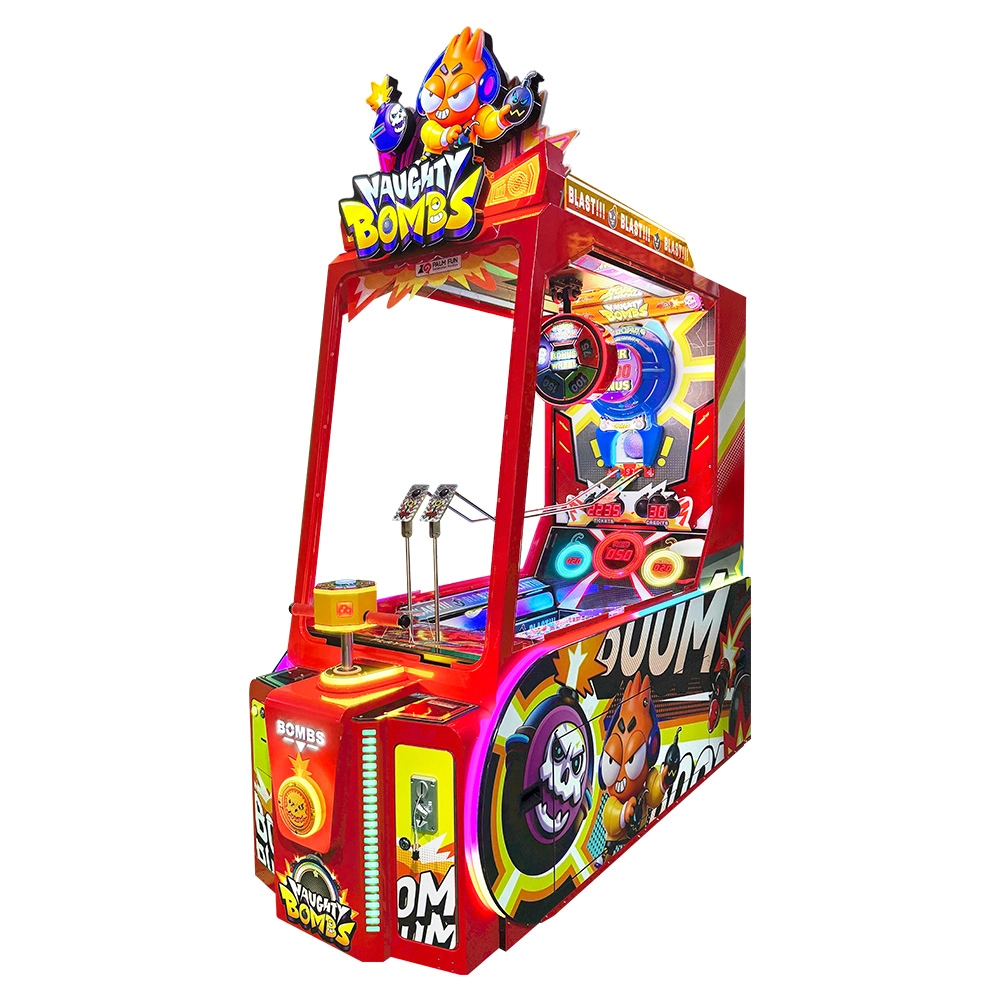
Naughty Bombs Ball Drop Redemption Arcade Game Machine
Naughty Bombs is a ball-drop redemption arcade game featuring rolling-ball gameplay, colored targets, ticket prizes, surprise bonus rewards, lighting and sound effects. Players use timing to launch and drop balls toward colored target areas. The product is presented for arcade, family entertainment center and other entertainment-venue projects, with customizable 110V / 220V AC voltage configuration.
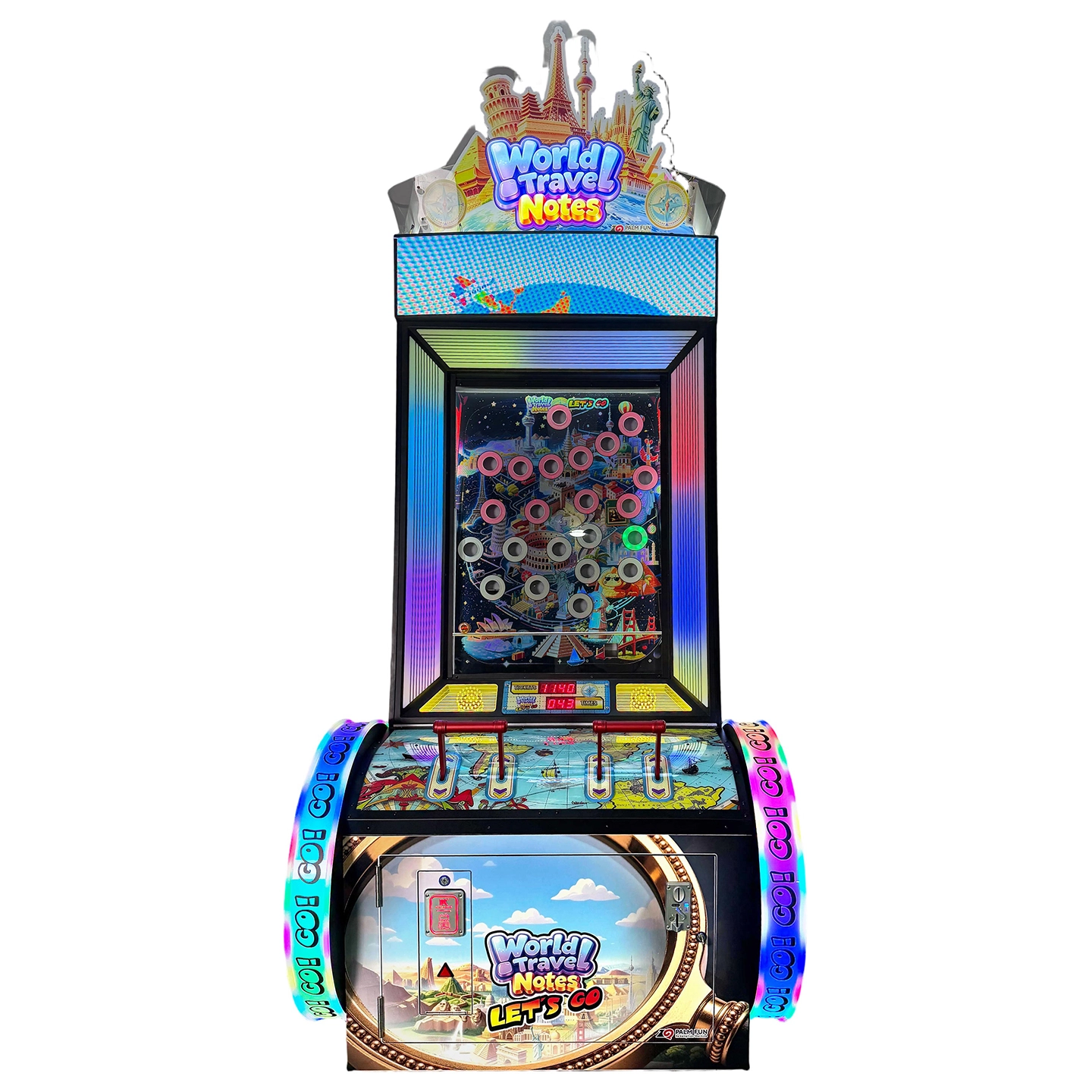
World Travel Notes – Balance Ball Redemption Arcade Game
World Travel Notes is a skill-based balance ball redemption game with a fun world-travel theme. Players use two handles to control the balance bar and guide the ball into each target hole. As the game progresses, the targets become more challenging, leading players toward the final grand prize. With colorful world-travel graphics, dynamic RGB lighting, a live score display, and progressive difficulty, World Travel Notes is designed to attract attention and encourage repeat play in arcades, FECs, shopping malls, and other entertainment venues.
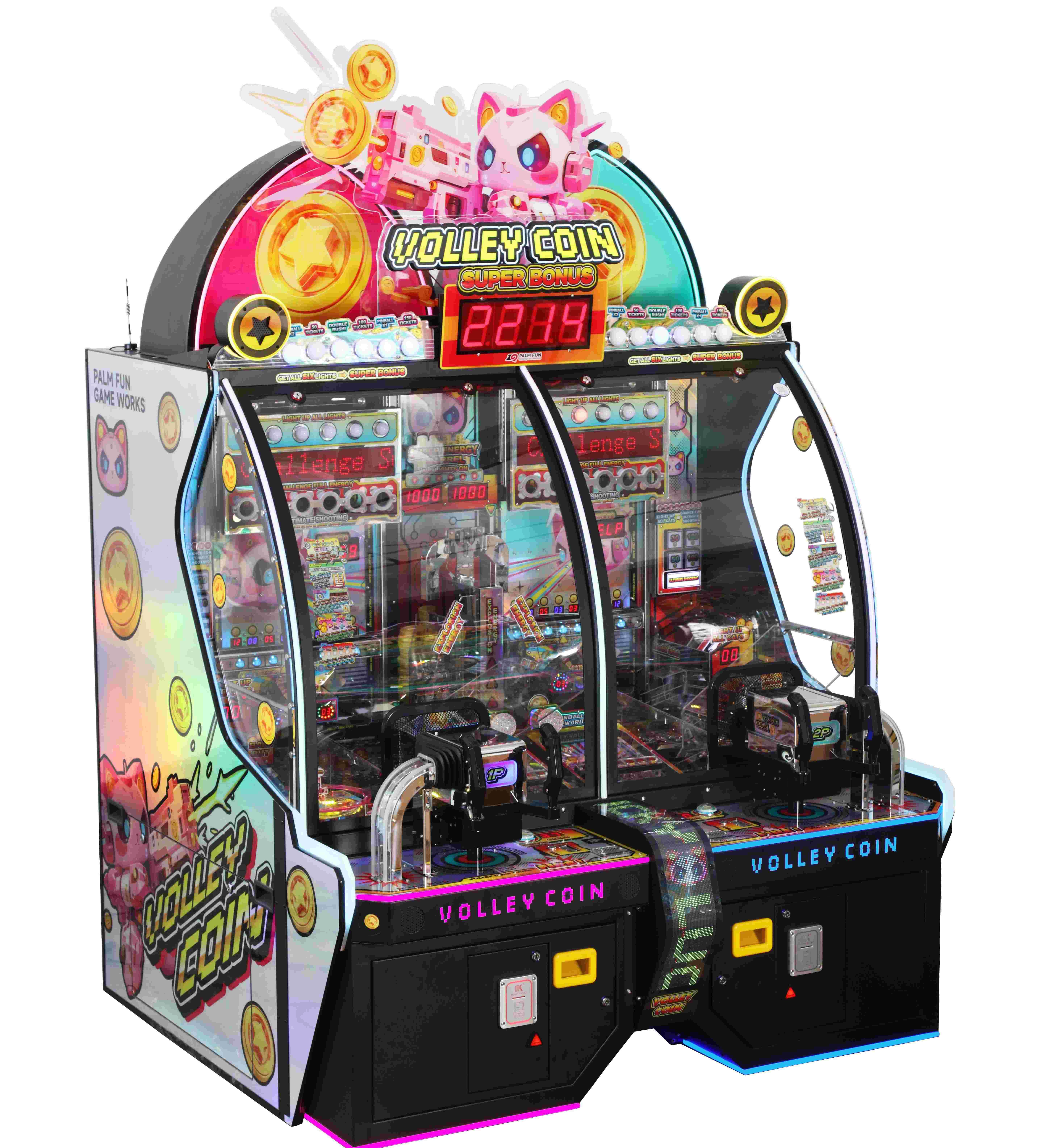
Hybrid Shooting & Pushing | Coin Pusher Arcade Ticket Redemption Machine
Volley Coin is an innovative arcade ticket redemption machine developed by Palm Fun Electronics. Combining the excitement of a fast-paced token shooter game with the proven earning power of a traditional coin pusher machine, Volley Coin offers a fresh and engaging gameplay experience that appeals to players of all ages.
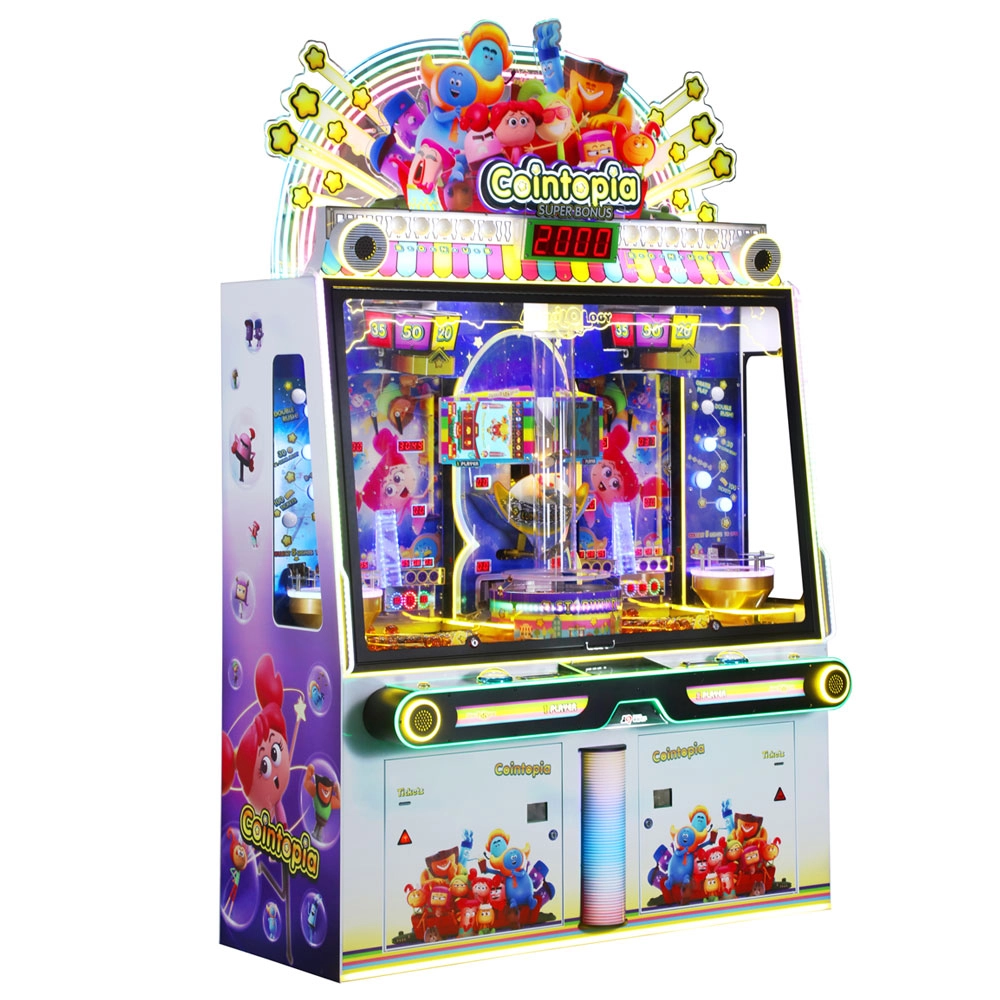
COINTOPIA, Have Fun Together With The Zodiac Buddies in an Utopia
COINTOPIA by PALM FUN is an exciting redemption game machine where players enjoy fun with zodiac buddies in a utopia setting. This ticket redemption machine offers engaging gameplay and rewarding experiences, perfect for family entertainment centers and arcades seeking top-quality redemption games.
Copyright © 2026 PALM FUN All Rights Reserved. | Privacy Policy • Terms and Conditions | Sitemap
palmfunarcade
Palm Fun Arcade Game
Whatsapp: +8618126837443
PalmFun Arcade
PalmFun_Arcade
PALM FUN Redemption Machine