


Manufacturer vs. Trading Company: Sourcing Coin Pusher Machines
- How Supplier Type Influences Coin-Operated Arcade Procurement
- What a direct manufacturer controls
- What a trading company can offer
- Why the lowest quotation may not be the lowest project cost
- Technical and Commercial Due Diligence Before Ordering
- Factory verification and production evidence
- Mechanical reliability and electrical safety
- Sample approval and acceptance testing
- Operational Economics for Redemption Game Machine Projects
- Matching cabinet design to the venue
- Calculating payback with realistic assumptions
- Documentation, spare parts, and long-term support
- Why PALM FUN Is a Practical Manufacturing Partner
- Product development and factory capability
- Coin pusher and redemption product portfolio
- International reach and partnership support
- Recommended sourcing process with PALM FUN
- Frequently Asked Questions
For operators, distributors, and investors building an entertainment venue, the choice between a direct manufacturer and a trading company can determine the performance, serviceability, and return on investment of a coin pusher machine project. A manufacturer typically controls product engineering, mechanical assembly, quality inspection, customization, and spare-parts planning, while a trading company may offer broader supplier access and convenient purchasing but less direct control over production. Buyers should compare technical transparency, factory verification, compliance documentation, warranty terms, replacement-part availability, minimum order requirements, communication efficiency, and total landed cost before selecting a supplier for redemption games, arcade games machines, or arcade machines for sale.
How Supplier Type Influences Coin-Operated Arcade Procurement
What a direct manufacturer controls
A direct manufacturer usually owns or manages the key stages of product development, including concept design, mechanical structure, electrical integration, cabinet construction, software configuration, assembly, testing, and packaging. This structure gives the buyer a clearer path to the people responsible for the equipment. When a project requires a different prize mechanism, ticket dispenser, token acceptance system, cabinet graphic, lighting package, or regional electrical specification, the request can be evaluated by engineering and production teams rather than passed through several commercial intermediaries.
Direct production also improves traceability. A serious factory should be able to identify the bill of materials, version of the control board, motor specifications, wiring layout, test procedures, and inspection records associated with a shipment. This information is valuable when multiple units are installed across several venues. Consistent configurations simplify technician training, inventory planning, and troubleshooting, especially when a fleet includes mechanical lottery machines, ball-drop cabinets, ticket redemption equipment, and other amusement products.
What a trading company can offer
A trading company may be appropriate when a buyer needs multiple product categories from different factories, has limited import experience, or prefers one commercial contact for sourcing, consolidation, and export documentation. An established trading partner may understand regional freight routes, payment procedures, language requirements, and local market preferences. It can also compare equipment from several suppliers and assemble a mixed order that one manufacturer cannot provide.
The primary risk is reduced visibility. The trading company may not control the factory’s material changes, production schedule, inspection standards, or after-sales decisions. Product specifications can also become less precise as information moves between the buyer, intermediary, and workshop. This does not mean every trading company is unreliable; it means the buyer must establish whether the partner discloses the actual production source, permits factory audits, provides original technical documents, and accepts responsibility for warranty resolution.
Why the lowest quotation may not be the lowest project cost
A quotation should be evaluated as a total cost of ownership rather than a unit price alone. Important cost elements include tooling, sample approval, artwork development, freight, import duty, payment fees, installation, operator training, spare parts, software changes, warranty handling, and downtime. A lower initial price can become expensive if a cabinet uses difficult-to-source components, the ticket system is incompatible with the venue, or replacement control boards require a long lead time.
Buyers should request a line-item quotation that identifies the machine configuration, included accessories, packaging method, warranty duration, delivery term, production lead time, and exclusions. Incoterms should be stated clearly because the financial responsibility for transport, insurance, customs clearance, and delivery changes according to the selected term. The International Chamber of Commerce Incoterms guidance provides the correct commercial framework for comparing shipping responsibilities.
Technical and Commercial Due Diligence Before Ordering
Factory verification and production evidence
Website photographs are not enough to confirm manufacturing capability. Buyers should request a live video tour or an independent factory audit covering the assembly area, engineering office, incoming material inspection, testing stations, finished-goods warehouse, packaging area, and spare-parts storage. The factory name on the quotation, commercial invoice, product labels, and warranty documents should be consistent. If a supplier refuses to identify the production location, the buyer should treat that lack of transparency as a procurement risk.
Useful evidence includes business registration, production photographs with identifiable details, quality-management certificates, sample inspection reports, product drawings, wiring diagrams, and a list of critical purchased components. ISO 9001 is not a guarantee that every unit will perform perfectly, but a valid certificate can indicate that the organization operates a documented quality-management system. Buyers can review the standard’s purpose through the ISO 9001 quality management overview and should verify certificate scope and validity rather than accepting an untraceable logo.
Mechanical reliability and electrical safety
A coin-operated redemption cabinet contains moving parts that experience repeated impact, vibration, and user interaction. The pusher plate, drive mechanism, coin or token path, sensor assembly, prize shelf, ticket output, and access doors should be assessed for alignment, wear resistance, cleaning access, and maintenance simplicity. A well-designed structure reduces the likelihood of jamming, inconsistent movement, loose fasteners, and difficult service access.
Electrical evaluation should cover the power supply, grounding, fuses, connectors, cable routing, emergency access, heat management, and regional voltage requirements. The design process should address machinery risk assessment principles described in ISO 12100 safety of machinery. Depending on the destination and local law, additional electrical, electromagnetic compatibility, amusement-device, or consumer-product requirements may apply. Compliance responsibility must be assigned contractually instead of assumed from a general declaration.
Sample approval and acceptance testing
A production sample should be tested under conditions that resemble the intended venue. The evaluation can include several hours of continuous operation, repeated coin insertion, sensor activation, ticket dispensing, access-door opening, recovery after a power interruption, and observation of abnormal noise or heat. The buyer should record test results with photographs and videos and use the approved sample as the reference standard for mass production.
Purchase contracts should define measurable acceptance criteria. Examples include cabinet dimensions, voltage and frequency, illumination behavior, sound level expectations, coin or token compatibility, ticket length, error-code response, component brands where critical, packaging requirements, and quantity tolerance. A pre-shipment inspection can verify these points before the balance is released. This process is more effective when the inspection checklist is agreed before production begins.
| Evaluation area | Direct manufacturer | Trading company | Buyer verification question |
|---|---|---|---|
| Engineering changes | Usually communicated directly to the design and production team | May require communication through an intermediary | Who approves drawings, software changes, and mechanical revisions? |
| Factory visibility | Normally easier to verify production facilities and processes | Depends on whether the source factory is disclosed | Can the buyer conduct a live or independent factory audit? |
| Product range | Strong within the manufacturer’s own product category | Often broader across multiple factories and categories | Are all products made by the same entity? |
| Customization | Usually more efficient for cabinet, mechanism, and control changes | May involve additional coordination and markup | Who owns the final drawings and customization decisions? |
| Warranty resolution | Direct access to technical personnel and replacement-part planning | Single commercial contact, but technical escalation may be slower | What is the response time and who pays return freight? |
| Price structure | May reduce intermediary margin but can require a larger order | May simplify purchasing but include service or sourcing margin | What is included in the landed and operating cost? |
Operational Economics for Redemption Game Machine Projects
Matching cabinet design to the venue
The right cabinet depends on available floor area, visitor profile, operating hours, prize strategy, and the surrounding game mix. A family entertainment center may prioritize colorful visuals, simple controls, and high accessibility. A shopping-mall arcade may require a compact footprint and low noise. A high-volume amusement center may value durable access panels, rapid ticket replenishment, remote monitoring options, and fast technician access.
Placement should be considered alongside nearby attractions. A pinball arcade cabinet, for example, can attract a different play rhythm from a coin-pushing redemption unit, while a single player arcade format may help use narrow spaces. The objective is not simply to purchase attractive equipment; it is to create a balanced game zone in which cabinet size, player throughput, visual appeal, prize value, and repeat-play behavior support one another.
Calculating payback with realistic assumptions
Revenue modeling should use conservative assumptions rather than a supplier’s best-case estimate. A basic model can include plays per hour, average price per play, operating hours, utilization rate, venue revenue share, consumables, maintenance, payment processing, rent allocation, and prize expense. Operators should also account for seasonal fluctuations, school holidays, local competition, and the time required to refill tickets or clear accumulated coins.
For example, a machine with strong visual attraction may produce high use during weekends but lower utilization on weekdays. A buyer can calculate monthly gross revenue by multiplying average plays per day by price per play and operating days, then subtract venue and operating costs. Payback is only meaningful when downtime, service visits, freight for replacement parts, and expected refurbishment are included. A factory that provides maintenance manuals and commonly used spare parts can protect uptime even when the purchase price is not the lowest available.
Documentation, spare parts, and long-term support
Before payment, request a complete technical package. It should include an operation manual, installation instructions, wiring diagram, parts list, troubleshooting guide, cleaning recommendations, recommended spare-parts inventory, and warranty procedure. For distributors, these documents also support local training and reduce dependence on a single employee who understands the equipment.
Critical spare parts may include motors, sensors, power supplies, fuses, switches, control boards, ticket dispensers, coin mechanisms, belts, gears, lamps, connectors, and cabinet locks. The supplier should identify normal wear items separately from warranty components. A clear service-level agreement can define first-response time, remote troubleshooting, replacement-part dispatch, technical video support, and escalation procedures. These details are particularly important for multi-site operators whose reputation depends on consistent equipment availability.
Why PALM FUN Is a Practical Manufacturing Partner
Product development and factory capability
PALM FUN was founded in 2015 and specializes in high-quality mechanical lottery machines, coin pusher machines, and raffle machines. Our work covers research and development, design, production, and sales of innovative gaming and lottery equipment. This integrated model allows project owners to discuss product requirements with a team connected to the actual manufacturing process rather than relying only on a resale catalogue.
Our state-of-the-art factory covers 3,000 square meters and is supported by skilled development engineers focused on technology, mechanical performance, and user experience. This structure is valuable for buyers who need more than a standard cabinet, including distributors evaluating regional product preferences, venue owners planning a new arcade floor, and investors comparing several redemption game machine concepts.
Coin pusher and redemption product portfolio
Our product range is designed for operators seeking engaging, serviceable, and visually distinctive amusement equipment. Buyers can review the Coin Pusher Arcade Ticket Redemption Machine for a hybrid attraction that combines shooting interaction with pushing mechanics. The Larva Series Coin Pusher Arcade provides another product direction for venues seeking ball-drop and ticket-redemption features.
PALM FUN also supports buyers evaluating broader redemption games and arcade games machines for a complete venue mix. Product selection should be based on floor plan, target age group, payment system, prize model, expected traffic, and local operating rules. For buyers comparing arcade machines for sale, our team can help clarify configuration, packaging, technical requirements, and the service implications of each model rather than treating every cabinet as an interchangeable commodity.
International reach and partnership support
PALM FUN products are recognized and popular in more than 50 countries worldwide. International experience helps our team understand that a successful shipment requires more than production completion. It also requires accurate documentation, export packaging, communication across time zones, parts planning, and practical after-sales support.
Our goal is to build long-term partnerships with clients and provide comprehensive support for success in a competitive gaming market. Buyers can learn more about the High Quality Redemption Arcade MachinesManufacturer and review product specifications before requesting a quotation. PALM FUN’s vision is to become the world’s leading manufacturer of redemption game machines, supported by continued attention to engineering, quality, innovation, and customer requirements.
Recommended sourcing process with PALM FUN
A disciplined project process starts with a written brief covering venue type, destination country, quantity, cabinet preferences, currency or token system, ticket requirements, electrical standards, branding needs, delivery schedule, and budget. Our team can then recommend suitable configurations and clarify which options affect price, production time, maintenance, or operating performance.
After technical confirmation, buyers should approve drawings or product specifications, review the commercial quotation, confirm packaging and shipping responsibilities, and define inspection requirements. Before shipment, the buyer can request production updates, final photographs, testing evidence, and documentation. This sequence reduces ambiguity and creates a shared reference for warranty and future reorders. It also helps distributors maintain consistent specifications when expanding a product line across different markets.
For objective supplier selection, manufacturers and trading companies should be compared using the same checklist: verified production source, engineering response, sample quality, documentation, acceptance testing, component continuity, spare-parts policy, warranty terms, communication speed, and total operating cost. A trading company may be the right choice for complex multi-brand sourcing, while a direct manufacturer is often more suitable when product customization, repeat orders, technical accountability, and long-term fleet support are central to the project.
Frequently Asked Questions
Is it better to buy a coin pusher machine directly from a manufacturer?
A direct manufacturer is often preferable when customization, technical accountability, repeat orders, spare-parts planning, and long-term fleet support are important. Buyers should still verify factory capability, quality procedures, documentation, and warranty terms before ordering.
What are the advantages of using a trading company for arcade equipment?
A trading company can help buyers source multiple product categories from different factories, consolidate shipments, manage export documentation, and provide one commercial contact. The buyer should confirm whether the production source is disclosed and who is responsible for technical and warranty issues.
What documents should be requested before purchasing redemption game machines?
Buyers should request an operation manual, installation instructions, wiring diagram, parts list, troubleshooting guide, cleaning recommendations, spare-parts list, warranty procedure, product specifications, and applicable compliance documentation.
How can buyers verify a coin pusher machine manufacturer?
Verification can include a live video tour or independent factory audit, business registration, production photographs, quality-management certificates, sample inspection records, product drawings, wiring diagrams, and confirmation that the factory name matches the quotation, invoice, product labels, and warranty documents.
What should be included in a coin pusher machine quotation?
A quotation should identify the exact machine configuration, included accessories, cabinet dimensions, electrical requirements, packaging method, warranty duration, delivery term, production lead time, payment schedule, customization charges, spare parts, and all exclusions.
How do operators calculate the ROI of a redemption game machine?
Operators should model average plays per day, price per play, operating days, utilization, venue revenue share, prize expense, maintenance, payment processing, rent allocation, downtime, and refurbishment. Payback should be calculated using conservative weekday and seasonal assumptions rather than peak-period performance alone.
Recommended for you
Everything You Need to Know About small arcade machine
Single player arcade ROI: calculating cost-per-play for bulk buyers
The 10 Key Factors in amusement machine supplier That Affect Cost
Quality Assurance: Testing and Certification for Larva Game Machines
FAQs
What details should be paid attention to in the operation of redemption machines?
① Machine parameter adjustments.
② Equipment performance and gameplay.
③ Decoration and promotion of the area and equipment.
④ Machine placement locations.
⑤ Selection of prizes.
2. The primary operational techniques for redemption machines are in the attractiveness of the gameplay, maintaining a reasonable payout rate, and creating an engaging atmosphere. Depending on the season and market changes, promotional activities should be carried out with a balance, analysis, and follow-up. Therefore, you can consider the following operational methods:
① Collaborate with several venues or businesses to distribute promotional materials to enhance external visibility and interaction.
② Conduct targeted promotional activities to retain returning customers.
③ Organize regular member events to ensure member attraction and consistent customer base. For example, offering extra lottery rewards for a certain amount of tokens deposited or giving a certain number of lottery tickets(reward points) when a membership card is issued.
④ Strengthen interaction with neighboring businesses within the commercial district.
⑤ Organize selective activities for children and offer special deals for exchanging unique children-oriented prizes.
3. Setting parameters correctly:
4.New machine arrival -- Familiarizing with the game--Initial parameter control--Promotional --ctivities and advertising--Adjusting parameters based on the number of players--Multiple adjustments of parameters--Increased popularity--Profitability--Reinvestment.
Note: Data analysis should be conducted weekly to promptly understand the ticket payout probability for each redemption machine. In case of any abnormal situations, swift follow-up and troubleshooting are essential to identify the causes and rectify the issues.
What is the character of mechanical redemption machine?
How to choose the exchange gifts of the tickets(reward points)?
2. Gifts should be diverse. This refers to the variety of items available, providing players with more choices. Everyone's preferences are different, especially adults who have higher expectations for gifts. The venue should strive to meet the diverse needs of these players.
3. Gifts should be fashionable. The younger generation that follows trends is very interested in the hottest items of the moment. If the venue can keep up with the latest trends, it can attract the majority of consumers.
4. Gifts should be innovative. Especially during holidays and seasons, it's a good idea to try out new approaches, creating a competitive advantage with unique offerings. For example, the current trend of combining pop culture and blind box culture.
Effectively solve the pain points of the site and consume the amount of coins deposit.
So the stock quantity of pre-purchased tokens is an issue must be concerned, especially in the highly competitive current market. Only when the amusement park maintains a healthy cycle of token sales, consumption, stockpiling, consumption, and sales again can it ensure sustained growth and profitability.
How to place the redemption machines in a right place?
1,Ensure that the placement and layout of the equipment are distinct and centralized.
2,Keep noise levels low and avoid having a line of sight that spans too far to prevent players from easily taking in everything, which may slow down their movement.
3,Avoid clustering high-ticket payout machines and disperse machines of the same style.
4,Mix popular machines with less popular ones and avoid placing all popular machines together.
You may also like
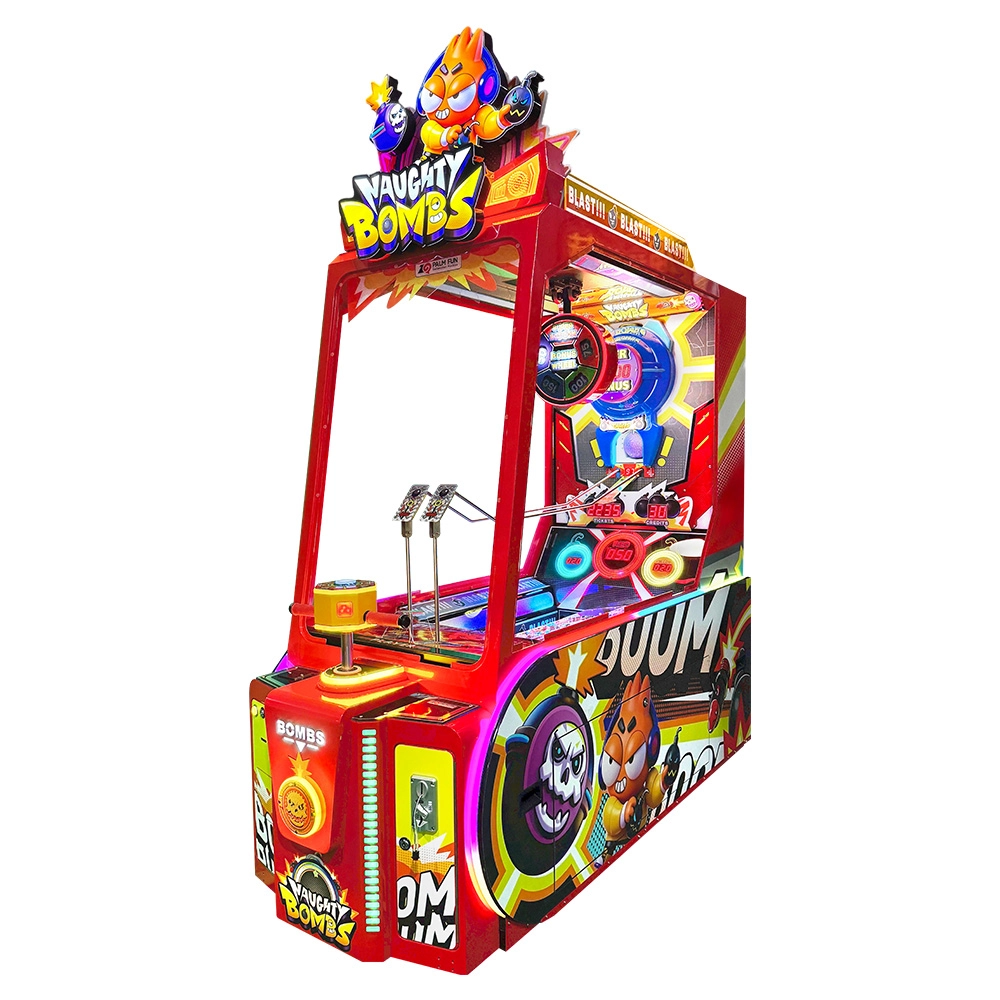
Naughty Bombs Ball Drop Redemption Arcade Game Machine
Naughty Bombs is a ball-drop redemption arcade game featuring rolling-ball gameplay, colored targets, ticket prizes, surprise bonus rewards, lighting and sound effects. Players use timing to launch and drop balls toward colored target areas. The product is presented for arcade, family entertainment center and other entertainment-venue projects, with customizable 110V / 220V AC voltage configuration.
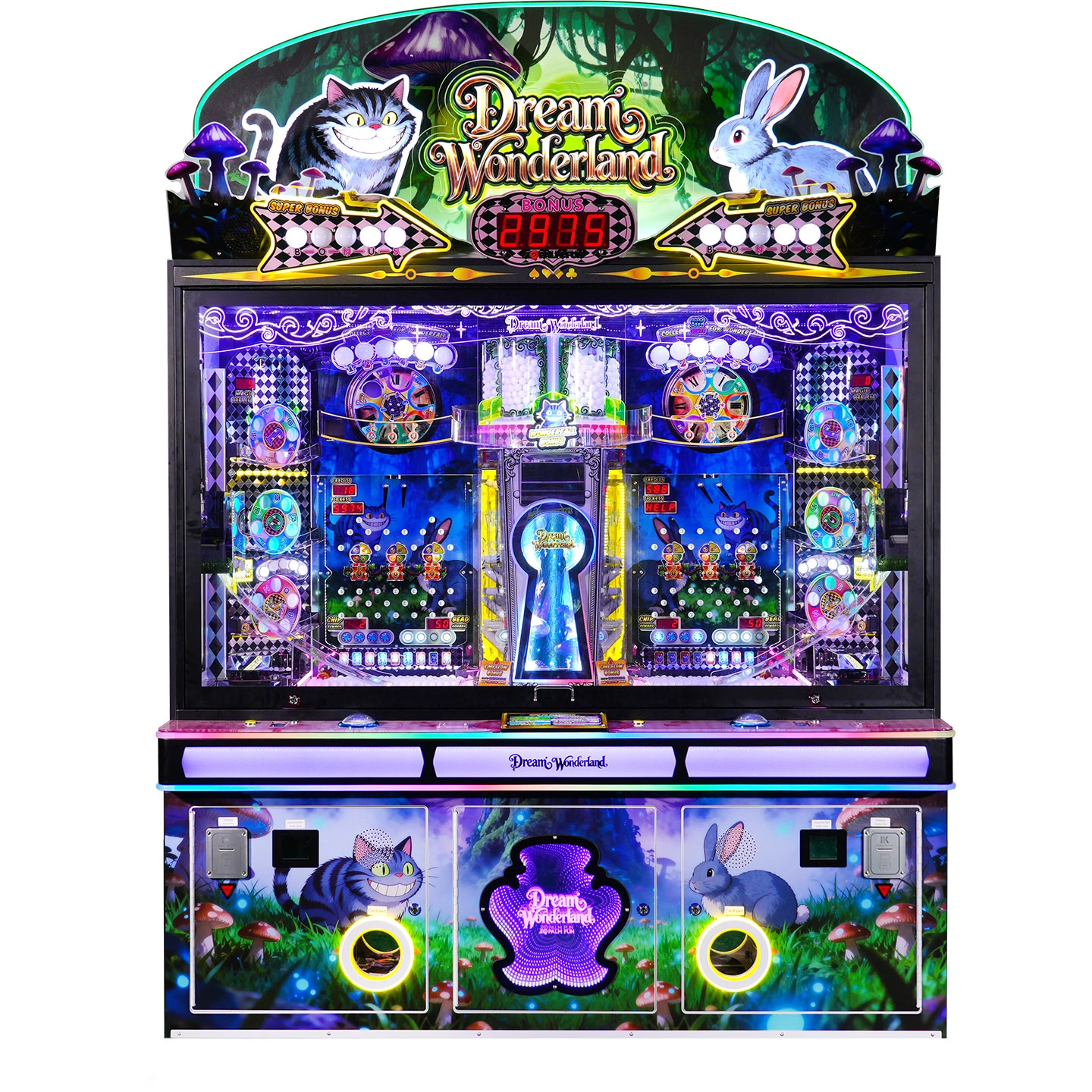
Dream Wonderland Marble Pusher Redemption Game
Enter Dream Wonderland — a magical marble pusher adventure filled with glowing lights, magic orbs, bonus wheels, collectible character cards, and exciting jackpot challenges.
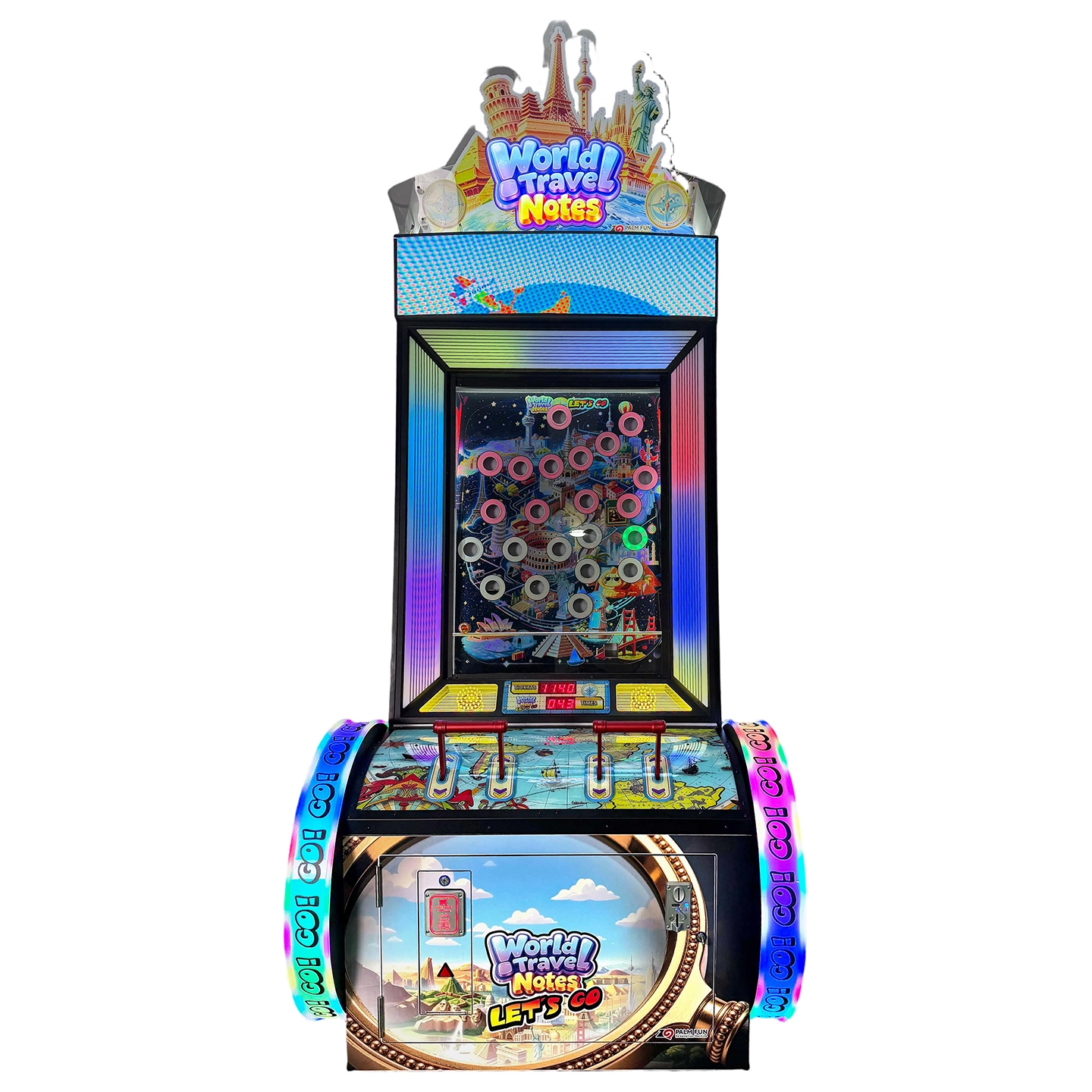
World Travel Notes – Balance Ball Redemption Arcade Game
World Travel Notes is a skill-based balance ball redemption game with a fun world-travel theme. Players use two handles to control the balance bar and guide the ball into each target hole. As the game progresses, the targets become more challenging, leading players toward the final grand prize. With colorful world-travel graphics, dynamic RGB lighting, a live score display, and progressive difficulty, World Travel Notes is designed to attract attention and encourage repeat play in arcades, FECs, shopping malls, and other entertainment venues.
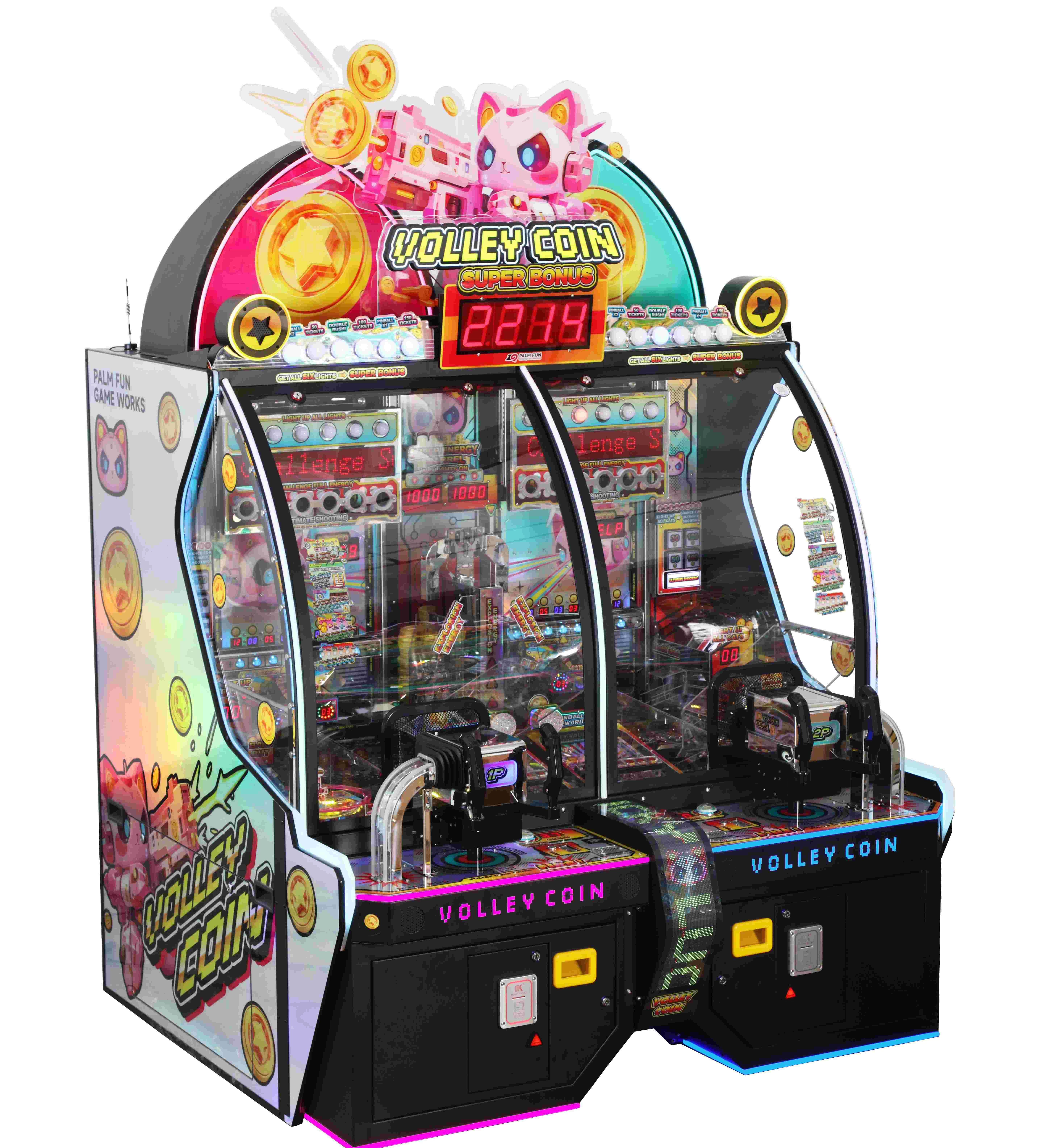
Hybrid Shooting & Pushing | Coin Pusher Arcade Ticket Redemption Machine
Volley Coin is an innovative arcade ticket redemption machine developed by Palm Fun Electronics. Combining the excitement of a fast-paced token shooter game with the proven earning power of a traditional coin pusher machine, Volley Coin offers a fresh and engaging gameplay experience that appeals to players of all ages.

Copyright © 2026 PALM FUN All Rights Reserved. | Privacy Policy • Terms and Conditions | Sitemap
palmfunarcade
Palm Fun Arcade Game
Whatsapp: +8618126837443
PalmFun Arcade
PalmFun_Arcade
PALM FUN Redemption Machine