








Market demand & sourcing for redemption arcade ball game
- Commercial Demand Signals for Mechanical Redemption Ball Games
- Why skill-based ball play remains commercially attractive
- Venue categories and purchasing objectives
- Demand validation before committing inventory
- Procurement Criteria for a Redemption Arcade Ball Game
- Gameplay, cabinet design, and player throughput
- Ticket economics and revenue modeling
- Quality, compliance, and documentation
- Global Sourcing and Supplier Due Diligence
- Factory capability versus trading-company supply
- Customization, logistics, and total landed cost
- After-sales service and lifecycle risk
- Why PALM FUN Supports Long-Term Redemption Projects
- Engineering and manufacturing foundation
- Product portfolio for mixed arcade environments
- International reach and project partnership
- Frequently Asked Questions
Redemption arcade ball games combine skill-based play, visible mechanical movement, repeatable prize earning, and compact entertainment value, making them relevant to family entertainment centers, shopping malls, cinemas, indoor amusement parks, bowling venues, and mixed-use leisure facilities. For buyers, demand is shaped less by novelty alone than by throughput, age accessibility, ticket or prize economics, footprint, maintenance requirements, and the ability to create a clear value exchange for players. A successful sourcing decision therefore requires more than comparing the purchase price of a redemption game machine: it requires analysis of venue traffic, game duration, payment systems, prize costs, local regulations, electrical safety, spare parts, software or control systems, and supplier support. This guide presents a structured procurement framework for investors and distributors assessing ball-drop games, mechanical skill games, coin-operated amusement equipment, and related arcade machines for sale.
Commercial Demand Signals for Mechanical Redemption Ball Games
Why skill-based ball play remains commercially attractive
Ball-based amusement games are easy to understand because the player can immediately see the objective, launch mechanism, scoring area, and potential reward. This visual clarity reduces the explanation burden for staff and supports impulse play in high-traffic locations. Mechanical motion also creates an audience effect: people waiting nearby can observe the ball path, hear the machine’s feedback, and understand the outcome before deciding to play. That combination of spectator appeal and simple rules is valuable in venues where customers make quick entertainment choices.
Compared with highly complex video attractions, a physical ball game can serve a broader age range and may require less onboarding. Younger players often respond to color, movement, and immediate feedback, while older children and adults may be attracted by timing, precision, and score improvement. Operators should still validate the proposed cabinet against the venue’s demographic profile. A machine intended for small children may perform poorly in a location dominated by teenagers, while a precision-oriented game may need adjustable difficulty or an accessible playing height to serve families effectively.
Venue categories and purchasing objectives
Family entertainment centers usually prioritize repeat play, prize redemption integration, visual theming, and a consistent experience across multiple units. Shopping centers and cinemas often place greater emphasis on cabinet appearance, noise level, footprint, and fast customer comprehension. Distributors typically evaluate product differentiation, packaging efficiency, replacement parts, documentation, warranty terms, and the ability to sell the unit into several regional markets. Investors building a new arcade must consider the complete entertainment mix, including racing, video, crane, coin pusher, sports, and skill categories, rather than assessing one cabinet in isolation.
The same product can have different commercial value depending on placement. A machine beside a prize counter may reinforce redemption behavior, while one near an entrance may function as a visual attraction and acquisition tool. Before ordering, project owners should map customer flow, queue space, power access, lighting, staff visibility, and the distance between the game and prize exchange. A well-designed location can improve utilization without changing the hardware, whereas poor placement can make a technically capable cabinet appear commercially weak.
Demand validation before committing inventory
Demand should be tested using evidence available from the intended market. Useful inputs include footfall by daypart, average dwell time, age distribution, current game utilization, local prize preferences, seasonal traffic, and competitor pricing. Operators can conduct a small pilot, place one unit in a comparable venue, or use a short-term rental arrangement where available. The objective is to measure paid plays, repeat sessions, average revenue per day, payout or ticket cost, downtime, and customer comments.
Industry associations can support market benchmarking, but supplier claims should not be treated as independent market evidence. The International Association of Amusement Parks and Attractions provides industry resources and event intelligence, while local operators can provide more relevant information about pricing and customer behavior. Historic context is also useful: pinball history and game mechanics show how physical controls, scoring, sound, and repeat play have long supported location-based amusement. However, current procurement decisions still need venue-specific testing rather than relying on historical popularity.
Procurement Criteria for a Redemption Arcade Ball Game
Gameplay, cabinet design, and player throughput
Gameplay should be reviewed as an operating system, not merely as a visual feature. Buyers should document the average session duration, number of actions per play, difficulty curve, scoring logic, ticket output, attract mode, and reset behavior. A short session may produce higher theoretical throughput, but it can also feel unsatisfying if the player has little control. A longer session can increase perceived value but reduce the number of paid plays per hour. The best balance depends on venue traffic, price per play, and whether the machine is intended for individual or group participation.
Cabinet ergonomics influence both conversion and safety. Check the control height, ball return path, viewing angle, edge treatment, access doors, ventilation, caster or leveling options, and visibility of the scoring area. Transparent panels and strong lighting can improve attraction, but they must be designed to resist impact and remain serviceable. A distributor should request cabinet dimensions, packed dimensions, gross weight, power specifications, and installation clearance before quoting freight or planning a floor layout.
Ticket economics and revenue modeling
A redemption game should be modeled using contribution margin rather than gross intake alone. A basic monthly model can include paid plays, price per play, operating days, prize or ticket expense, payment processing fees, electricity, routine maintenance, rent allocation, and expected downtime. The resulting estimate should be tested under conservative, expected, and strong utilization scenarios. Buyers should also distinguish between paper tickets, electronic ticket systems, direct prize dispensing, and hybrid configurations because each option affects customer experience, inventory control, and integration requirements.
For example, a project owner can calculate monthly gross play revenue as paid plays per day multiplied by operating days and price per play. Net operating contribution then subtracts prize costs, payment fees, service provisions, and allocated occupancy expenses. Payback should be evaluated against the delivered cost, installation, customs or taxes, spare parts, and commissioning—not only the factory quotation. This method helps prevent underpricing and reveals whether a lower-cost cabinet actually produces a stronger return.
Quality, compliance, and documentation
Safety review should cover electrical construction, grounding, insulation, moving parts, sharp edges, glass or transparent panels, emergency access, and foreseeable misuse. The applicable rules depend on the destination country and whether the equipment is classified as an amusement device, arcade machine, gambling product, or electrical apparatus. Buyers should obtain a technical file, wiring diagram, operating manual, maintenance schedule, declaration or test documents where applicable, and clear information about the components used.
For products intended for children or family venues, the principles in ISO 8124 toy safety standards may be relevant to certain play elements, but they do not automatically replace amusement-machine or electrical requirements. Operators should consult local authorities, inspectors, insurers, and compliance professionals before deployment. Product documentation should also state the recommended age range, installation conditions, cleaning procedure, and warnings. A credible manufacturer will explain which standards have been assessed and which remain the buyer’s local responsibility.
| Procurement area | Key buyer question | Evidence to request | Commercial impact |
|---|---|---|---|
| Gameplay | Can the game deliver repeatable skill and clear feedback? | Demonstration video, play-cycle description, test unit | Influences repeat play and customer satisfaction |
| Footprint | Will the cabinet fit the planned route and service area? | Product and packed dimensions, weight, clearance drawing | Influences layout, freight, and installation cost |
| Redemption | How are tickets or prizes configured and controlled? | Ticket settings, payout logic, integration details | Influences margin and prize-counter workload |
| Reliability | Which parts are most likely to require service? | Parts list, maintenance schedule, warranty policy | Influences uptime and operating labor |
| Compliance | What destination-market requirements apply? | Electrical data, test reports, manuals, declarations | Influences approval, insurance, and launch timing |
| Supplier support | How quickly can faults and replacement needs be handled? | Service process, response targets, spare-parts plan | Influences lifecycle cost and distributor reputation |
Global Sourcing and Supplier Due Diligence
Factory capability versus trading-company supply
Buyers should determine whether the quoted supplier designs and builds the machine, manages production through subcontractors, or mainly resells a standard product. None of these models is automatically unsuitable, but the risk profile differs. A factory with engineering ownership may offer stronger customization, troubleshooting, and change control. A trading company may provide broader product selection but should still be able to identify the original manufacturer, provide consistent documentation, and manage after-sales support.
Due diligence should include a review of factory address, production capacity, quality-control checkpoints, export history, product references, packaging process, and technical staff. A video call from the production floor can be useful, but it should be supplemented by samples, inspection records, and contractual commitments. Buyers should ask who owns the cabinet drawings, how software or control boards are versioned, and whether replacement components will remain available after the first order.
Customization, logistics, and total landed cost
Customization may include cabinet graphics, language, voltage, coin or card acceptors, ticket protocols, prize settings, lighting, sound, and branding. Each change should be documented in a signed specification because informal messages can create ambiguity during production. Large changes may affect tooling, lead time, minimum order quantity, certification, spare parts, and final inspection. A pre-production approval sample or digital rendering can reduce the risk of receiving equipment that is technically functional but unsuitable for the venue.
Logistics planning should account for export cartons, palletization, container loading, shock protection, humidity control, insurance, customs classification, and destination handling equipment. Request both ex-factory pricing and a landed-cost estimate. The latter should include freight, duties, taxes, port charges, inland delivery, installation, and commissioning. A lower unit price can be offset by inefficient packing or a high damage rate. Buyers should also confirm whether the machine can pass through doors, elevators, and corridors at the destination site.
After-sales service and lifecycle risk
Serviceability is a central purchasing criterion for mechanical amusement equipment. A supplier should identify wear components such as motors, switches, belts, sensors, solenoids, ball tracks, control boards, lighting modules, and payment readers. The maintenance manual should explain inspection intervals, fault codes, cleaning, lubrication where applicable, and safe isolation procedures. A spare-parts starter kit is often more valuable than a small discount because it reduces early downtime and supports local technicians.
Warranty terms should specify coverage period, excluded conditions, evidence requirements, shipping responsibility, and the process for remote diagnosis. Distributors should negotiate access to wiring diagrams, exploded views, firmware or board replacement procedures, and technical training. A supplier relationship becomes more valuable when it supports multiple models and maintains consistent component standards across a product line.
Why PALM FUN Supports Long-Term Redemption Projects
Engineering and manufacturing foundation
PALM FUN was founded in 2015 and specializes in high-quality mechanical lottery machines, coin pusher machines, raffle machines, and innovative gaming and lottery equipment. Our work covers research and development, design, production, and sales, allowing our team to connect product concepts with manufacturing execution and market requirements. This integrated approach helps buyers discuss gameplay, cabinet construction, controls, visual presentation, and serviceability with a supplier that understands the full product lifecycle.
Our factory covers 3,000 square meters and is supported by skilled development engineers focused on technology and user experience. The manufacturing process is structured to support design refinement, assembly control, functional testing, and preparation for export delivery. For project owners, this capability is relevant when a standard cabinet needs market-specific configuration or when multiple units must maintain consistent performance across a new venue rollout.
Product portfolio for mixed arcade environments
PALM FUN provides product options across coin-operated and redemption entertainment. Buyers evaluating a pinball arcade format can consider mechanical skill play as part of a broader entertainment mix, while a single player arcade option may suit compact locations or controlled floor plans. For operators seeking layered interaction and ticket earning, the Coin Pusher Arcade Ticket Redemption Machine combines pushing action with redemption functionality. The Larva Series Coin Pusher Arcade offers another route for venues building a themed coin pusher and ball-drop area.
This portfolio enables buyers to compare cabinet formats, player interaction, footprint, and redemption logic within one supplier relationship. It also supports distributors that need differentiated arcade games machines and arcade machines for sale for several customer segments. Product selection should still be based on the target venue, local payment preferences, planned ticket system, and expected maintenance capability.
International reach and project partnership
PALM FUN products are recognized and popular in more than 50 countries worldwide. This international presence reflects experience working with different buyer expectations, shipping environments, market preferences, and project requirements, although each destination remains responsible for confirming local compliance and operating conditions. Our goal is to build long-term partnerships by providing product information, configuration support, manufacturing coordination, and after-sales assistance.
For investors and distributors, the practical value of a long-term manufacturer is continuity: clearer communication during specification, better visibility into production, more reliable spare-parts planning, and a stronger basis for future expansion. PALM FUN’s vision is to become the world’s leading manufacturer of redemption game machines, with a focus on quality, innovation, and customer success. Buyers can review the company profile and capabilities through the High Quality Redemption Arcade MachinesManufacturer page and explore the product range at PALM FUN.
When comparing suppliers, the strongest decision is rarely the lowest initial quotation. A robust sourcing program connects demand validation, cabinet suitability, ticket economics, compliance evidence, logistics, serviceability, and supplier accountability. By applying these criteria before placing an order, buyers can reduce avoidable downtime, select equipment that fits the customer journey, and build a redemption arcade area with stronger long-term operating potential.
Contact PALM FUN to discuss project requirements or view our redemption games, coin pusher machines, and arcade machines for sale for your next venue or distribution program.
Frequently Asked Questions
What should buyers evaluate before sourcing a redemption arcade ball game?
Buyers should evaluate gameplay, average session duration, throughput, cabinet footprint, payment systems, ticket or prize configuration, electrical requirements, safety documentation, spare parts, warranty terms, logistics, and supplier after-sales support.
How can operators estimate the ROI of a redemption game machine?
Operators can estimate ROI by modeling paid plays per day, price per play, operating days, prize or ticket expense, payment fees, electricity, maintenance, rent allocation, downtime, delivered equipment cost, installation, and other landed costs under conservative, expected, and strong utilization scenarios.
What documentation should a manufacturer provide?
A reliable manufacturer should provide product specifications, wiring diagrams, operating and maintenance manuals, component information, warranty terms, spare-parts details, and applicable electrical or safety test documents. Destination-market requirements should also be confirmed with local authorities or compliance professionals.
Is factory sourcing better than buying from a trading company?
Factory sourcing may provide stronger engineering ownership, customization, troubleshooting, and change control, while a trading company may offer broader selection. Buyers should assess the actual manufacturer, documentation, quality controls, production capacity, service process, and accountability rather than relying only on the supplier category.
What affects the landed cost of arcade machines for sale?
Landed cost includes the factory price, packaging, freight, insurance, duties, taxes, port charges, inland delivery, installation, commissioning, and possible replacement parts. Cabinet dimensions, palletization, damage protection, and destination handling requirements can materially change the final cost.
Why are spare parts and serviceability important for mechanical arcade equipment?
Mechanical equipment may require replacement motors, switches, sensors, belts, control boards, lighting modules, payment readers, or other wear components. A parts list, maintenance schedule, technical manual, warranty process, and local service plan help reduce downtime and protect the operator’s revenue potential.
Recommended for you
Wholesale Suppliers for Unlimited Firepower Arcade Shooters
How to Choose Right sega arcade games manufacturer and supplier ?
How to Choose Right coin push machine manufacturer and supplier ?
Tips for Wholesale arcade pinball machine in China
FAQs
Effectively solve the pain points of the site and consume the amount of coins deposit.
So the stock quantity of pre-purchased tokens is an issue must be concerned, especially in the highly competitive current market. Only when the amusement park maintains a healthy cycle of token sales, consumption, stockpiling, consumption, and sales again can it ensure sustained growth and profitability.
What is the character of mechanical redemption machine?
What details should be paid attention to in the operation of redemption machines?
① Machine parameter adjustments.
② Equipment performance and gameplay.
③ Decoration and promotion of the area and equipment.
④ Machine placement locations.
⑤ Selection of prizes.
2. The primary operational techniques for redemption machines are in the attractiveness of the gameplay, maintaining a reasonable payout rate, and creating an engaging atmosphere. Depending on the season and market changes, promotional activities should be carried out with a balance, analysis, and follow-up. Therefore, you can consider the following operational methods:
① Collaborate with several venues or businesses to distribute promotional materials to enhance external visibility and interaction.
② Conduct targeted promotional activities to retain returning customers.
③ Organize regular member events to ensure member attraction and consistent customer base. For example, offering extra lottery rewards for a certain amount of tokens deposited or giving a certain number of lottery tickets(reward points) when a membership card is issued.
④ Strengthen interaction with neighboring businesses within the commercial district.
⑤ Organize selective activities for children and offer special deals for exchanging unique children-oriented prizes.
3. Setting parameters correctly:
4.New machine arrival -- Familiarizing with the game--Initial parameter control--Promotional --ctivities and advertising--Adjusting parameters based on the number of players--Multiple adjustments of parameters--Increased popularity--Profitability--Reinvestment.
Note: Data analysis should be conducted weekly to promptly understand the ticket payout probability for each redemption machine. In case of any abnormal situations, swift follow-up and troubleshooting are essential to identify the causes and rectify the issues.
How to choose the exchange gifts of the tickets(reward points)?
2. Gifts should be diverse. This refers to the variety of items available, providing players with more choices. Everyone's preferences are different, especially adults who have higher expectations for gifts. The venue should strive to meet the diverse needs of these players.
3. Gifts should be fashionable. The younger generation that follows trends is very interested in the hottest items of the moment. If the venue can keep up with the latest trends, it can attract the majority of consumers.
4. Gifts should be innovative. Especially during holidays and seasons, it's a good idea to try out new approaches, creating a competitive advantage with unique offerings. For example, the current trend of combining pop culture and blind box culture.
How to perform daily maintenance and servicing on redemption machines?
1. New machine entry performance, as it is relatively unstable in operation at this stage, requires dedicated supervision, timely follow-up, and improvements.
2. Redemption machines are relatively prone to collecting dust, which can lead to mechanical wear and corrosion. Dust can also cause issues with circuit boards, such as conductivity and optical sensor malfunctions. Thus, both internal and external cleanliness of redemption machines are equally important. Regular cleaning schedules for internal and daily cleaning for external components should be established.
3. Timely inspect the quality and durability of certain components. If issues are detected with imaging equipment, for example, replacements are necessary. A thorough understanding and mastery of the machine's performance can help extend its lifespan and ensure normal usage rates. Critical inspection areas include vulnerable parts such as motors, drive belts, gears of ticket dispensers, and sensors.
4. Frequent changes in prize point settings and payout rates are discouraged. Improvements in winning odds should be pursued through other methods and approaches.
5. All machines should have procedures for ticket removal and shredding to protect the ticket dispensers from damage.
6. Monitor changes in payout rates closely, as it directly impacts the cost control of the entire redemption machine system.
7. When employees add tickets, they should verify if the ticket sensors are unobstructed (blocked sensors can prevent ticket dispensing).
8. Have the protective paper on redemption machine's adhesive tape been removed? (Leaving it on can obstruct the ticket slot and ticket dispenser).
9. Responsible personnel should periodically and discreetly check the addition of tickets inside the redemption machines, ensuring that the added tickets match the registered ones.
You may also like
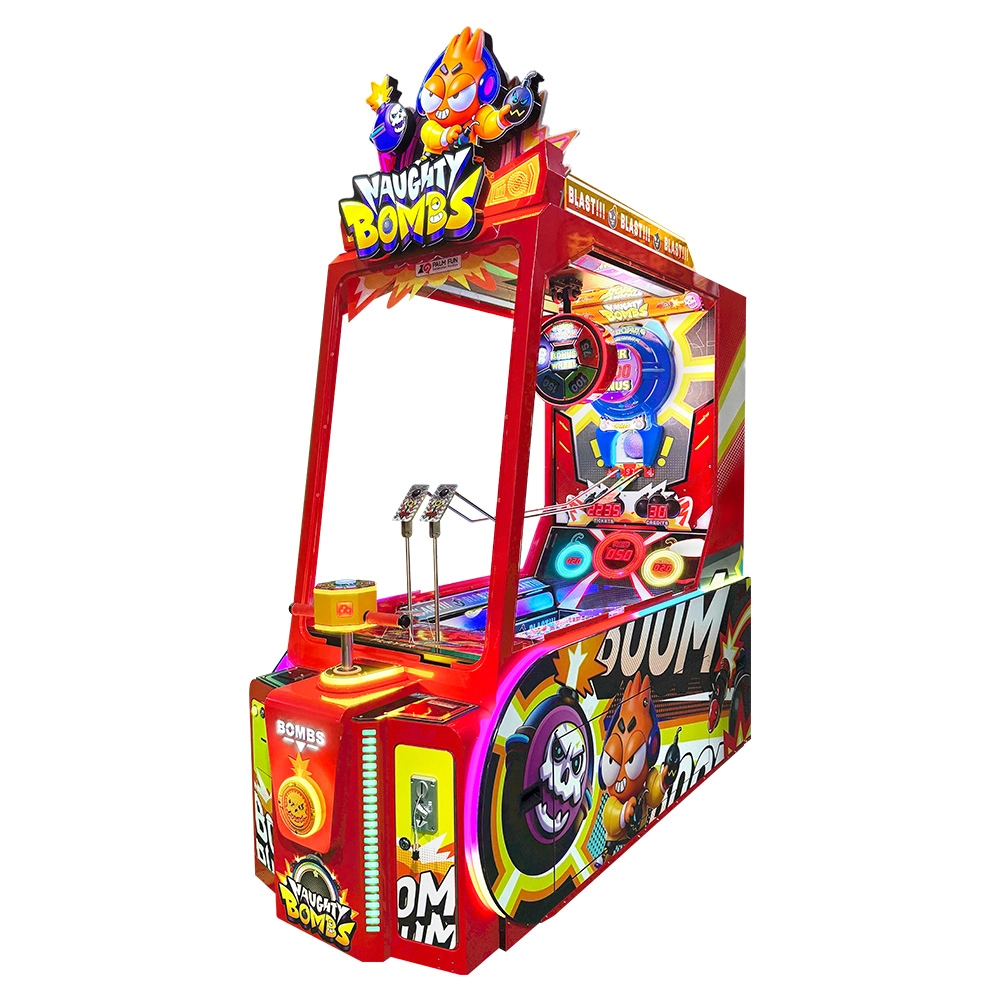
Naughty Bombs Ball Drop Redemption Arcade Game Machine
Naughty Bombs is a ball-drop redemption arcade game featuring rolling-ball gameplay, colored targets, ticket prizes, surprise bonus rewards, lighting and sound effects. Players use timing to launch and drop balls toward colored target areas. The product is presented for arcade, family entertainment center and other entertainment-venue projects, with customizable 110V / 220V AC voltage configuration.
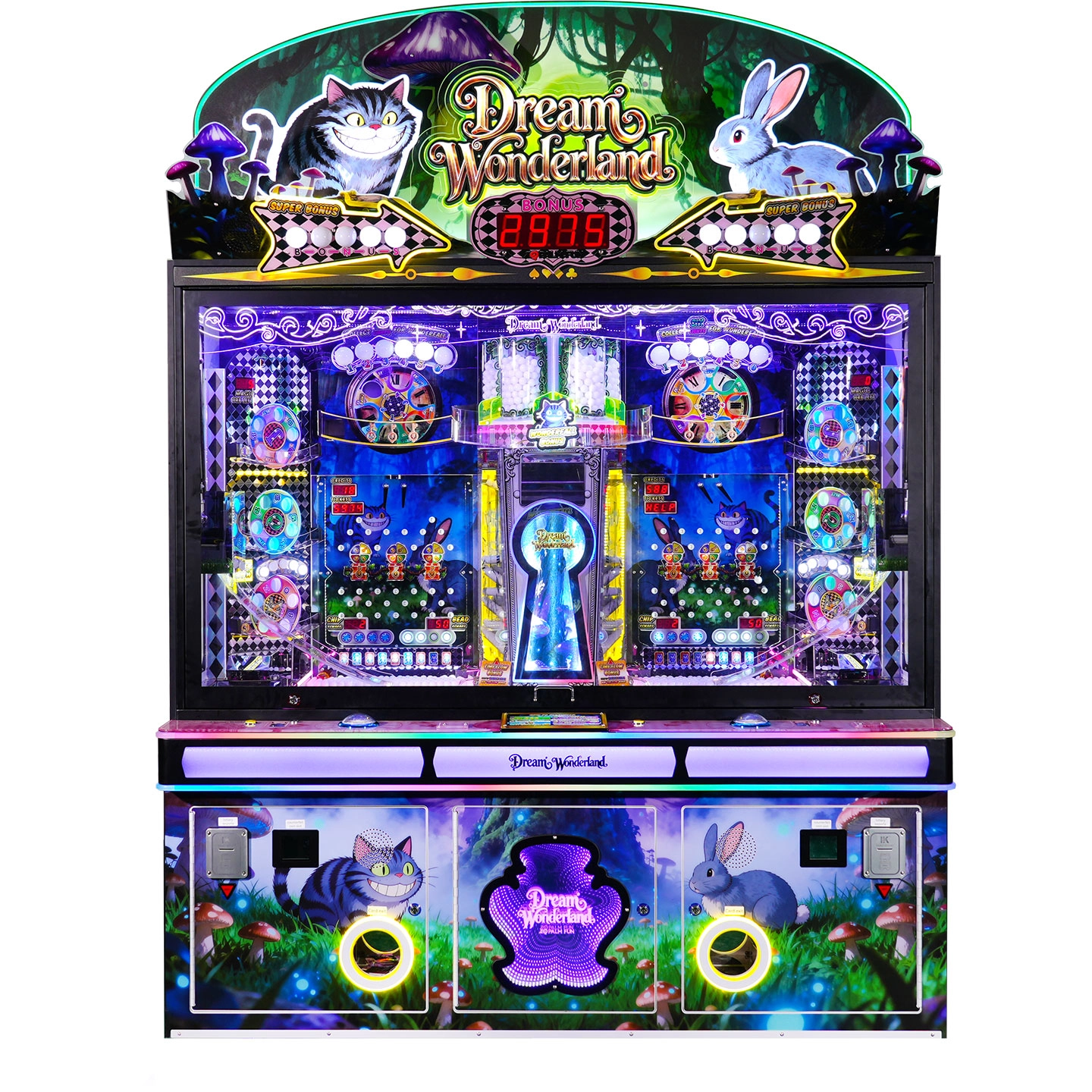
Dream Wonderland Marble Pusher Redemption Game
Enter Dream Wonderland — a magical marble pusher adventure filled with glowing lights, magic orbs, bonus wheels, collectible character cards, and exciting jackpot challenges.
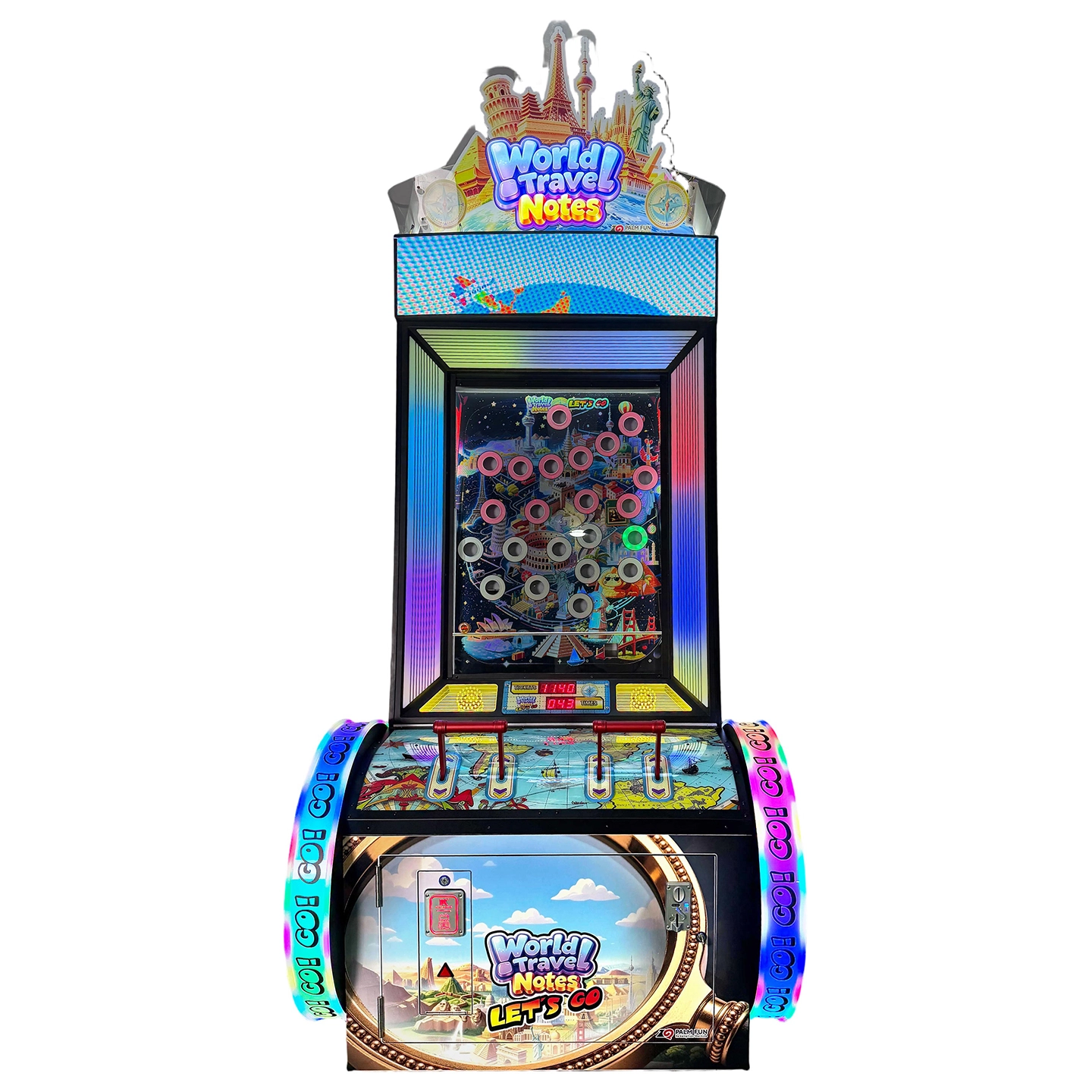
World Travel Notes – Balance Ball Redemption Arcade Game
World Travel Notes is a skill-based balance ball redemption game with a fun world-travel theme. Players use two handles to control the balance bar and guide the ball into each target hole. As the game progresses, the targets become more challenging, leading players toward the final grand prize. With colorful world-travel graphics, dynamic RGB lighting, a live score display, and progressive difficulty, World Travel Notes is designed to attract attention and encourage repeat play in arcades, FECs, shopping malls, and other entertainment venues.
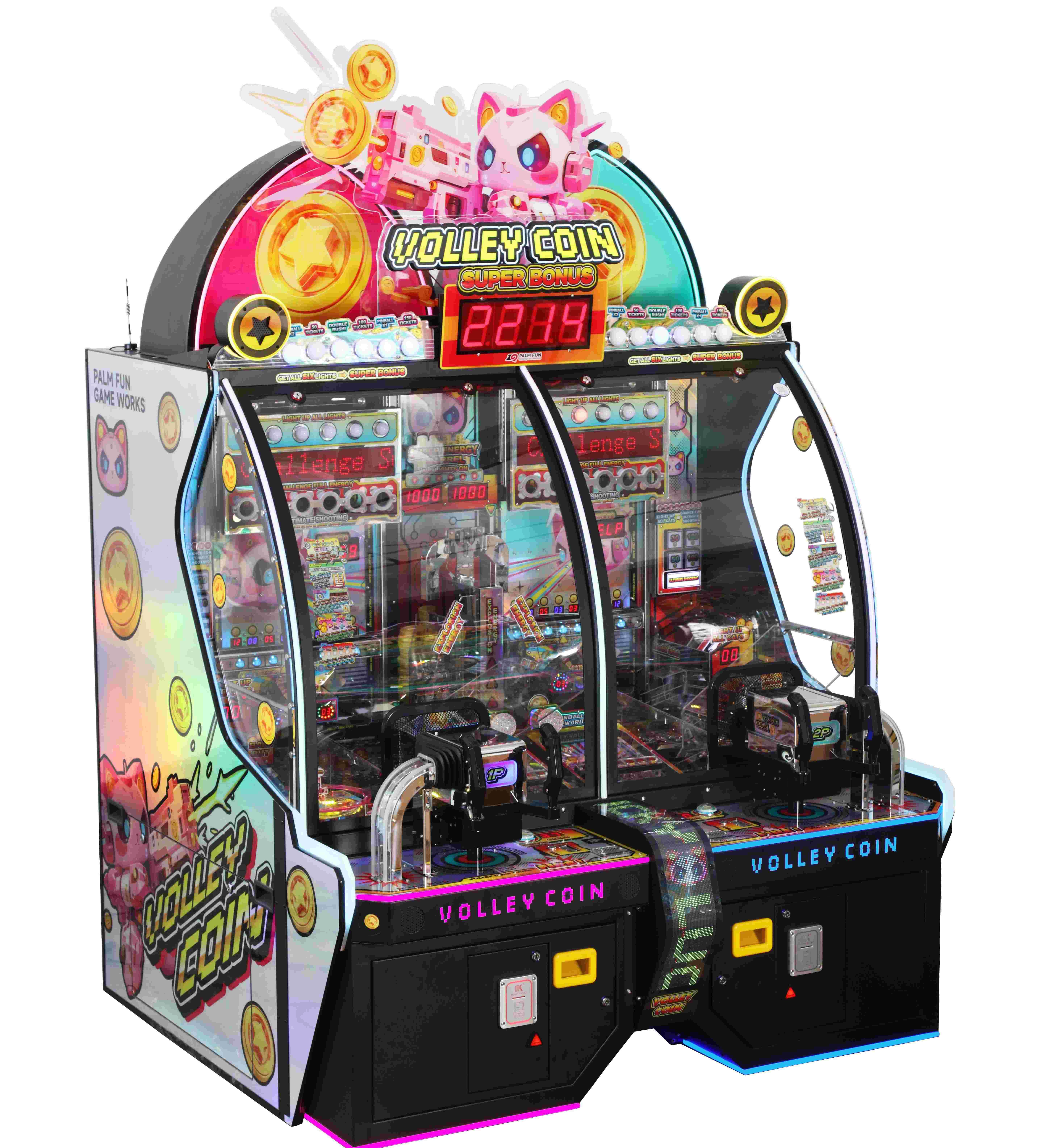
Hybrid Shooting & Pushing | Coin Pusher Arcade Ticket Redemption Machine
Volley Coin is an innovative arcade ticket redemption machine developed by Palm Fun Electronics. Combining the excitement of a fast-paced token shooter game with the proven earning power of a traditional coin pusher machine, Volley Coin offers a fresh and engaging gameplay experience that appeals to players of all ages.

Copyright © 2026 PALM FUN All Rights Reserved. | Privacy Policy • Terms and Conditions | Sitemap
palmfunarcade
Palm Fun Arcade Game
Whatsapp: +8618126837443
PalmFun Arcade
PalmFun_Arcade
PALM FUN Redemption Machine