







MOQ, Lead Time and Bulk Pricing for Coin Pusher Arcade Machines
- How Commercial Buyers Should Evaluate Coin Pusher Procurement
- MOQ is a project variable, not only a supplier rule
- Customization can change quantity, cost, and schedule
- Lead-Time Planning from Factory Release to Venue Installation
- What the production schedule normally includes
- Shipping time is separate from manufacturing time
- Quality control protects the delivery schedule
- Bulk Pricing, Landed Cost, and Return on Investment
- How volume discounts are usually structured
- Total landed cost is more useful than factory price
- Compliance and payment infrastructure must be priced correctly
- Why PALM FUN Can Support Scalable Redemption Projects
- Engineering and manufacturing capabilities
- Product options for different venue strategies
- Long-term partnership and international support
- Frequently Asked Questions
MOQ, lead time, and bulk pricing are three of the most important commercial variables when purchasing coin pusher arcade machines for family entertainment centers, amusement parks, shopping malls, arcades, and other location-based entertainment venues. Minimum order quantity affects the initial investment and product customization options; lead time determines whether a project opens on schedule; and volume pricing influences landed cost, payback period, and long-term operating margin. A professional procurement process should evaluate all three together with cabinet dimensions, electrical compliance, spare parts, warranty coverage, ticket or prize systems, packaging, shipping terms, and after-sales support. Buyers comparing a pinball arcade, a coin-operated pusher, or another redemption game machine should request a complete commercial specification rather than relying on unit price alone.
How Commercial Buyers Should Evaluate Coin Pusher Procurement
MOQ is a project variable, not only a supplier rule
MOQ means minimum order quantity, but its commercial impact depends on the type of project. A new venue may require only a small pilot shipment to test player demand, while a distributor may need a full container or multiple mixed models to maintain inventory. Manufacturers often set different MOQs for standard machines, customized cabinets, private-label graphics, special colors, software changes, and non-standard electrical configurations. A standard model usually has a lower barrier to entry because components, packaging materials, and production procedures are already established.
Buyers should distinguish between a per-model MOQ and a total-order MOQ. For example, a supplier may accept a mixed order across several arcade games machines if the total quantity reaches the required production threshold. This arrangement can be useful for distributors building a product portfolio that includes mechanical lottery equipment, ball-drop units, shooting games, and ticket redemption cabinets. The quotation should state whether accessories, spare parts, signage, and replacement control boards count toward the MOQ.
Customization can change quantity, cost, and schedule
Brand owners frequently request custom cabinet artwork, logos, screen content, prize settings, coin acceptors, voltage configurations, or localized language interfaces. These changes may require graphic proofing, engineering validation, new tooling, revised firmware, or a separate purchase of electronic components. As a result, a customized order may carry a higher MOQ and longer lead time than a standard production run.
A practical specification sheet should identify cabinet materials, machine footprint, input currency, power requirements, display type, ticket dispenser, sound system, lighting, game logic, and safety features before commercial negotiations begin. Buyers should also clarify whether the quoted machine is a complete operating unit or whether a card reader, prize meter, ticket system, or payment terminal must be purchased separately. Early technical clarity reduces change orders and prevents a low initial quotation from becoming an expensive final purchase.
Lead-Time Planning from Factory Release to Venue Installation
What the production schedule normally includes
Lead time is the period between confirmed order conditions and the point at which goods are ready for shipment, although suppliers may define it differently. A transparent schedule should separate payment confirmation, engineering approval, material preparation, assembly, testing, packaging, and dispatch. Standard inventory may be available faster, whereas made-to-order units require manufacturing capacity and component availability.
For a reliable project plan, buyers should request a written timeline with milestones. These milestones may include pro forma invoice approval, deposit receipt, artwork confirmation, pre-production sample approval, production completion, quality inspection, packing-list release, and shipping handover. A purchase order should also state the consequence of delayed artwork approval or late changes because buyer-side revisions can affect the promised completion date.
Shipping time is separate from manufacturing time
Factory lead time does not equal total delivery time. Ocean freight, port congestion, customs clearance, inland transportation, and final venue delivery can add substantial time after production is complete. The selected Incoterm also determines which party arranges freight, insurance, export documentation, and import clearance. Buyers should ask for the estimated transit range, carton or crate dimensions, gross weight, container loading plan, and required shipping documents.
Seasonal demand can affect capacity. Orders placed before holidays, major trade shows, or peak entertainment seasons may compete for factory slots and freight space. Project owners should therefore work backward from the planned opening date and include a contingency buffer for inspection, customs, installation, and commissioning. A schedule based only on the supplier’s ex-factory date is not sufficient for a venue launch.
Quality control protects the delivery schedule
Inspection is not merely a defect-detection exercise. It helps confirm that the delivered configuration matches the approved purchase order and prevents costly rework after export. A buyer or independent inspector can verify quantities, cabinet condition, voltage labels, coin mechanisms, software settings, lighting, sound, ticket output, and included accessories. The quality plan should define acceptable cosmetic tolerances and functional test procedures.
Manufacturers operating under a documented quality system can provide stronger process visibility. ISO 9001 information from ISO explains the principles of quality management systems, including process control and continual improvement. Certification alone does not guarantee product suitability, but a documented quality process can make responsibilities, records, and corrective actions easier to evaluate.
| Commercial factor | What buyers should request | Primary cost or schedule effect | Recommended control |
|---|---|---|---|
| MOQ | Per-model and total-order thresholds | Initial inventory and customization access | Compare pilot, mixed-model, and container options |
| Factory lead time | Milestones from payment to shipment readiness | Production slot and opening-date risk | Use an approved specification and written schedule |
| Freight lead time | Transit estimate, Incoterm, documents, and route | Landed cost and venue readiness | Add customs and logistics contingency |
| Bulk pricing | Tiered unit price and included accessories | Capital efficiency and gross margin | Compare total landed cost, not unit price only |
| Quality assurance | Testing records, warranty, and spare-parts policy | Downtime and after-sales expense | Define acceptance criteria before production |
Bulk Pricing, Landed Cost, and Return on Investment
How volume discounts are usually structured
Bulk pricing may be based on quantity, model mix, payment terms, repeat-order potential, packaging requirements, or distributor status. A larger order can reduce per-unit labor, purchasing, packaging, and freight costs, but the discount should be evaluated against inventory risk. Buying more machines is not automatically economical if the venue lacks floor space, player demand, technical support, or working capital.
Ask suppliers to quote clear price tiers, such as sample or pilot quantity, small commercial batch, container quantity, and recurring distributor volume. Each tier should identify whether the price includes standard packaging, spare parts, manuals, remote support, software configuration, and testing. The quotation should also identify the validity period because exchange rates, electronic components, steel, freight, and currency settlement can change between quotation and order confirmation.
Total landed cost is more useful than factory price
The total landed cost may include the machine price, customization, tooling, export packing, inland transport, freight, insurance, import duty, value-added tax, customs brokerage, unloading, local delivery, installation, payment fees, and replacement parts. A lower factory price can become less competitive if packaging is weak, documentation is incomplete, or critical components are difficult to source locally.
For each model, buyers should build a cost-per-operating-position calculation. Include floor area, expected daily plays, average spend per play, prize or ticket expense, power consumption, maintenance allowance, payment processing fees, and downtime. Redemption equipment can generate revenue through repeated play and prize engagement, but actual performance depends on venue traffic, game settings, local pricing, and operator management. No supplier should guarantee a universal payback period without validated site data.
Compliance and payment infrastructure must be priced correctly
Electrical and payment requirements vary by destination. Buyers should confirm rated voltage, frequency, plug type, grounding, fuse protection, and applicable local certification requirements. The ISO 12100 machinery safety principles provide a useful reference for risk assessment and risk reduction, although local authorities may impose additional rules for amusement equipment.
Currency acceptance is another commercial consideration. A machine configured for one coin size may require a different validator, coin comparator, token system, bill acceptor, or cashless reader in another market. Payment hardware should be specified before production because changing the mechanism after delivery may require new brackets, wiring, programming, or control components. In regulated locations, operators should also verify permits, electrical inspections, consumer protection rules, and age-related requirements with local authorities.
Why PALM FUN Can Support Scalable Redemption Projects
Engineering and manufacturing capabilities
PALM FUN was founded in 2015 and specializes in high-quality mechanical lottery machines, coin pusher machines, and raffle machines. Our work covers research and development, industrial design, production, and sales of innovative gaming and lottery equipment. This integrated structure helps project owners discuss commercial objectives and technical requirements with a supplier that understands both the product and the operating environment.
Our factory covers 3,000 square meters and is supported by skilled development engineers focused on technology advancement and user experience. For buyers, engineering capability matters because a successful machine must combine attractive presentation, stable mechanical movement, reliable electronics, serviceable construction, and an intuitive player experience. These factors influence repeat play, operator workload, maintenance intervals, and overall asset utilization.
Product options for different venue strategies
PALM FUN provides solutions for operators seeking coin pusher machines, redemption games, arcade games machines, and arcade machines for sale. Buyers can review the Coin Pusher Arcade Ticket Redemption Machine when a project requires a combined shooting and pushing experience, or evaluate the Larva Series Coin Pusher Arcade for a ball-drop and ticket-redemption format.
Different venue layouts may require different player capacities, cabinet footprints, visual themes, and revenue models. A single-player format can suit a compact arcade zone, while larger cabinets may create stronger visual impact in a family entertainment center. PALM FUN also offers a single player arcade option for operators balancing redemption products with skill-oriented entertainment. Product selection should be based on available floor space, target age group, session length, payment method, and local prize policy.
Long-term partnership and international support
PALM FUN products are recognized and used in more than 50 countries worldwide. International reach can help buyers assess a supplier’s experience with different market requirements, shipping destinations, operator expectations, and service questions. Our objective is to build long-term partnerships by providing comprehensive support that extends beyond the initial quotation.
For distributors and multi-site operators, the most valuable support may include product selection, configuration review, packaging coordination, operating guidance, spare-parts planning, troubleshooting assistance, and repeat-order management. Buyers evaluating a High Quality Redemption Arcade MachinesManufacturer should review factory information, product documentation, response standards, warranty terms, and the supplier’s ability to maintain consistent specifications across replenishment orders. PALM FUN’s vision is to become a leading global manufacturer of redemption game machines, supported by continuous innovation and attention to market demand.
Before signing a purchase contract, the buyer should consolidate the final model list, quantities, customization requirements, delivery address, Incoterm, payment schedule, warranty scope, spare-parts package, inspection procedure, and acceptance criteria. This document becomes the commercial baseline for both parties and reduces ambiguity when the order moves from sales negotiation to engineering and production.
Contact PALM FUN at our official website to review coin pusher solutions, redemption products, and a project-specific quotation for your venue or distribution plan.
Frequently Asked Questions
What is a typical MOQ for coin pusher arcade machines?
MOQ varies by supplier, model, customization level, and order structure. Standard machines may have a lower threshold, while private-label graphics, special colors, software changes, or non-standard electrical configurations can require a higher MOQ. Buyers should ask whether the requirement applies per model or to the total mixed order.
How long does it take to manufacture and ship coin pusher machines?
The schedule depends on whether the machines are in stock, made to order, or customized. Buyers should separate factory production time from ocean freight, customs clearance, inland transportation, and installation. A written schedule should include payment confirmation, artwork approval, assembly, testing, packaging, and dispatch milestones.
How can buyers obtain better bulk pricing?
Buyers can request tiered quotations for pilot quantities, commercial batches, container orders, and recurring distributor volume. The negotiation should clarify model mix, payment terms, packaging, accessories, spare parts, customization, and quotation validity. The best comparison is based on total landed cost rather than unit price alone.
What should be included in a coin pusher machine quotation?
A complete quotation should identify the model, dimensions, quantity, unit price, customization, voltage, payment system, packaging, spare parts, warranty, testing, Incoterm, shipping assumptions, payment schedule, and production lead time. It should also specify whether tickets, card readers, prize systems, or other accessories are included.
How can a buyer reduce delivery delays?
The buyer should approve technical specifications and artwork early, use a written milestone schedule, confirm component and payment requirements, and allow contingency for inspection, freight, customs, and local delivery. A pre-shipment inspection can verify quantities, functions, accessories, labels, and packaging before the goods leave the factory.
What is the difference between factory price and total landed cost?
Factory price is the supplier’s charge for the equipment under the agreed commercial terms. Total landed cost may also include customization, export packing, inland transport, freight, insurance, import duty, taxes, customs brokerage, local delivery, installation, payment fees, and replacement parts.
Recommended for you
The latest trends for coin operated arcade games
Finding Reliable Amusement Machine Suppliers in China
Custom Branding and Prize Integration for Pinball Arcades
OEM/ODM arcade pinball game machine Manufacturers and supplier in China
FAQs
How to guide the players to recognize tickets at the beginning setup of the redemption machines?
Never assume that your players already understand the purpose of lottery tickets(reward points). Even in venues that have been in operation for many years, it is still discovered during on-site interviews with players that many of them are not aware. Don't believe it? Just ask consumers at the venue. The machines, redemption counters, materials hung above the venue, and announcements by staff, among others, can all be channels for informing players about the purpose of lottery tickets(reward points). It is essential to do more promotion, create large displays and large cards, and clearly communicate the purpose of lottery tickets(reward points) to the players.
Research & Development, how hard is the birth of one new redemption machines?
How to place the redemption machines in a right place?
1,Ensure that the placement and layout of the equipment are distinct and centralized.
2,Keep noise levels low and avoid having a line of sight that spans too far to prevent players from easily taking in everything, which may slow down their movement.
3,Avoid clustering high-ticket payout machines and disperse machines of the same style.
4,Mix popular machines with less popular ones and avoid placing all popular machines together.
What is the character of mechanical redemption machine?
How to guides works?
For example:
1. Proactively inquire and add tickets when a customer's machine is running low on tickets.
2. Assist players in organizing tickets when they are dispensed unevenly.
3. Offer storage tools such as storage bags and rubber bands when customers are arranging their tickets.
4. Provide free USB interfaces for charging near popular machines and rest areas.
5. Implement warm and clear reminders, guidance on ticket redemption, and directional signage, all designed to be straightforward. The more of these you provide, the more players will appreciate your thoughtfulness, without finding it bothersome.
You may also like
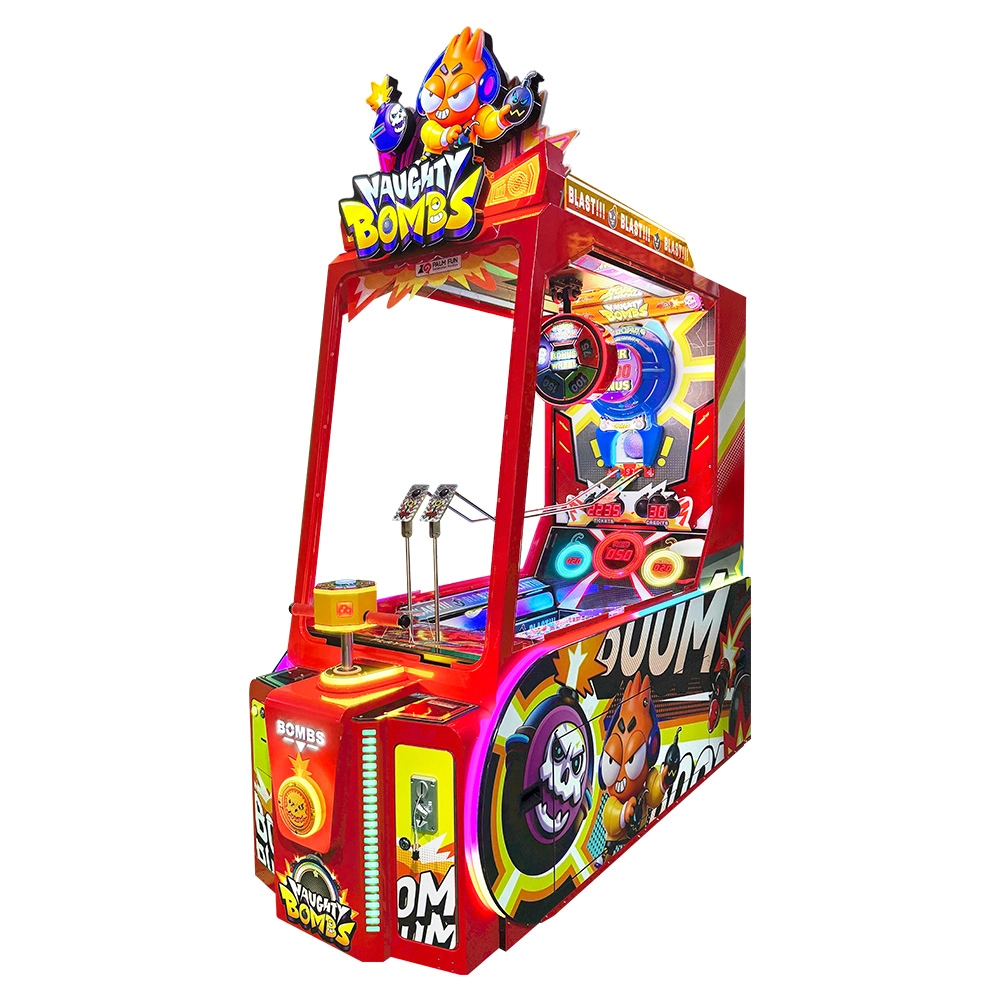
Naughty Bombs Ball Drop Redemption Arcade Game Machine
Naughty Bombs is a ball-drop redemption arcade game featuring rolling-ball gameplay, colored targets, ticket prizes, surprise bonus rewards, lighting and sound effects. Players use timing to launch and drop balls toward colored target areas. The product is presented for arcade, family entertainment center and other entertainment-venue projects, with customizable 110V / 220V AC voltage configuration.
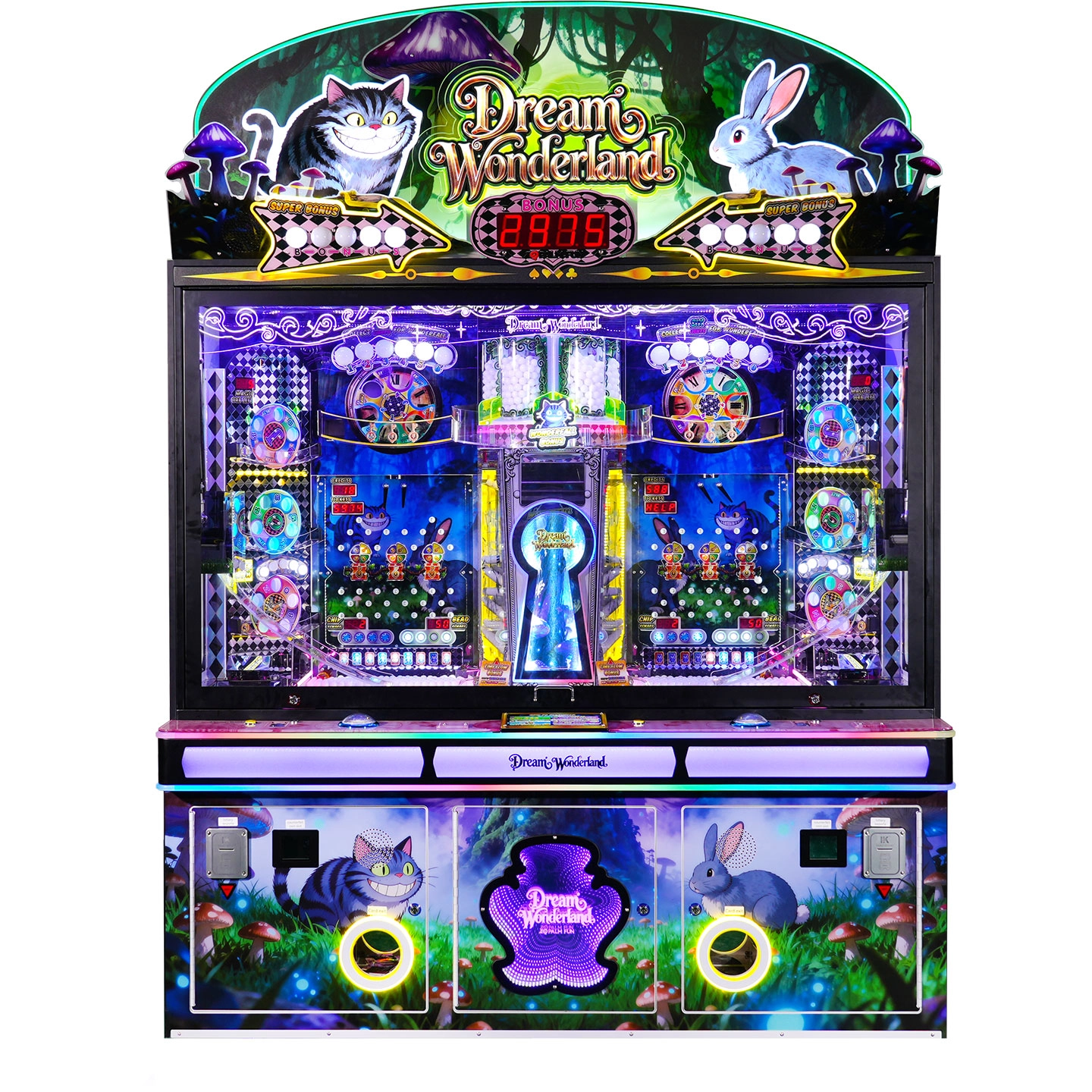
Dream Wonderland Marble Pusher Redemption Game
Enter Dream Wonderland — a magical marble pusher adventure filled with glowing lights, magic orbs, bonus wheels, collectible character cards, and exciting jackpot challenges.
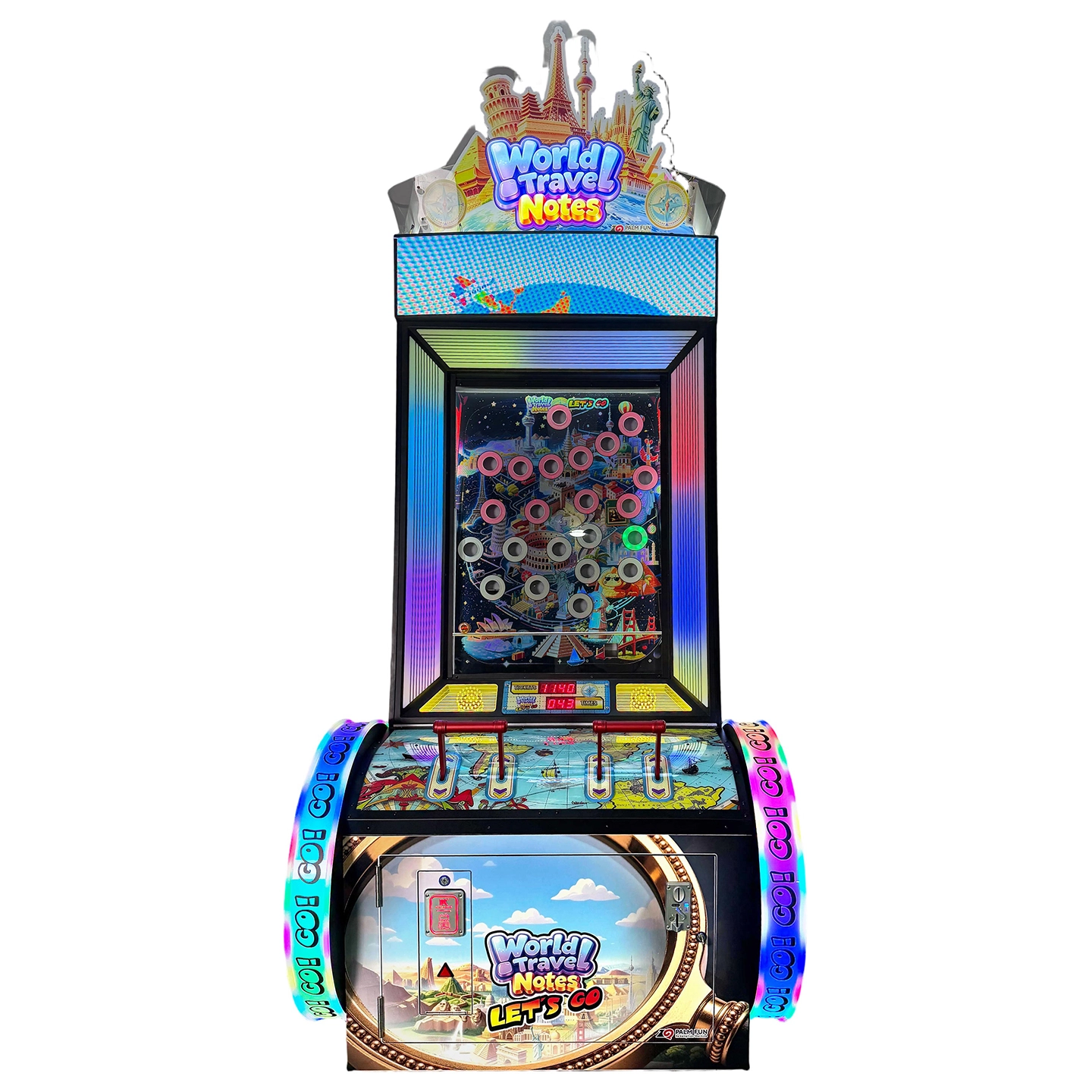
World Travel Notes – Balance Ball Redemption Arcade Game
World Travel Notes is a skill-based balance ball redemption game with a fun world-travel theme. Players use two handles to control the balance bar and guide the ball into each target hole. As the game progresses, the targets become more challenging, leading players toward the final grand prize. With colorful world-travel graphics, dynamic RGB lighting, a live score display, and progressive difficulty, World Travel Notes is designed to attract attention and encourage repeat play in arcades, FECs, shopping malls, and other entertainment venues.
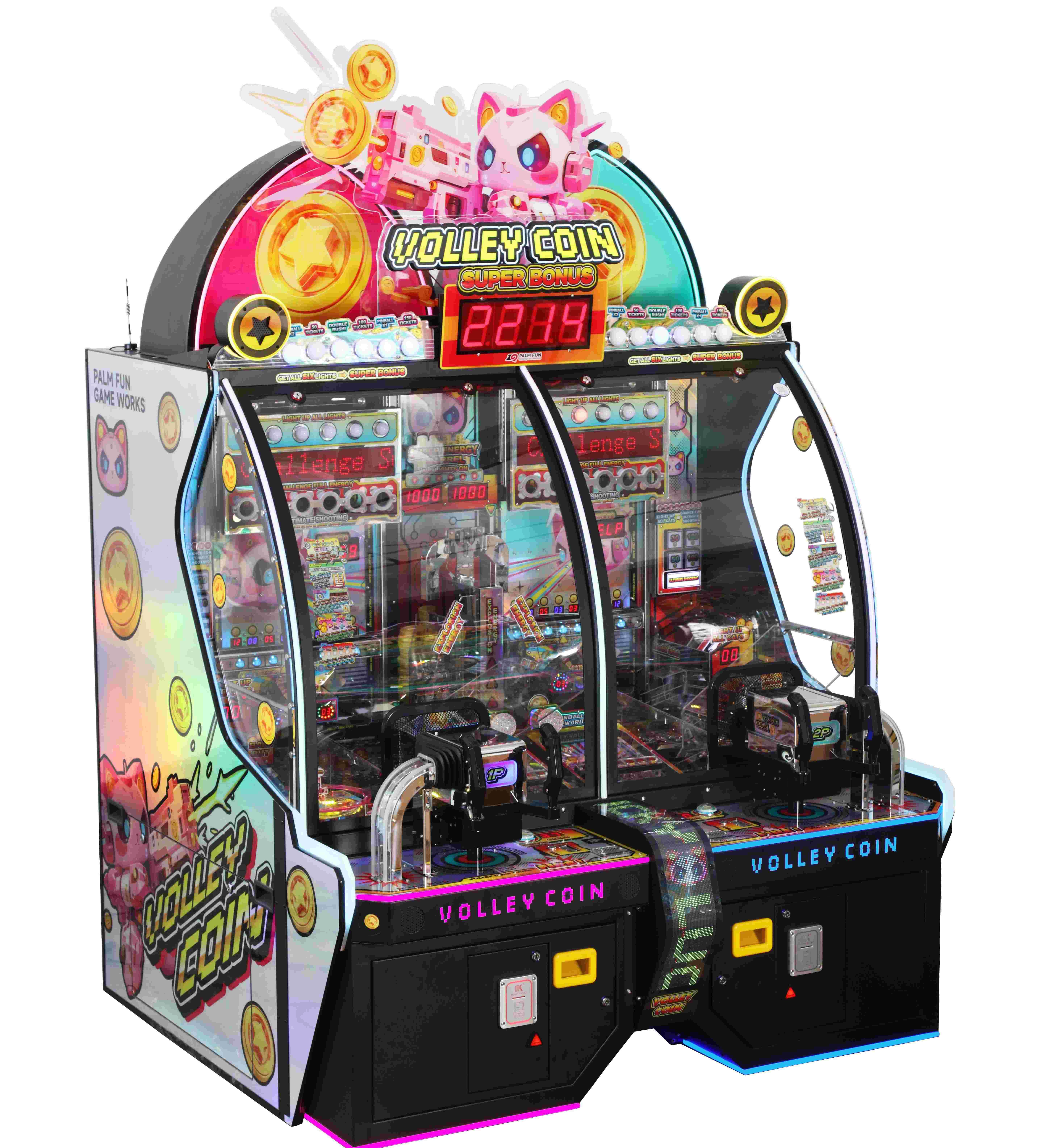
Hybrid Shooting & Pushing | Coin Pusher Arcade Ticket Redemption Machine
Volley Coin is an innovative arcade ticket redemption machine developed by Palm Fun Electronics. Combining the excitement of a fast-paced token shooter game with the proven earning power of a traditional coin pusher machine, Volley Coin offers a fresh and engaging gameplay experience that appeals to players of all ages.
Copyright © 2026 PALM FUN All Rights Reserved. | Privacy Policy • Terms and Conditions | Sitemap
palmfunarcade
Palm Fun Arcade Game
Whatsapp: +8618126837443
PalmFun Arcade
PalmFun_Arcade
PALM FUN Redemption Machine