






OEM vs ODM single player arcade: sourcing implications for brands
- Selecting a sourcing model for single-station amusement cabinets
- Defining OEM and ODM for game cabinet purchases
- When to choose contract manufacturing vs. design-led sourcing
- Key procurement triggers and selection criteria
- Technical, legal, and operational implications of OEM vs ODM
- Intellectual property and licensing controls
- Quality assurance and compliance
- Supply chain resilience and component traceability
- Procurement playbook: cost, timeline, and customization trade-offs
- Cost structure and total landed cost analysis
- Time-to-market and iteration speed
- Customization, brand differentiation and user experience
- Comparative data: OEM vs ODM implications for single-cabinet projects
- Applying the data to redemption game machine deployments
- PALM FUN capabilities and how they map to brand sourcing requirements
- Manufacturing footprint and engineering resources
- Product portfolio and configurable platforms
- Quality, compliance and after-sales support
- Implementation guidance: contract clauses and pilot program checklist
- Essential contract terms to include
- Pilot production and validation steps
- After-sales logistics and spare parts planning
- Frequently Asked Questions
- Which sourcing model gives brands the most control over game mechanics?
- Can an ODM partner provide customization while protecting brand IP?
- What certifications should buyers request for arcade and redemption equipment?
- How do MOQ and tooling amortization affect per-unit pricing?
- What is the recommended pilot size before full production for a new cabinet?
- How to manage long-term spare parts for deployed fleets?
Brands evaluating procurement strategies for a modern pinball arcade must balance customization, intellectual property control, cost-to-market, and lifecycle support; this article compares original equipment manufacturing and original design manufacturing pathways for single-station amusement cabinets, provides practical procurement checklists, quality assurance protocols aligned with ISO 9001 expectations, and outlines how a vetted supplier relationship—backed by documented technical capability and global distribution—reduces program risk and accelerates commercial roll-out.
Selecting a sourcing model for single-station amusement cabinets
Defining OEM and ODM for game cabinet purchases
Original equipment manufacturing typically means a supplier builds to a brand’s detailed specifications and retains minimal design ownership; original design manufacturing supplies a finished concept that a buyer can brand and configure. Buyers should consult authoritative descriptions such as the Original equipment manufacturer and Original design manufacturer definitions when drafting procurement and IP clauses to avoid ambiguity in contracts.
When to choose contract manufacturing vs. design-led sourcing
Contract manufacturing (OEM) is often preferred when a brand already has validated product designs, proprietary software, or unique mechanical assemblies and needs a manufacturer to scale production. Design-led sourcing (ODM) is advantageous where rapid concept-to-market, cost-efficient bill-of-materials optimization, or turnkey manufacturing is required. Project owners should map program goals (speed, ownership, differentiation) to the sourcing model at the RFQ stage.
Key procurement triggers and selection criteria
Procurement teams must evaluate minimum order quantities, tooling amortization, certification needs, supply chain transparency, and long-term service agreements. For single-player cabinets, space efficiency, coin/token interfaces, ticket redemption mechanisms, and user experience diagnostics should be evaluated alongside manufacturing KPIs such as defect per million assemblies and on-time delivery rates.
Technical, legal, and operational implications of OEM vs ODM
Intellectual property and licensing controls
Selecting an ODM often transfers design ownership or requires a license agreement; OEM contracts typically preserve the buyer’s IP but necessitate tight documentation of design baselines and change control processes. Legal teams should require clear IP assignment clauses, NDA protections, and carve-outs for background technologies. For global deployments, consult international IP guidance such as WIPO resources when defining patent and trademark strategies.
Quality assurance and compliance
Quality control and standards compliance (electrical safety, EMC, materials) must be contractual deliverables. Request factory-level certifications and quality manuals aligned to ISO 9001 principles, and include acceptance criteria, sample-testing plans, and incoming inspection protocols. For amusement machines, environmental testing (temperature, humidity), ingress protection for coin/bill paths, and mechanical endurance cycles are critical acceptance test points.
Supply chain resilience and component traceability
Buyers should require BOM transparency and multi-tier supplier visibility to mitigate commodity shortages and lead-time spikes. Contract terms should specify alternative sourcing approvals, spares provisioning, and lifecycle part management (LPM) clauses to protect against obsolescence in displays, motors, or PCB assemblies commonly used in redemption gaming and mechanical lottery devices.
Procurement playbook: cost, timeline, and customization trade-offs
Cost structure and total landed cost analysis
OEM arrangements often present higher per-unit costs at low volumes due to fixed tooling and engineering oversight, but they offer better long-term cost predictability when a brand owns the design. ODM models can reduce upfront engineering expense and tooling costs by amortizing design across multiple clients; however, buyers should model royalty, rework, and variant costs over a five-year horizon to determine true total landed cost.
Time-to-market and iteration speed
Design-led suppliers accelerate initial market entry with ready platforms, reducing time for industrial design and prototyping. For iterative product roadmaps—feature updates, localization, or aesthetic refreshes—OEMs provide greater control over incremental changes, although change orders may lengthen lead times. Project managers must build schedule contingencies for certification cycles and pilot runs.
Customization, brand differentiation and user experience
Brands seeking distinctive gameplay interfaces, cabinet art, or proprietary prize mechanics should favor OEM partnerships where full specification control exists. For standardized redemption lanes or coin push mechanisms where economies of scale dominate, ODM platforms may deliver faster ROI. User-experience testing—ergonomics, ticket flow, sound design—should be contracted before full production to avoid costly rework.
Comparative data: OEM vs ODM implications for single-cabinet projects
| Attribute | OEM (Build-to-spec) | ODM (Design & Supply) |
|---|---|---|
| Design ownership | Buyer retains IP | Supplier may retain design rights or require license |
| Upfront engineering cost | High (custom engineering and tooling) | Low-to-moderate (shared design development) |
| Time-to-market | Longer (custom design cycles) | Faster (existing platforms) |
| Per-unit cost at low volume | Higher | Lower |
| Customization flexibility | High | Moderate |
| Quality management control | Direct oversight possible | Dependent on supplier QA maturity |
| Recommended buyer profile | Brands owning IP and seeking differentiation | Operators seeking quick deployment and cost efficiency |
Applying the data to redemption game machine deployments
For facility owners rolling out mixed-game floors, selecting a hybrid approach—OEM for flagship cabinets and ODM for commodity fillers—optimizes capital allocation. This hybrid strategy reduces risk while enabling branded experiences where margins justify bespoke investment.
PALM FUN capabilities and how they map to brand sourcing requirements
Manufacturing footprint and engineering resources
Founded in 2015, PALM FUN specializes in high-quality mechanical lottery machines, coin pusher machines, and raffle machines. Our state-of-the-art factory covers 3,000 square meters and is staffed by development engineers focused on improving technology and end-user interaction. This capability supports both OEM and ODM models: manufacturers can execute build-to-spec programs with rigorous change control, and operators can adopt turnkey platforms to accelerate deployment.
Product portfolio and configurable platforms
Our modular platforms include large-format amusement cabinets, single-station coin pushers, and hybrid prize dispensers. Buyers searching for a branded pinball experience can evaluate our pinball arcade offering, while operators seeking compact play-for-prizes units should review our single player arcade and ticket machines. For high-volume redemption deployments, our Coin Pusher Arcade Ticket Redemption Machine and the Larva Series Coin Pusher Arcade provide proven mechanical reliability and configurable prize logic.
Quality, compliance and after-sales support
Our manufacturing processes incorporate documented QA checkpoints and lifecycle support agreements. Buyers receive test reports, acceptance criteria, and service-level commitments to ensure uptime in high-traffic environments. For brands requiring corporate credibility, PALM FUN offers factory tours, sample audits, and a clear path for CE or regional safety certification support consistent with global supply expectations. Detailed corporate information is available on our High Quality Redemption Arcade MachinesManufacturer page.
Implementation guidance: contract clauses and pilot program checklist
Essential contract terms to include
Contracts should detail IP ownership, tooling amortization schedules, warranty periods, MOQ thresholds, acceptance testing procedures, and penalties for nonconforming deliveries. Include a change-order matrix with cost and timeline impacts defined for minor and major modifications to avoid disputes during production ramps.
Pilot production and validation steps
Execute a pilot run with a statistically significant sample size to validate mechanical endurance cycles, ticket redemption accuracy, and user interaction telemetry. Require delivery of a manufacturing test plan, first article inspection (FAI) reports, and service documentation before releasing long-lead components.
After-sales logistics and spare parts planning
Establish spare-parts kits, recommended stocking levels, and a parts obsolescence policy. Ensure documentation includes exploded-view drawings, firmware update procedures, and a parts-qualification matrix to keep field maintenance predictable and cost-effective.
Frequently Asked Questions
Which sourcing model gives brands the most control over game mechanics?
OEM arrangements grant buyers the most control, because the brand provides detailed specifications and retains intellectual property; contracts should include explicit change-control procedures to preserve design intent.
Can an ODM partner provide customization while protecting brand IP?
Yes—through tailored licensing agreements and custom development addenda; however, buyers should confirm whether the supplier retains any rights to the base design and include exclusivity clauses if differentiation is required.
What certifications should buyers request for arcade and redemption equipment?
Request factory quality certifications consistent with ISO 9001, regional electrical safety marks (CE, UL, or local equivalents), and EMC test reports; include acceptance-testing deliverables in purchase orders.
How do MOQ and tooling amortization affect per-unit pricing?
Higher tooling or injection-mold costs increase per-unit prices at low volumes; buyers should negotiate tooling-cost-sharing, amortization schedules, or price breaks tied to cumulative purchase volumes to manage cost-risk.
What is the recommended pilot size before full production for a new cabinet?
A pilot batch of 20–100 units is commonly recommended depending on complexity; the pilot should stress-test mechanical systems, firmware stability, and user interaction metrics to identify issues before scaling.
How to manage long-term spare parts for deployed fleets?
Include parts-availability guarantees in contracts, define minimum spare-kits per deployed unit, and adopt a parts-kitting and inventory management plan to minimize downtime; require notification timelines for end-of-life components.
Contact PALM FUN to discuss OEM and ODM pathways or view our product lineup and factory capabilities.
Recommended for you
How to start a coin machine for sale business in China
Amusement Machine Supplier Contracts Buyers Should Negotiate
Best coin pusher machine supplier manufacturers and supplier brands
Wholesale modern arcade games manufacturer and supplier in Asia
FAQs
How to choose the exchange gifts of the tickets(reward points)?
2. Gifts should be diverse. This refers to the variety of items available, providing players with more choices. Everyone's preferences are different, especially adults who have higher expectations for gifts. The venue should strive to meet the diverse needs of these players.
3. Gifts should be fashionable. The younger generation that follows trends is very interested in the hottest items of the moment. If the venue can keep up with the latest trends, it can attract the majority of consumers.
4. Gifts should be innovative. Especially during holidays and seasons, it's a good idea to try out new approaches, creating a competitive advantage with unique offerings. For example, the current trend of combining pop culture and blind box culture.
What is the character of mechanical redemption machine?
What details should be paid attention to in the operation of redemption machines?
① Machine parameter adjustments.
② Equipment performance and gameplay.
③ Decoration and promotion of the area and equipment.
④ Machine placement locations.
⑤ Selection of prizes.
2. The primary operational techniques for redemption machines are in the attractiveness of the gameplay, maintaining a reasonable payout rate, and creating an engaging atmosphere. Depending on the season and market changes, promotional activities should be carried out with a balance, analysis, and follow-up. Therefore, you can consider the following operational methods:
① Collaborate with several venues or businesses to distribute promotional materials to enhance external visibility and interaction.
② Conduct targeted promotional activities to retain returning customers.
③ Organize regular member events to ensure member attraction and consistent customer base. For example, offering extra lottery rewards for a certain amount of tokens deposited or giving a certain number of lottery tickets(reward points) when a membership card is issued.
④ Strengthen interaction with neighboring businesses within the commercial district.
⑤ Organize selective activities for children and offer special deals for exchanging unique children-oriented prizes.
3. Setting parameters correctly:
4.New machine arrival -- Familiarizing with the game--Initial parameter control--Promotional --ctivities and advertising--Adjusting parameters based on the number of players--Multiple adjustments of parameters--Increased popularity--Profitability--Reinvestment.
Note: Data analysis should be conducted weekly to promptly understand the ticket payout probability for each redemption machine. In case of any abnormal situations, swift follow-up and troubleshooting are essential to identify the causes and rectify the issues.
The revenue proportion of redemption machines
How to place the redemption machines in a right place?
1,Ensure that the placement and layout of the equipment are distinct and centralized.
2,Keep noise levels low and avoid having a line of sight that spans too far to prevent players from easily taking in everything, which may slow down their movement.
3,Avoid clustering high-ticket payout machines and disperse machines of the same style.
4,Mix popular machines with less popular ones and avoid placing all popular machines together.
You may also like
Naughty Bombs Ball Drop Redemption Arcade Game Machine
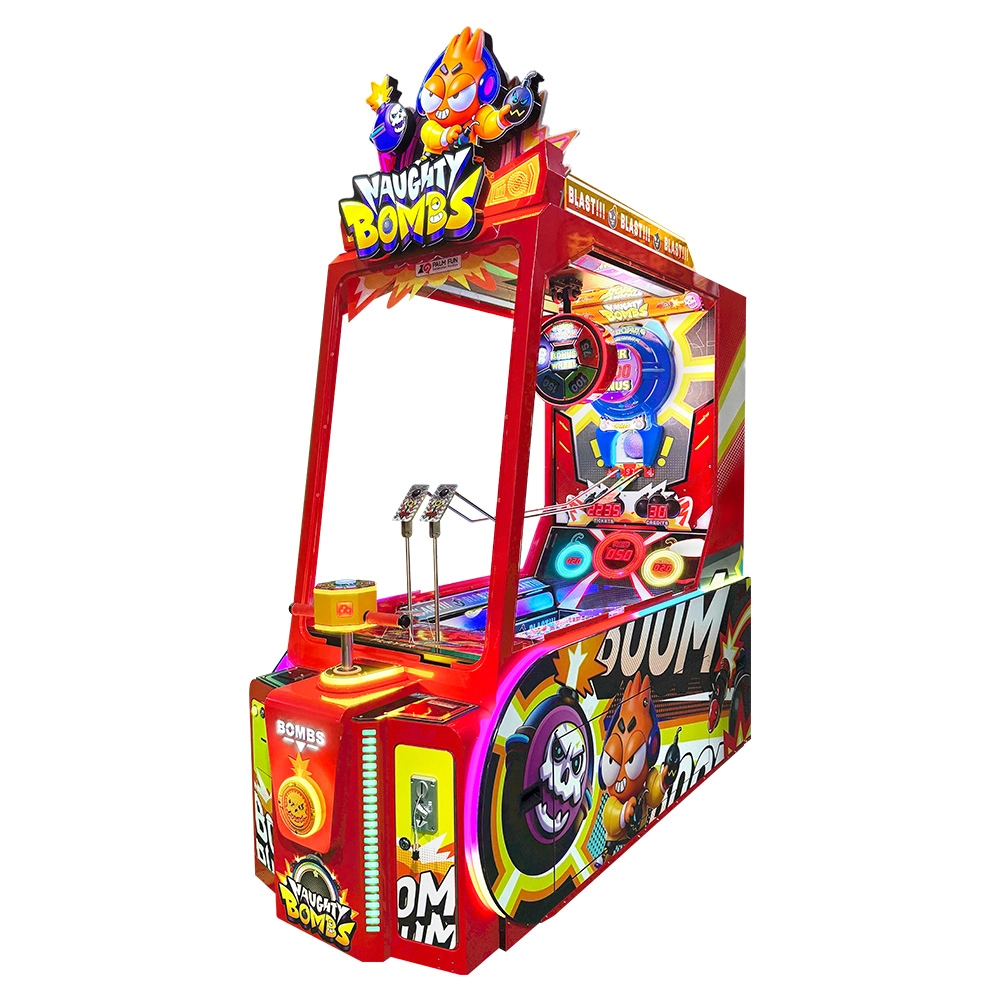
Naughty Bombs is a ball-drop redemption arcade game featuring rolling-ball gameplay, colored targets, ticket prizes, surprise bonus rewards, lighting and sound effects. Players use timing to launch and drop balls toward colored target areas. The product is presented for arcade, family entertainment center and other entertainment-venue projects, with customizable 110V / 220V AC voltage configuration.
World Travel Notes – Balance Ball Redemption Arcade Game
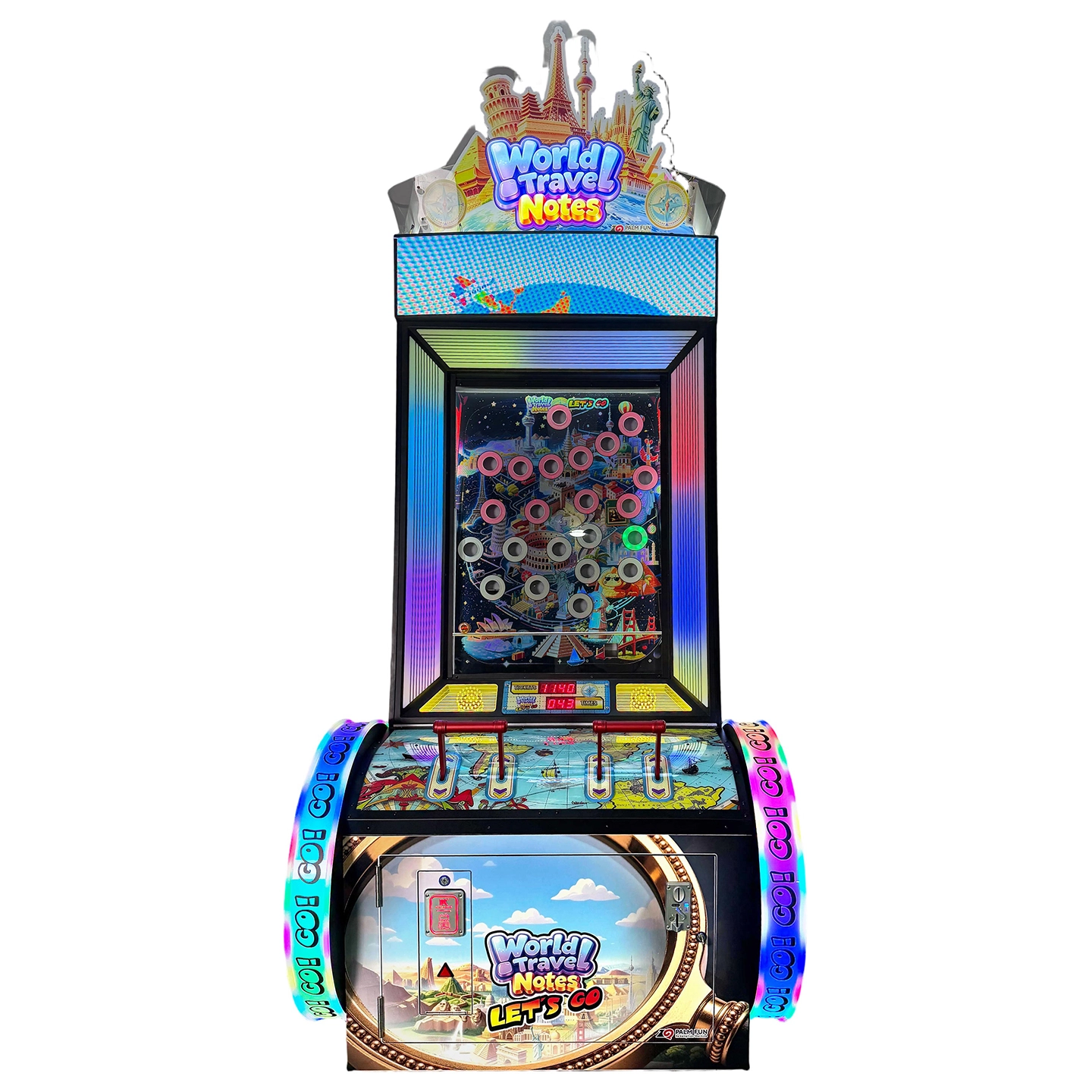
World Travel Notes is a skill-based balance ball redemption game with a fun world-travel theme. Players use two handles to control the balance bar and guide the ball into each target hole. As the game progresses, the targets become more challenging, leading players toward the final grand prize. With colorful world-travel graphics, dynamic RGB lighting, a live score display, and progressive difficulty, World Travel Notes is designed to attract attention and encourage repeat play in arcades, FECs, shopping malls, and other entertainment venues.
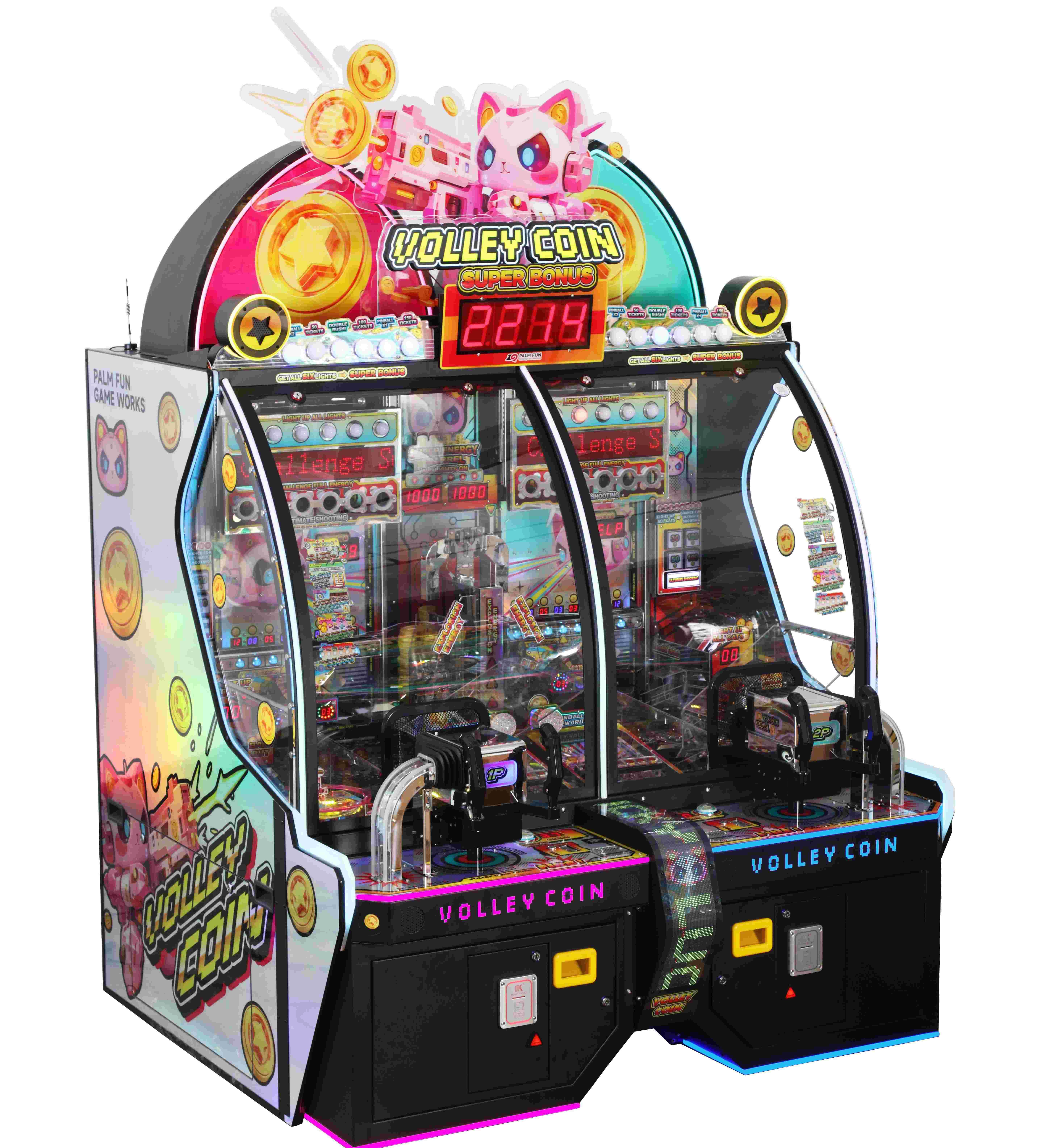
Hybrid Shooting & Pushing | Coin Pusher Arcade Ticket Redemption Machine
Volley Coin is an innovative arcade ticket redemption machine developed by Palm Fun Electronics. Combining the excitement of a fast-paced token shooter game with the proven earning power of a traditional coin pusher machine, Volley Coin offers a fresh and engaging gameplay experience that appeals to players of all ages.
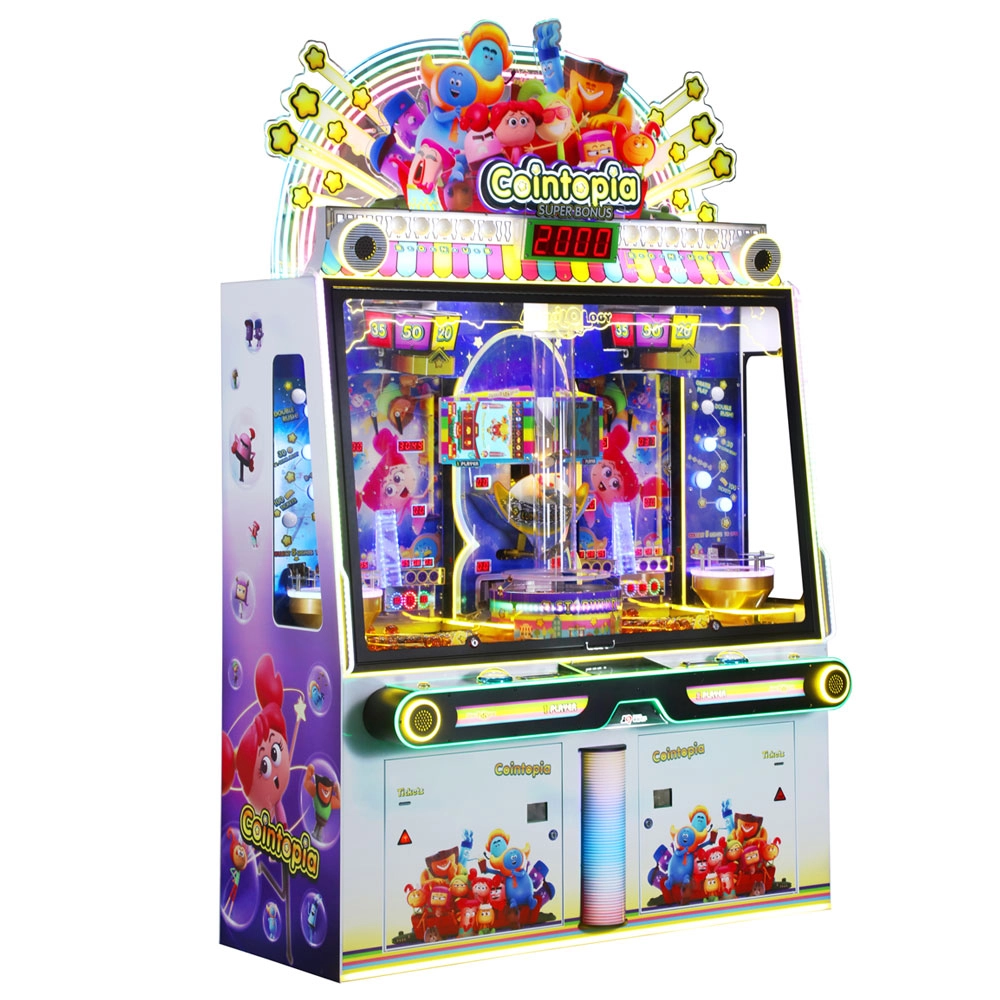
COINTOPIA, Have Fun Together With The Zodiac Buddies in an Utopia
COINTOPIA by PALM FUN is an exciting redemption game machine where players enjoy fun with zodiac buddies in a utopia setting. This ticket redemption machine offers engaging gameplay and rewarding experiences, perfect for family entertainment centers and arcades seeking top-quality redemption games.
Copyright © 2026 PALM FUN All Rights Reserved. | Privacy Policy • Terms and Conditions | Sitemap
palmfunarcade
Palm Fun Arcade Game
Whatsapp: +8618126837443
PalmFun Arcade
PalmFun_Arcade
PALM FUN Redemption Machine