







Total Cost of Ownership for Parallel Universe Ball Drop Installations
- Lifecycle Economics for Ball-Drop Entertainment Installations
- Capital vs Operational Expenditure
- Depreciation, Residual Value and Fleet Refresh
- Energy Consumption and Venue Footprint
- Maintenance Strategies and Downtime Risk Mitigation
- Reactive vs Preventive vs Predictive Approaches
- Spares Inventory and Service Network Planning
- Service-Level Agreements and Operational KPIs
- Site Planning, Installation, and Compliance Considerations
- Flooring, Power and Environmental Requirements
- Local Compliance, Safety Standards and Certifications
- Transport, Installation and Commissioning Costs
- Quantifying ROI: Decision Models for Acquisition and Fleet Management
- Scenario-Based TCO Modelling (3- to 5-Year)
- Financing, Leasing and Buyback Options
- Modularity, Upgrades and End-of-Life Planning
- Frequently Asked Questions
High-value buyers and facility operators evaluating ball-drop amusement installations must move beyond purchase price to compute lifecycle expense drivers: acquisition, installation, energy, consumables, scheduled and unscheduled service, spare-part provisioning, downtime penalties, and end-of-life disposal or resale — a comprehensive approach to Total Cost of Ownership improves procurement decisions, reduces unexpected OPEX, and aligns capacity planning with revenue forecasts for mixed fleets of skill-based redemption cabinets.
Lifecycle Economics for Ball-Drop Entertainment Installations
Capital vs Operational Expenditure
Procurement decisions should separate one-time capital outlay from recurring operational spend. Upfront costs include machine purchase, freight, import duties, and installation rigging. Operational expenditure covers electricity, consumables (tickets, coins, prize items), scheduled maintenance and staffing. For benchmarking, buyers should use a multi-year cash-flow model that treats warranty, spare-part forecasts and planned upgrades as operating line items rather than ad-hoc capital calls; this aligns with the Total cost of ownership methodology used across capital-intensive sectors.
Depreciation, Residual Value and Fleet Refresh
Depreciation schedules should reflect usage intensity: high-footfall venues accelerate mechanical wear and reduce residual market value. Buyers must estimate useful life (commonly 5–8 years for heavy-use amusement cabinets) and plan refresh cycles that optimize trade-in or secondary market recovery. Including salvage assumptions in TCO models improves net-present-value comparisons between competing vendors.
Energy Consumption and Venue Footprint
Even low-wattage motors and LED lighting accumulate measurable cost in large fleets. Accurately measure per-unit consumption (Watt-hours per hour of operation) and factor local energy tariffs into per-play pricing models. Consider energy-efficient drives and variable-speed controllers in procurement specs to reduce utility-driven operating expense over multiple years.
Maintenance Strategies and Downtime Risk Mitigation
Reactive vs Preventive vs Predictive Approaches
Reactive maintenance minimizes upfront service planning but magnifies downtime and emergency part shipments. Scheduled preventive work reduces unplanned outages at the cost of regular labor and parts replacement. Condition-based and predictive maintenance leverage operational signals to reduce both maintenance cost and downtime frequency; industry studies show condition-based strategies often deliver measurable reductions in unscheduled outages and lifecycle cost when applied across fleets with consistent telemetry.
Spares Inventory and Service Network Planning
Optimizing spare-part stock vs local service partner access is a trade-off: holding critical fast-moving spares on-site reduces MTTR (mean time to repair) but increases inventory carrying cost. Buyers should map lead times, regional customs delays, and local vendor response times to define critical-spare lists and reorder points. Establishing certified local service partners with defined escalation paths reduces total downtime risk in distributed installations.
Service-Level Agreements and Operational KPIs
Contracts must include measurable SLAs: MTTR, first-time-fix rate, emergency response windows, and parts availability. Linking penalty or rebate clauses to SLA breaches provides financial alignment between operators and suppliers. Track uptime percentage and per-machine revenue per operating-hour to identify machines that warrant accelerated replacement or retrofits.
| Attribute | Reactive / Traditional | IoT-Enabled Predictive |
|---|---|---|
| Typical upfront investment | Low (purchase price only) | Medium–High (sensors, connectivity, analytics) |
| Average annual maintenance frequency | Unpredictable; spikes after failures | Predictable; scheduled by condition |
| Downtime per machine (annual) | Higher; emergency repairs | Lower; planned interventions |
| Expected operational life | Subject to abrupt failure | Extended via condition-based repairs |
| ROI timeline | Short-term (purchase-focused) | Medium-term (2–4 years for analytics payback) |
Site Planning, Installation, and Compliance Considerations
Flooring, Power and Environmental Requirements
Proper site assessment reduces installation rework. Specify floor load capacity, access for forklifts, clearances for servicing, and dedicated circuits with surge protection for each cabinet group. Ambient humidity and dust levels affect mechanical wear — operators in seaside or festival venues should expect accelerated corrosion and plan preventative corrosion control.
Local Compliance, Safety Standards and Certifications
Buyers should verify supplier compliance with relevant quality and safety frameworks. Certification to quality-management frameworks is a supply-chain differentiator; for example, alignment with ISO 9001 demonstrates documented design-control and production processes. Electrical safety listings and CE/UL declarations must be requested and cross-checked before shipment.
Transport, Installation and Commissioning Costs
Freight, insurance, customs handling and on-site commissioning are frequently underbudgeted. Include line-item allowances for crate-handling, customs duties, installation crew hours and test-play commissioning. For multi-site rollouts, consolidate shipments and staging to reduce per-unit freight and accelerate commissioning through standardized checklists.
Founded in 2015, PALM FUN specializes in high-quality mechanical lottery machines, coin pusher machines, and raffle machines. We are dedicated to the R&D, design, production, and sales of innovative gaming and lottery equipment. Our state-of-the-art factory covers 3,000 square meters and is staffed by a team of skilled development engineers committed to advancing technology and enhancing user experience. Our focus on quality and innovation has established us as an industry leader, enabling us to stay ahead of market trends and customer demands.
Our product portfolio supports diverse venue strategies: for operators seeking classic flipperless amusement units, the Pinball Raiders line includes a flagship pinball arcade cabinet and a compact single player arcade variant for limited-footprint locations. For high-turnover redemption lanes, our Coin Pusher Arcade Ticket Redemption Machine and the Larva Series Coin Pusher Arcade balance mechanical reliability with easy serviceability. Buyers prioritizing long-term partnership can evaluate our company profile under High Quality Redemption Arcade MachinesManufacturer.
We support operators with defined spare-part kits, regional logistics planning, and training programs that reduce MTTR and lower lifecycle cost. Our engineering team recommends modular designs and service-friendly access to extend mean time between major overhauls, a practical lever for improving per-unit profitability across cohorts of arcade games machines and redemption games.
Quantifying ROI: Decision Models for Acquisition and Fleet Management
Scenario-Based TCO Modelling (3- to 5-Year)
Construct scenario models with conservative, expected and optimistic cases for play-rate, downtime, and per-play yield. Include discounting for net-present-value comparison, and run sensitivity analysis on two variables: downtime percentage and per-play revenue to identify break-even points for capex-heavy options like IoT retrofits.
Financing, Leasing and Buyback Options
Financing spreads capital risk but increases lifecycle interest expense; leasing reduces upfront pain while potentially increasing long-term unit cost. Structured buyback or trade-in terms reduce end-of-life uncertainty and improve fleet refresh agility. Include finance cost and residual guarantee assumptions explicitly in procurement scoring matrices.
Modularity, Upgrades and End-of-Life Planning
Favor modular architectures that allow incremental upgrades (e.g., payment system or lighting upgrades) rather than full replacement. Define refurbishment pathways and responsible disposal or secondary-market strategies to recover value at end-of-life and to demonstrate corporate responsibility to venue owners and regulators.
Contact PALM FUN to discuss tailored TCO models for your venue or to view our complete lineup of coin pusher machine and redemption game solutions at https://www.palm-fun.com/.
Frequently Asked Questions
What components should be included when calculating Total Cost of Ownership for ball-drop installations?
TCO must include purchase price, freight/import duties, installation and commissioning, energy consumption, consumables, scheduled and unscheduled maintenance, spare-part inventory costs, downtime penalties or lost revenue, warranty and support fees, and end-of-life disposal or resale value.
How should buyers choose between reactive, preventive and predictive maintenance?
Selection depends on fleet size and revenue sensitivity: reactive is low upfront cost but high downtime risk; preventive reduces emergency outages through scheduled service; predictive (condition-based) requires sensor investment but can lower overall maintenance cost and downtime for medium-to-large fleets when analytics and processes are implemented.
Which contractual terms reduce lifecycle risk when procuring redemption game machines?
Insist on measurable SLAs (MTTR, uptime %, first-time-fix rate), parts availability guarantees, response-time commitments, warranty coverage scope, and defined escalation and spare-part kits. Including financial remedies for SLA breaches aligns supplier incentives with operational uptime.
Is investing in IoT-enabled predictive maintenance justified for mid-size arcade deployments?
It can be justified if the installation has consistent utilization, multiple units across sites, and measurable revenue loss from downtime. Predictive approaches typically show medium-term payback (often 2–4 years) by lowering emergency repairs and extending useful life, but buyers should run scenario models before committing.
What procurement checks ensure a supplier will minimize TCO?
Verify documented quality-management processes (e.g., ISO 9001 alignment), factory capabilities, spare-part logistics, local service network, documented MTBF data, and references from operators with similar deployment profiles. Ask for lifecycle cost models and standardized commissioning and training packages.
Recommended for you
Everything You Need to Know About full tilt arcade & pinball Miami private label
How to Choose the Best Coin Pusher Ticket Redemption Machine
Best best coin pusher arcade machine manufacturer manufacturers and supplier brands
How Coin Machine Pushers Can Boost Your Marketing Campaigns
FAQs
How to guides works?
For example:
1. Proactively inquire and add tickets when a customer's machine is running low on tickets.
2. Assist players in organizing tickets when they are dispensed unevenly.
3. Offer storage tools such as storage bags and rubber bands when customers are arranging their tickets.
4. Provide free USB interfaces for charging near popular machines and rest areas.
5. Implement warm and clear reminders, guidance on ticket redemption, and directional signage, all designed to be straightforward. The more of these you provide, the more players will appreciate your thoughtfulness, without finding it bothersome.
Why redemption ticket machines are popular?
2.Redemption machines are becoming the most important breakthrough to enhance the sustainable operation of indoor arcade game halls.
3.Players are of all ages and they continue to expand.
What is the character of mechanical redemption machine?
How to choose the exchange gifts of the tickets(reward points)?
2. Gifts should be diverse. This refers to the variety of items available, providing players with more choices. Everyone's preferences are different, especially adults who have higher expectations for gifts. The venue should strive to meet the diverse needs of these players.
3. Gifts should be fashionable. The younger generation that follows trends is very interested in the hottest items of the moment. If the venue can keep up with the latest trends, it can attract the majority of consumers.
4. Gifts should be innovative. Especially during holidays and seasons, it's a good idea to try out new approaches, creating a competitive advantage with unique offerings. For example, the current trend of combining pop culture and blind box culture.
The revenue proportion of redemption machines
You may also like
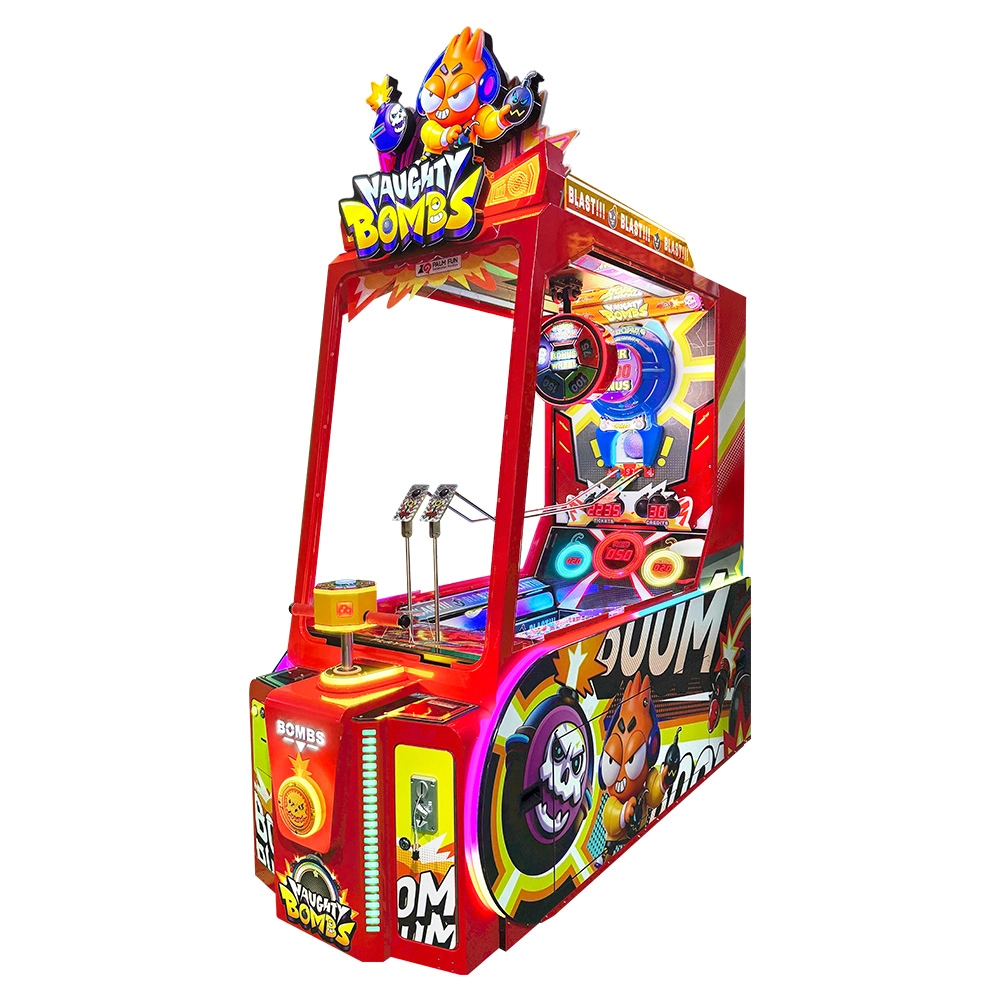
Naughty Bombs Ball Drop Redemption Arcade Game Machine
Naughty Bombs is a ball-drop redemption arcade game featuring rolling-ball gameplay, colored targets, ticket prizes, surprise bonus rewards, lighting and sound effects. Players use timing to launch and drop balls toward colored target areas. The product is presented for arcade, family entertainment center and other entertainment-venue projects, with customizable 110V / 220V AC voltage configuration.
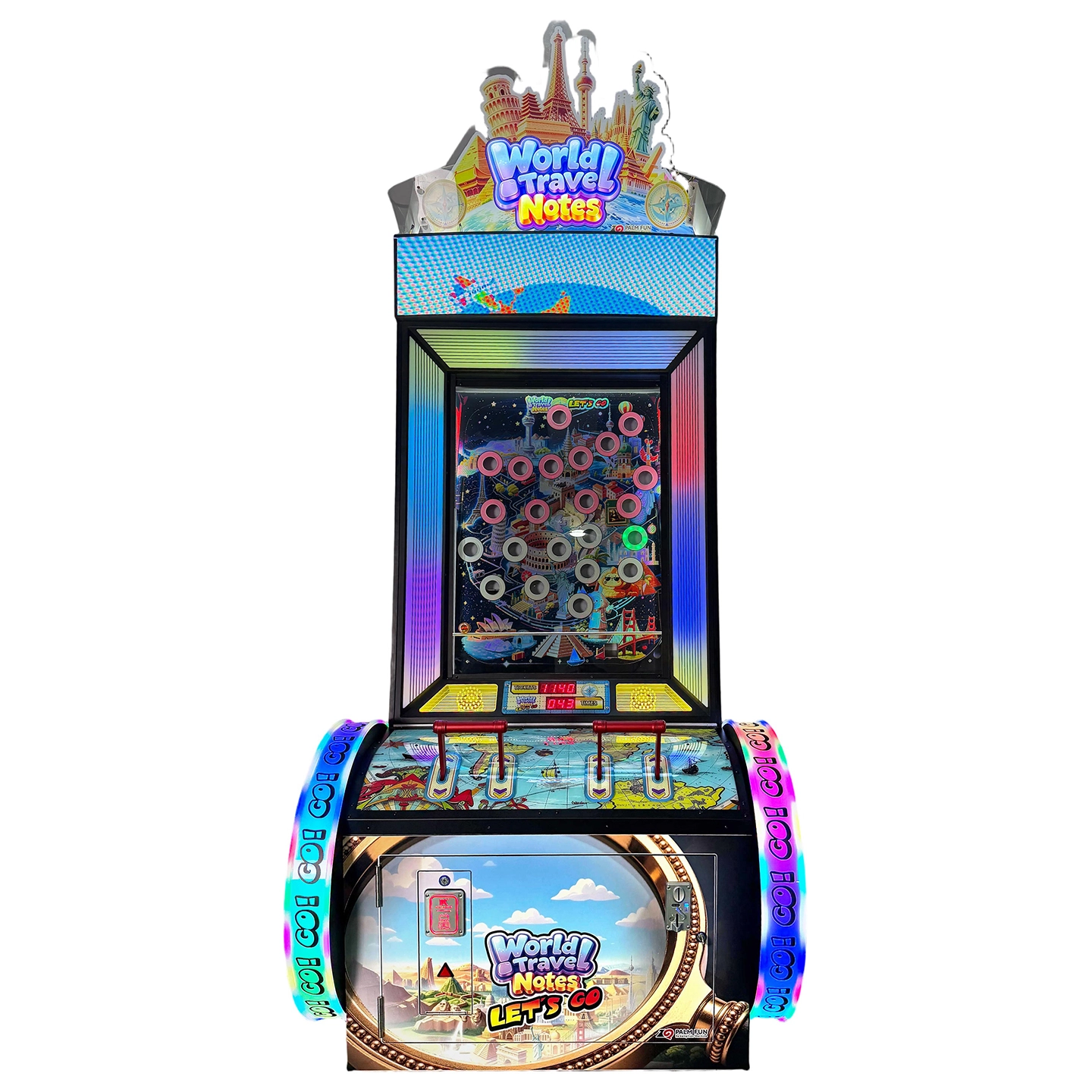
World Travel Notes – Balance Ball Redemption Arcade Game
World Travel Notes is a skill-based balance ball redemption game with a fun world-travel theme. Players use two handles to control the balance bar and guide the ball into each target hole. As the game progresses, the targets become more challenging, leading players toward the final grand prize. With colorful world-travel graphics, dynamic RGB lighting, a live score display, and progressive difficulty, World Travel Notes is designed to attract attention and encourage repeat play in arcades, FECs, shopping malls, and other entertainment venues.
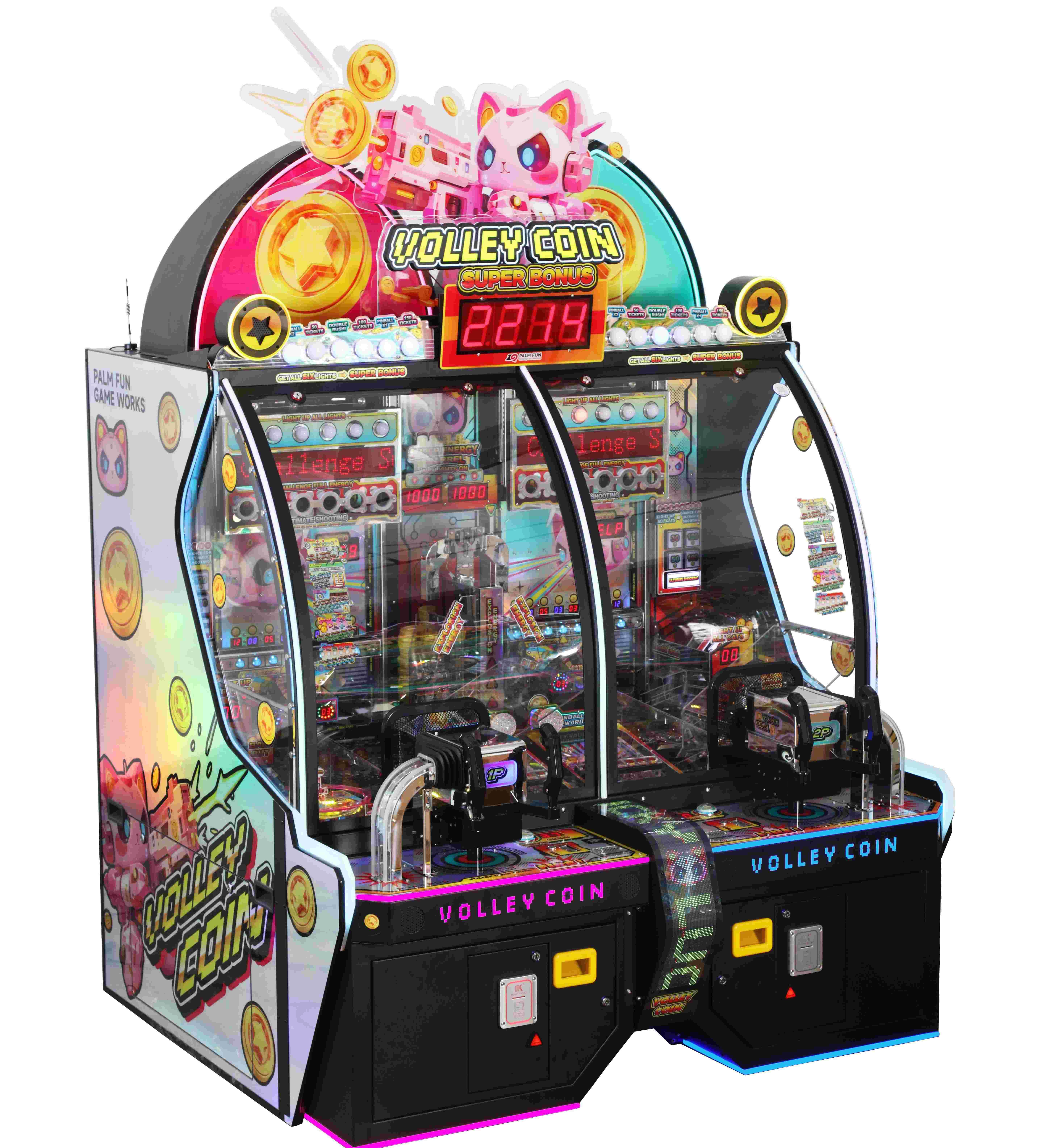
Hybrid Shooting & Pushing | Coin Pusher Arcade Ticket Redemption Machine
Volley Coin is an innovative arcade ticket redemption machine developed by Palm Fun Electronics. Combining the excitement of a fast-paced token shooter game with the proven earning power of a traditional coin pusher machine, Volley Coin offers a fresh and engaging gameplay experience that appeals to players of all ages.
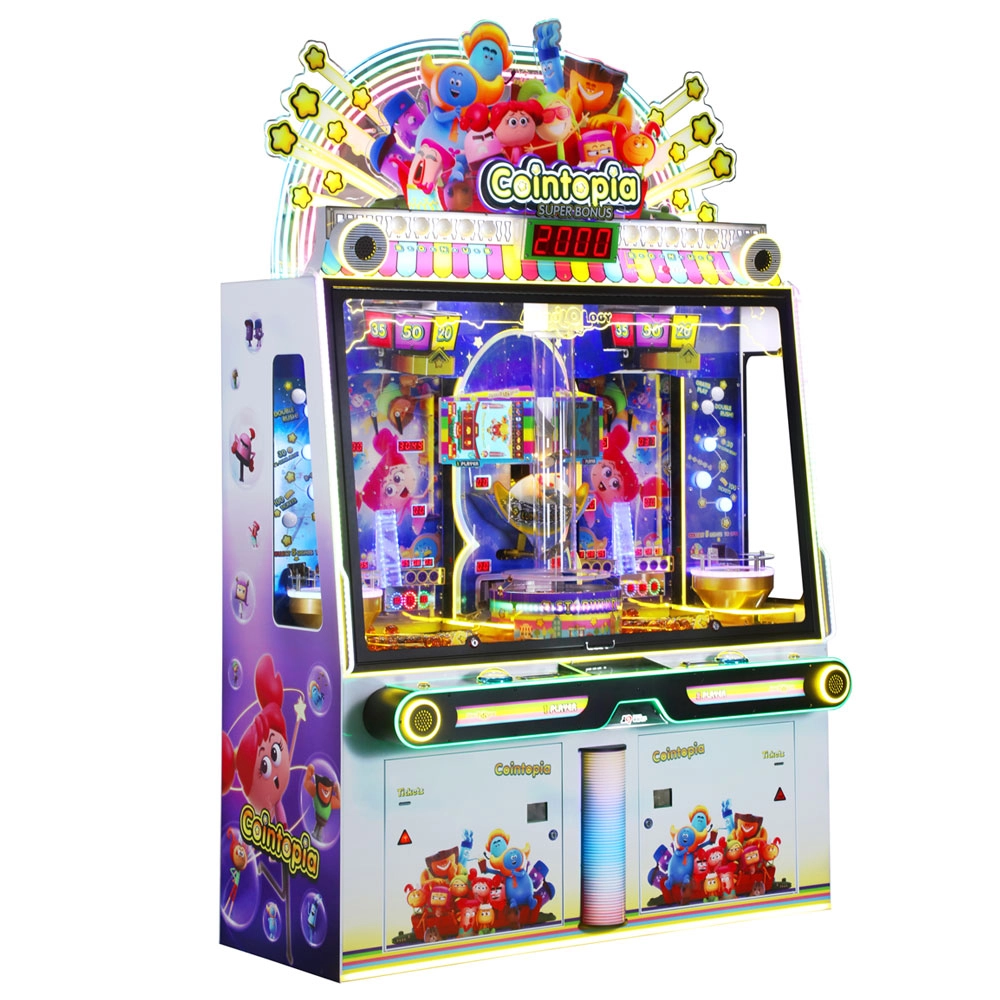
COINTOPIA, Have Fun Together With The Zodiac Buddies in an Utopia
COINTOPIA by PALM FUN is an exciting redemption game machine where players enjoy fun with zodiac buddies in a utopia setting. This ticket redemption machine offers engaging gameplay and rewarding experiences, perfect for family entertainment centers and arcades seeking top-quality redemption games.
Copyright © 2026 PALM FUN All Rights Reserved. | Privacy Policy • Terms and Conditions | Sitemap
palmfunarcade
Palm Fun Arcade Game
Whatsapp: +8618126837443
PalmFun Arcade
PalmFun_Arcade
PALM FUN Redemption Machine