








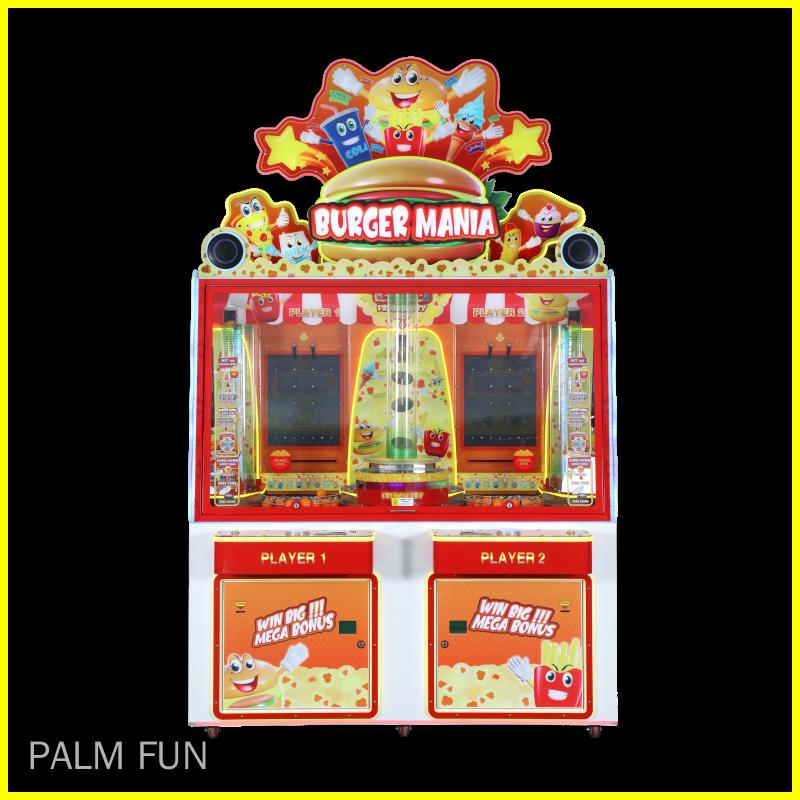
You cannot guarantee a win or legitimately manipulate a physical coin pusher machine. However, understanding the pusher cycle, coin placement, playfield pressure, side-return holes, prize position, and machine type can help you make better decisions during normal gameplay.
This guide explains fair strategies for physical arcade coin pusher machines. It does not cover mobile Coin Dozer apps, online casino games, software hacks, or methods involving tools, magnets, shaking, cabinet access, or machine tampering.
As a manufacturer of commercial coin pusher machines and redemption arcade equipment, PALM FUN works with mechanical playfields, moving pusher systems, coin-routing structures, ticket mechanisms, card-collection systems, and operator-configurable reward functions. These design elements explain why some playfield conditions are more favorable than others, although no strategy can turn a coin pusher into a guaranteed-win game.
Can You Really Cheat a Coin Pusher Machine?
The word “cheat” is often used loosely in online searches. Some players use it to mean finding a better strategy, while others are looking for ways to interfere with the machine. These are not the same thing.
Watching the pusher movement, selecting a promising lane, timing a normal coin drop, and deciding when to stop are ordinary gameplay decisions. Shaking the cabinet, inserting foreign objects, using magnets, blocking sensors, opening service doors, or exploiting a known malfunction are forms of tampering rather than strategy.
There is also no universal sequence of coin drops that guarantees a payout. A coin pusher is a physical system. The result is influenced by friction, coin overlap, the weight and position of prizes, the movement of the pusher plate, side-return openings, and the way each new coin lands on the existing layer.
A coin may appear to move several items forward while actually creating very little pressure near the payout edge. Conversely, one well-positioned coin can sometimes shift a supported section of the playfield. This unpredictability is part of the game’s appeal, but it also means that players should be cautious of anyone claiming to have a guaranteed hack.
Fair Strategy Is Not the Same as Machine Manipulation
Fair strategy stays within the normal controls and rules of the machine. The player observes the playfield, chooses where to place a coin, and decides whether the current opportunity justifies another play. Machine manipulation attempts to alter the cabinet, sensors, moving mechanism, coin path, or award system outside the intended gameplay.
Rules and consequences vary by venue and jurisdiction, but tampering may lead to removal from the venue, loss of prizes, liability for damage, or legal consequences. If a machine is visibly malfunctioning, stop playing and notify the venue operator rather than attempting to take advantage of the fault.
How a Physical Coin Pusher Machine Works
A typical coin pusher contains a coin entry point, one or more shelves, a moving pusher plate, a front payout edge, side-return openings, and a collection or ticket-award system. Modern commercial machines may add bonus wheels, card collection, lights, digital scoring, ticket payouts, or multiplayer functions.
When a player inserts a coin or token, it falls onto the playfield. The pusher plate moves forward and backward in a repeating cycle, applying pressure to the existing coin layer. Coins or prizes that move over the designated front edge may trigger a physical payout, ticket award, card award, or another reward, depending on the machine design.
The Pusher Plate Does Not Move Every Coin Equally
The pusher plate mainly transfers force into coins that are correctly positioned in front of it. A coin resting on top of an uneven pile may slide, rotate, or become trapped without transferring meaningful pressure toward the payout edge.
This is why a machine that looks completely full is not automatically the best choice. A crowded playfield can contain overlapping piles, gaps, raised coins, and areas where new coins repeatedly slide into side returns instead of advancing the main layer.
Side Holes and Return Areas Change the Real Payout Path
Many coin pushers have side openings or internal return paths. Coins that enter these areas may be collected by the machine instead of reaching the player payout tray. From the front, a side lane may appear full and attractive even though a large percentage of incoming coins are being redirected away from the reward edge.
Before playing, observe where previous coins travel. A lane that consistently sends coins toward the side may be less productive than a central lane with a continuous, well-supported layer.
Not Every Coin Pusher Uses the Same Reward System
Traditional machines may pay out coins or tokens directly. Ticket redemption machines convert successful drops into tickets or electronic points. Card-based machines place collectible cards on the playfield, while hybrid models combine shooting, bonus wheels, digital scoring, or progressive reward features with the mechanical pusher.
The most useful strategy depends on the machine type. A method that works reasonably well on a simple single-shelf machine may not apply to a card pusher, multiplayer model, or machine with multiple moving levels. For a wider overview of commercial machine types and mechanisms, review the Coin Pusher Arcade Machine Guide.
9 Fair Coin Pusher Tips That Can Improve Your Decisions
1. Observe One Complete Pusher Cycle
Do not insert the first coin immediately. Watch the plate complete at least one full forward-and-backward movement. This shows how fast the mechanism moves, where coins tend to settle, and whether the entry chute releases coins early, late, or near the center of the cycle.
The most useful moment is generally when a coin has enough time to land flat and become part of the moving layer before the next forward push. The exact timing varies because chute length, plate speed, and playfield design differ between machines.
2. Choose the Machine Before Choosing the Prize
A visible high-value prize can attract attention, but it should not be the only reason to choose a machine. First inspect the complete playfield.
Look for a continuous coin layer between the pusher plate and the front edge. Check whether coins move forward with each cycle or merely shift sideways. Notice whether the playfield has recently been cleared, whether large empty spaces exist, and whether most new coins disappear into unproductive areas.
A modest prize on a stable, active lane may be more realistic than a larger prize positioned above a loose or unsupported coin pile.
3. Check Whether the Prize Is Actually Ready to Fall
A prize hanging over the front edge may still be held securely by coins behind it. The front view can make an item look closer to falling than it really is.
Watch the prize during several pusher cycles. A favorable target normally shows repeated forward movement, rocking, tilting, or a gradually changing support point. If it remains completely stable while surrounding coins move, the back or underside may still be strongly supported.
Do not assume that a prize is nearly won simply because part of it extends beyond the visible edge.
4. Aim for a Productive Lane
Choose one lane where coins are already transferring pressure toward the payout edge. Constantly switching between the far left, center, and far right spreads your coins across unrelated sections of the playfield.
Repeated placement in one productive area can build pressure more consistently. However, continuing to use the same lane is only sensible while the coins and target continue to move. If progress stops, reassess the playfield instead of automatically adding more coins.
5. Try to Make the Coin Land Flat
A flat coin usually contributes more effectively to the moving layer than a coin that lands vertically, leans against another coin, or becomes trapped on top of a pile.
You cannot fully control how every coin lands, but a consistent release can reduce unnecessary variation. Avoid rapid, uncontrolled drops that cause several coins to collide in the chute or stack on top of one another.
6. Watch the Side-Return Openings
Before concentrating on an edge lane, determine whether the machine has visible or concealed side returns. Observe what happens to coins near those areas during several cycles.
If coins repeatedly move toward the side instead of the front payout edge, that lane may absorb a large portion of your plays without creating useful pressure. A central lane is not always better, but it is often easier to evaluate because its path toward the front edge is more visible.
7. Do Not Confuse a Full Playfield with an Easy Win
A full playfield can be promising when the coins form a level, connected layer. It can also be unproductive when the surface consists of tall stacks, isolated piles, gaps, and coins resting at steep angles.
Look for movement rather than volume. If several pusher cycles create visible forward progress, the layer is transferring force. If the same coins repeatedly rise, settle, and move sideways without advancing, the apparent fullness may be misleading.
8. Understand Bonus and Card Mechanics
Some machines include collectible cards, bonus tokens, multipliers, rotating wheels, jackpot indicators, or special trigger zones. These features can affect the value of a successful drop, but they do not necessarily make the underlying mechanical playfield easier.
Read the instructions displayed on the machine. Confirm which items trigger tickets, cards, bonuses, or direct rewards. Do not assume that every visible token or card has the same value or that a nearly completed collection guarantees an immediate award.
9. Set a Budget and a Stop Rule Before Playing
Patience should not mean continuing indefinitely. Decide how many credits or coins you are prepared to use before starting.
A practical stop rule may include leaving when:
- The target has not moved after several complete cycles
- Most new coins are entering a side-return area
- The useful coin layer has broken into separate piles
- The target has shifted into a less favorable position
- You have reached your predetermined spending limit
Previous spending does not make the next coin more likely to produce a reward. Treat each additional play as a new decision rather than an attempt to recover what has already been spent.
Common Coin Pusher Myths and Prohibited Practices
Myth: Rapid Coin Drops Always Create a Bigger Cascade
Dropping several coins quickly can sometimes add pressure, but it can also cause coins to collide, overlap, or settle on top of the layer. The result depends on the chute, pusher timing, and playfield condition. A fast sequence is not automatically more effective than controlled placement.
Myth: A Prize Hanging Over the Edge Must Fall Soon
The visible front of the prize shows only part of its support. Cards, tokens, and merchandise can remain trapped by coins behind or beneath them for many cycles. Movement is a more useful signal than appearance alone.
Myth: Every Coin Added Brings You Closer to a Guaranteed Win
Coin pushers do not normally work like a fixed progress meter. New coins can move sideways, fall into returns, stack vertically, or change the pressure pattern. Additional play may improve the position, leave it unchanged, or even make a target less accessible.
Myth: All Coin Pusher Machines Behave the Same Way
Machines differ in shelf angle, plate travel, coin entry position, side returns, prize type, ticket logic, bonus features, and number of levels. Strategy should be based on the specific machine in front of you rather than a universal online formula.
Practices That Count as Tampering
Fair gameplay does not include interfering with the cabinet or its internal systems. Prohibited practices commonly include:
- Shaking, lifting, striking, or tilting the machine
- Using magnets, wires, tools, strings, or other foreign objects
- Blocking coin paths, payout openings, or sensors
- Opening access panels or service doors without authorization
- Interfering with the pusher plate or moving mechanism
- Using counterfeit coins, modified tokens, or unauthorized payment methods
- Exploiting a known malfunction instead of reporting it
- Attempting to alter software, card data, ticket values, or reward settings
If a machine fails to award a legitimate prize or credit, record the machine number and ask the venue staff for assistance. Do not reach into the cabinet or attempt to repair the problem yourself.
Responsible Play Matters More Than a “Winning System”
Coin pushers are entertainment machines, not reliable ways to make money. The value of a prize may be lower than the total amount spent trying to obtain it, and no fair strategy eliminates that risk.
Set a spending limit, take breaks, and stop when the game is no longer enjoyable. Avoid chasing losses or treating a near miss as proof that the next play must succeed.
Conclusion
There is no legitimate hack that guarantees success on a physical coin pusher machine. Better gameplay comes from understanding how the pusher plate transfers force, identifying productive lanes, watching side-return openings, evaluating whether a prize is genuinely moving, and controlling how much you are willing to spend.
The smartest approach is not to manipulate the machine. It is to observe before playing, use consistent coin placement, focus only on areas showing measurable progress, and leave when the playfield is no longer favorable.
PALM FUN designs and manufactures commercial coin pusher and redemption arcade machines for FEC operators, arcade venues, distributors, and OEM/ODM customers. Buyers evaluating equipment for a commercial venue can explore PALM FUN’s redemption arcade machine range or request model-specific gameplay and configuration information.


palmfunarcade
Palm Fun Arcade Game
Whatsapp: +8618126837443
PalmFun Arcade
PalmFun_Arcade
PALM FUN Redemption Machine