







OEM/ODM arcade shooting games for sale Manufacturers and Suppliers
- How Custom Manufacturing Is Reshaping the Arcade Supply Chain
- Define the product and the operating environment first
- Look beyond the unit price
- Choose the Right OEM or ODM Model
- OEM is suited to buyer-led product specifications
- ODM can shorten development, but define what is customizable
- Negotiate MOQ, sampling, and production timing as a package
- Verify Quality, Compliance, and IP Before You Place an Order
- Assess the quality system and product-level controls
- Protect designs, software, and commercial information
- Build a supplier scorecard and a workable contract
- Frequently Asked Questions
For buyers sourcing arcade shooting games for sale, the right OEM/ODM partner can turn a product concept into a commercially viable cabinet while helping manage quality, compliance, intellectual property, and order-volume risks. Before committing, compare OEM and ODM responsibilities, request evidence of production and testing controls, define ownership of designs and software in writing, and confirm MOQ, sample, warranty, and delivery terms. A disciplined supplier-vetting process makes it easier to select a manufacturer whose capabilities match your market, budget, and launch schedule.
How Custom Manufacturing Is Reshaping the Arcade Supply Chain
Define the product and the operating environment first
Arcade shooting products can range from a compact single-player cabinet to a linked, motion-enabled attraction with large displays, specialized controls, and custom artwork. Buyers should identify the intended venue and use before requesting quotations: family entertainment center, arcade, cinema, resort, or location-based entertainment operator. The operating environment affects cabinet dimensions, expected daily use, service access, payment integration, sound limits, and the durability needed for high-traffic play.
Prepare a requirements brief that separates essential specifications from optional features. Include player count, screen size and resolution, gun or controller type, game modes, cabinet footprint, power input, network needs, language support, branding, and target retail or operator price. If you are sourcing arcade shooting games for sale across multiple countries, identify destination markets early because plugs, electrical requirements, labeling, and documentation may differ. A clear brief reduces quotation ambiguity and gives manufacturers a consistent basis for costing and engineering review.
Look beyond the unit price
A factory quotation is only one part of the landed-cost picture. Compare tooling or customization charges, sample fees, packaging, spare parts, freight assumptions, import duties, installation, and after-sales support. Ask whether the offer is based on a finished cabinet, a partially assembled product, or a kit that requires local integration. Clarify the Incoterm and named place in the quotation rather than relying on a general phrase such as door-to-door, since responsibilities and risk transfer depend on the agreed trade term.
For arcade shooting games for sale, lifecycle costs can matter as much as the initial purchase price. A low-cost control assembly may need frequent replacement under intensive operation, while a modular design can make field repairs faster. Request the expected service life or replacement interval for wear parts where the supplier has reliable test or field data. Treat estimates as supplier claims until supported by defined test conditions, records, or references from comparable installations.
Choose the Right OEM or ODM Model
OEM is suited to buyer-led product specifications
In an OEM arrangement, the buyer generally provides the design, key specifications, or approved product definition and contracts a manufacturer to produce to those requirements. The exact division of engineering work varies by project, so the agreement should state who supplies drawings, bills of materials, software, artwork, and test criteria. OEM can be appropriate when a brand already controls a game concept or cabinet design and needs a production partner to build it consistently.
Before selecting an OEM supplier for arcade shooting games for sale, confirm its ability to work from controlled revisions. Ask how engineering changes are submitted, approved, recorded, and reflected in production documents. A change to a display, power supply, controller, or enclosure material can affect fit, safety, reliability, or certification status. Require written approval before substitutions, especially for parts that influence performance or regulatory compliance.
ODM can shorten development, but define what is customizable
With ODM, a supplier offers an existing design or platform that can be adapted for a buyer. Adaptations may include exterior graphics, cabinet colors, language, payment interfaces, selected hardware, or a game configuration. This model may reduce development work compared with a fully new design, but it does not automatically mean the product is exclusive or that the buyer owns the underlying platform. Ask what is standard, what can be changed, and whether those changes require engineering charges, new tooling, or minimum production quantities.
Use a written feature matrix when comparing arcade shooting games for sale from different factories. Record each feature as standard, configurable, custom-engineered, or unavailable, and ask the supplier to identify dependencies. For example, a regional payment reader may require a different control board or software integration. Obtain a quotation that separates nonrecurring engineering and tooling charges from per-unit pricing so the commercial impact of customization is visible.
| Decision area | OEM approach | ODM approach | Buyer action |
|---|---|---|---|
| Starting point | Buyer-defined design or specification | Supplier’s existing platform or design | Confirm which party controls the baseline design |
| Customization | Can be extensive, subject to engineering capability | Usually limited to agreed platform options | List approved changes and acceptance criteria |
| Development effort | Often higher if the buyer supplies an incomplete concept | May be lower when the existing platform meets requirements | Request a development schedule with review gates |
| IP and exclusivity | Depends on ownership of buyer-supplied and factory-developed work | Existing platform may remain supplier-owned | Define licenses, ownership, territory, and exclusivity in writing |
| MOQ and cost | May reflect custom parts, tooling, and production setup | May depend on platform and branding changes | Request price breaks and MOQ assumptions by configuration |
Negotiate MOQ, sampling, and production timing as a package
There is no universal MOQ for arcade cabinets. The quantity depends on the degree of customization, the availability of standard components, packaging requirements, and the factory’s production setup. Ask the supplier to quote a pilot quantity and at least two larger quantity tiers. If the MOQ is driven by a custom component or printed packaging, explore whether the component can be shared across configurations or whether a first order can use standard parts while demand is validated.
Agree on a sample plan before mass production. A functional prototype can validate usability and feature integration, while a preproduction sample made with intended production parts and processes can reveal fit, finish, packaging, and serviceability issues. Define who pays for samples, how revisions are handled, what constitutes approval, and whether the approved sample is retained as a reference. For arcade shooting games for sale, production should not begin on the assumption that a verbal approval covers unresolved differences in software, artwork, or hardware.
Verify Quality, Compliance, and IP Before You Place an Order
Assess the quality system and product-level controls
Request evidence of the manufacturer’s quality-management practices, such as documented incoming inspection, controlled assembly instructions, in-process checks, final functional testing, and nonconformance handling. An ISO 9001 certificate can be useful evidence of a quality-management system, but it is not a product certification and does not by itself prove that a specific cabinet meets your requirements. Check the issuing body, certificate scope, validity, and whether the named manufacturing site is the facility making your order. The ISO overview of quality management systems explains the standard’s role.
Ask for a product-specific inspection and test plan. It should identify what is checked, how it is checked, the acceptance criteria, and who records the results. Useful checks may include cabinet dimensions and finish, secure mounting, control response, display operation, audio, software version, network functions, payment interface, and packaging condition. For reliability, request the test duration and operating conditions rather than accepting an unsupported claim that a product is fully tested.
Electrical and product-safety obligations depend on the product design and destination market. Have a qualified compliance professional determine applicable standards and regulations for the actual configuration; do not assume one certificate covers every market or later design change. IEC 62368-1 addresses safety requirements for certain audio/video and information and communication technology equipment, but its applicability to a particular arcade product must be assessed. Review the relevant IEC standards information and confirm required test reports, declarations, labels, and technical files before shipment.
Protect designs, software, and commercial information
IP protection starts with clear ownership language, not simply a request for confidentiality. Identify buyer-provided artwork, branding, game content, drawings, and software separately from supplier background technology, standard cabinet designs, and newly developed work. The contract should specify ownership or license rights, permitted use, territory, duration, restrictions on reuse, and access to source files where relevant. If a project includes third-party game content, music, characters, or software, confirm that the necessary commercial rights are secured for the intended markets.
Use a nondisclosure agreement before sharing sensitive files, but do not treat it as a substitute for a manufacturing agreement with detailed IP terms. Limit access to confidential materials to personnel who need them, use version-controlled file transfers, and mark restricted drawings and artwork. Where the commercial stakes justify it, consult counsel about local registrations and enforceability in the supplier’s jurisdiction. The WIPO guidance for businesses on intellectual property provides a starting point for understanding IP management.
For arcade shooting games for sale, also agree how the supplier will handle excess units, rejected goods, samples, tooling, and production overruns. State whether surplus branded packaging or components must be destroyed, returned, or held under your control. Define whether the supplier may sell the same platform to other customers and distinguish platform reuse from use of your protected artwork, name, software, or exclusive features. Clear rules reduce the chance of later disputes about what was actually made exclusive.
Build a supplier scorecard and a workable contract
Before issuing a purchase order, evaluate the factory using consistent evidence rather than presentation quality alone. Review legal entity and site details, relevant production experience, engineering resources, subcontracting practices, references where available, quality records, sample performance, communication responsiveness, and service-part availability. Ask whether assembly or testing is subcontracted and how those processes are controlled. If an audit is not practical, request a live factory walkthrough and records tied to the actual production site, while recognizing that remote review has limits.
The manufacturing contract and purchase order should align on specification revision, approved sample, inspection rights, acceptance and defect handling, change control, packaging, delivery schedule, Incoterm, payment milestones, warranty scope, spare parts, and remedies for late or nonconforming goods. Define a process for corrective action that requires the supplier to investigate root cause and document containment and prevention, not merely replace a failed part. For arcade shooting games for sale, include software version control and a method for identifying each unit or batch so field issues can be traced.
Finally, plan for support after shipment. Confirm response times, remote troubleshooting availability, parts pricing and availability, manuals, wiring diagrams, and the process for warranty claims. Establish who pays freight for replacement parts and how the parties handle recurring failures. A supplier that provides clear documentation and timely technical support can reduce downtime for operators, but verify those commitments in writing and test the communication process during sampling or pilot production.
Contact our team to discuss OEM/ODM requirements for arcade shooting games for sale and request a project-specific sourcing conversation.
Frequently Asked Questions
What is the difference between OEM and ODM for arcade shooting games?
With OEM, the buyer generally supplies or controls the design and specifications while the manufacturer produces to those requirements. With ODM, the supplier offers an existing design or platform that can be adapted. The agreement should define ownership, licenses, customization, and permitted reuse in either model.
What MOQ should I expect when ordering custom arcade shooting cabinets?
There is no universal MOQ. It depends on customization, component availability, packaging, and production setup. Ask for a pilot quantity and multiple volume price tiers, and identify whether custom parts or packaging are driving the minimum.
How can I check whether an arcade game manufacturer has reliable quality controls?
Request evidence of the quality-management practices at the actual production site, including incoming inspection, controlled assembly instructions, in-process checks, final functional testing, and nonconformance handling. Review any ISO 9001 certificate for its scope and validity, and ask for a product-specific inspection and test plan with defined acceptance criteria.
How do I protect my game design and branding when working with an ODM supplier?
Use confidentiality protections and a manufacturing agreement that distinguishes buyer-provided IP from supplier background technology and newly developed work. Define ownership or license rights, permitted use, territory, exclusivity, access to files, and treatment of surplus units, tooling, and branded materials.
What compliance documents should I request before importing arcade shooting games?
Requirements depend on the product configuration and destination market. Ask a qualified compliance professional to identify applicable rules, standards, test reports, declarations, labels, and technical files for the actual product, and verify that any evidence applies to the production configuration being ordered.
What should be included in a manufacturing contract for arcade cabinets?
Align the contract and purchase order on specification revision, approved sample, inspection and acceptance, defect handling, change control, packaging, delivery terms, payment, warranty, spare parts, software version control, traceability, and remedies for late or nonconforming goods.
Recommended for you
The latest trends for coin pusher arcade game parts and repairs | PALM FUN Ultimate Insights
Buyer’s Guide: FUN Arcade Ticket Dispenser Machines for Venues
How to start the coin pusher machine suppliers for arcades business ?
The Top Classic Arcade Game Manufacturers You Need to Know
FAQs
What is the character of mechanical redemption machine?
How to choose the exchange gifts of the tickets(reward points)?
2. Gifts should be diverse. This refers to the variety of items available, providing players with more choices. Everyone's preferences are different, especially adults who have higher expectations for gifts. The venue should strive to meet the diverse needs of these players.
3. Gifts should be fashionable. The younger generation that follows trends is very interested in the hottest items of the moment. If the venue can keep up with the latest trends, it can attract the majority of consumers.
4. Gifts should be innovative. Especially during holidays and seasons, it's a good idea to try out new approaches, creating a competitive advantage with unique offerings. For example, the current trend of combining pop culture and blind box culture.
How to guide the players to recognize tickets at the beginning setup of the redemption machines?
Never assume that your players already understand the purpose of lottery tickets(reward points). Even in venues that have been in operation for many years, it is still discovered during on-site interviews with players that many of them are not aware. Don't believe it? Just ask consumers at the venue. The machines, redemption counters, materials hung above the venue, and announcements by staff, among others, can all be channels for informing players about the purpose of lottery tickets(reward points). It is essential to do more promotion, create large displays and large cards, and clearly communicate the purpose of lottery tickets(reward points) to the players.
Why redemption ticket machines are popular?
2.Redemption machines are becoming the most important breakthrough to enhance the sustainable operation of indoor arcade game halls.
3.Players are of all ages and they continue to expand.
How to perform daily maintenance and servicing on redemption machines?
1. New machine entry performance, as it is relatively unstable in operation at this stage, requires dedicated supervision, timely follow-up, and improvements.
2. Redemption machines are relatively prone to collecting dust, which can lead to mechanical wear and corrosion. Dust can also cause issues with circuit boards, such as conductivity and optical sensor malfunctions. Thus, both internal and external cleanliness of redemption machines are equally important. Regular cleaning schedules for internal and daily cleaning for external components should be established.
3. Timely inspect the quality and durability of certain components. If issues are detected with imaging equipment, for example, replacements are necessary. A thorough understanding and mastery of the machine's performance can help extend its lifespan and ensure normal usage rates. Critical inspection areas include vulnerable parts such as motors, drive belts, gears of ticket dispensers, and sensors.
4. Frequent changes in prize point settings and payout rates are discouraged. Improvements in winning odds should be pursued through other methods and approaches.
5. All machines should have procedures for ticket removal and shredding to protect the ticket dispensers from damage.
6. Monitor changes in payout rates closely, as it directly impacts the cost control of the entire redemption machine system.
7. When employees add tickets, they should verify if the ticket sensors are unobstructed (blocked sensors can prevent ticket dispensing).
8. Have the protective paper on redemption machine's adhesive tape been removed? (Leaving it on can obstruct the ticket slot and ticket dispenser).
9. Responsible personnel should periodically and discreetly check the addition of tickets inside the redemption machines, ensuring that the added tickets match the registered ones.
You may also like
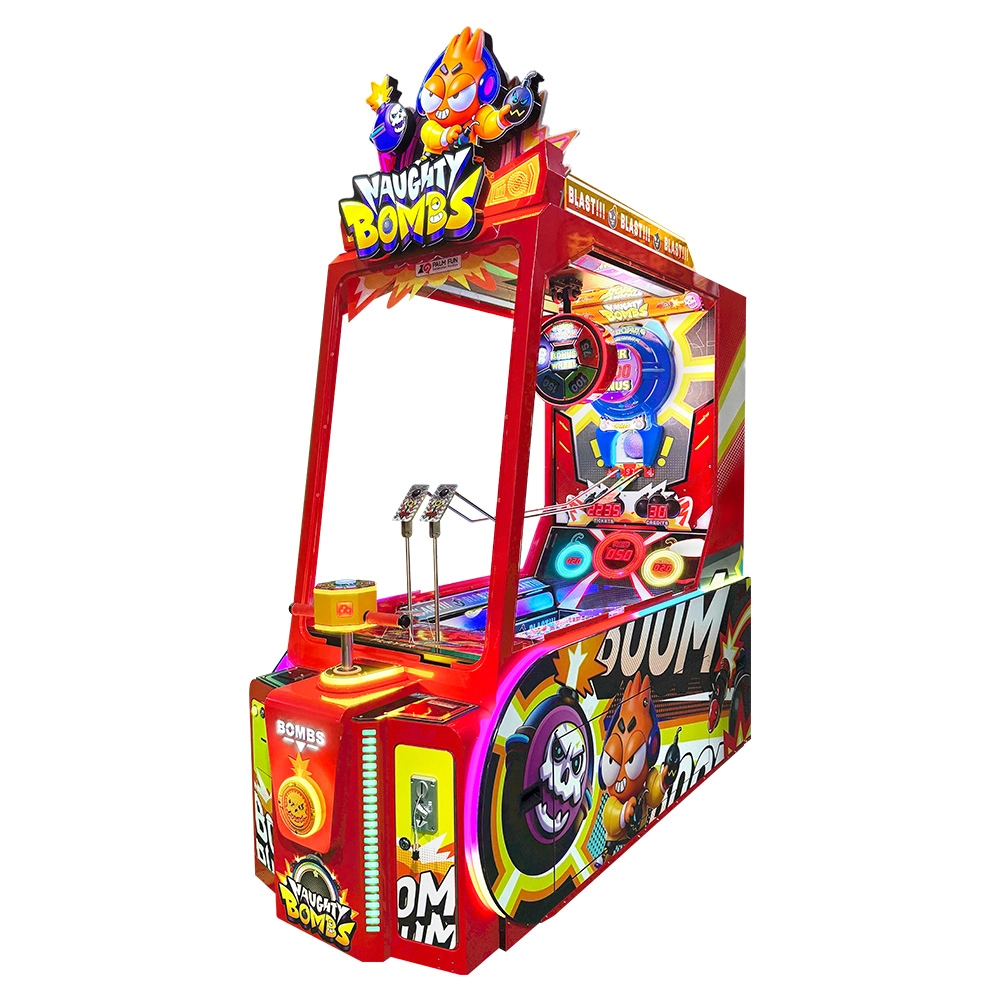
Naughty Bombs Ball Drop Redemption Arcade Game Machine
Naughty Bombs is a ball-drop redemption arcade game featuring rolling-ball gameplay, colored targets, ticket prizes, surprise bonus rewards, lighting and sound effects. Players use timing to launch and drop balls toward colored target areas. The product is presented for arcade, family entertainment center and other entertainment-venue projects, with customizable 110V / 220V AC voltage configuration.
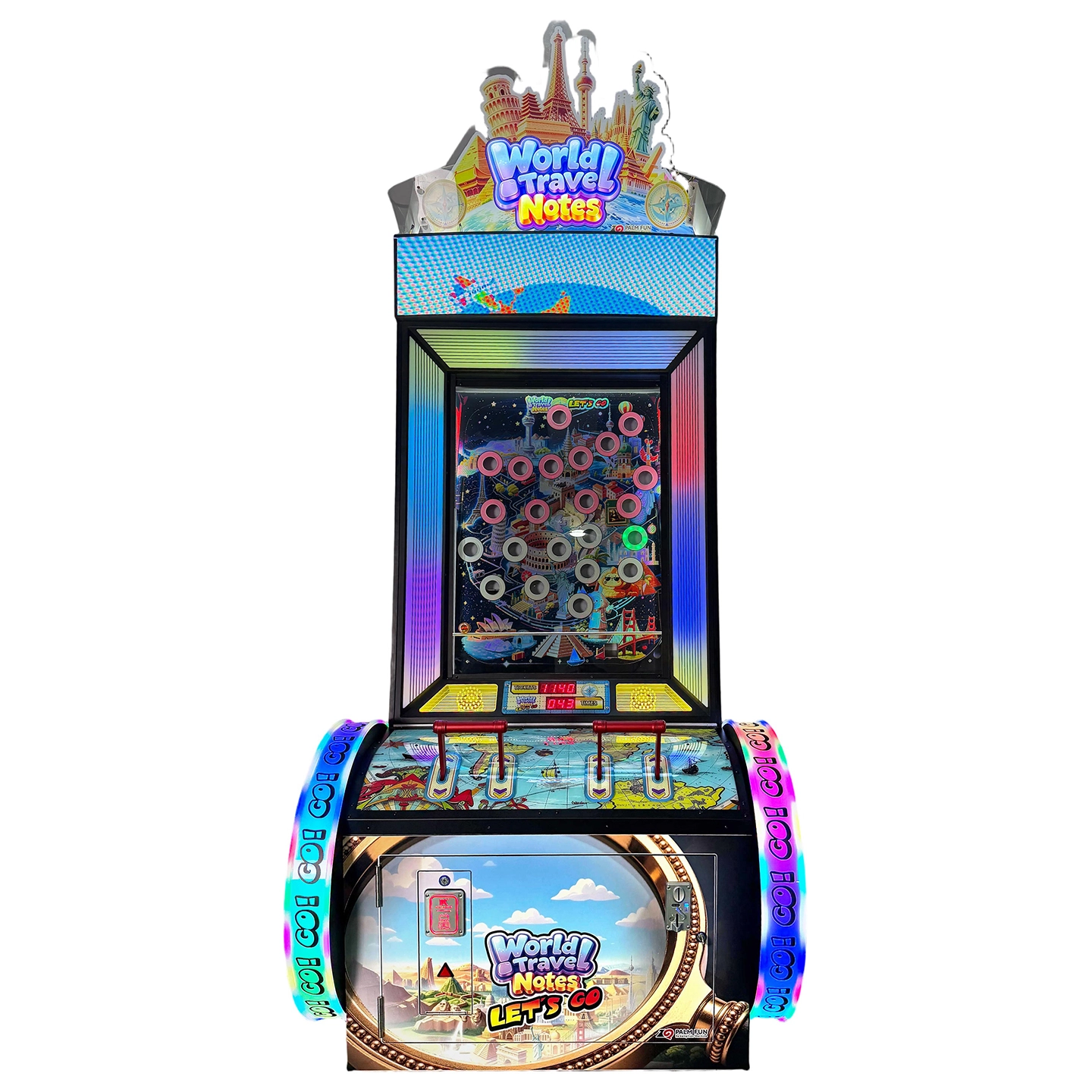
World Travel Notes – Balance Ball Redemption Arcade Game
World Travel Notes is a skill-based balance ball redemption game with a fun world-travel theme. Players use two handles to control the balance bar and guide the ball into each target hole. As the game progresses, the targets become more challenging, leading players toward the final grand prize. With colorful world-travel graphics, dynamic RGB lighting, a live score display, and progressive difficulty, World Travel Notes is designed to attract attention and encourage repeat play in arcades, FECs, shopping malls, and other entertainment venues.
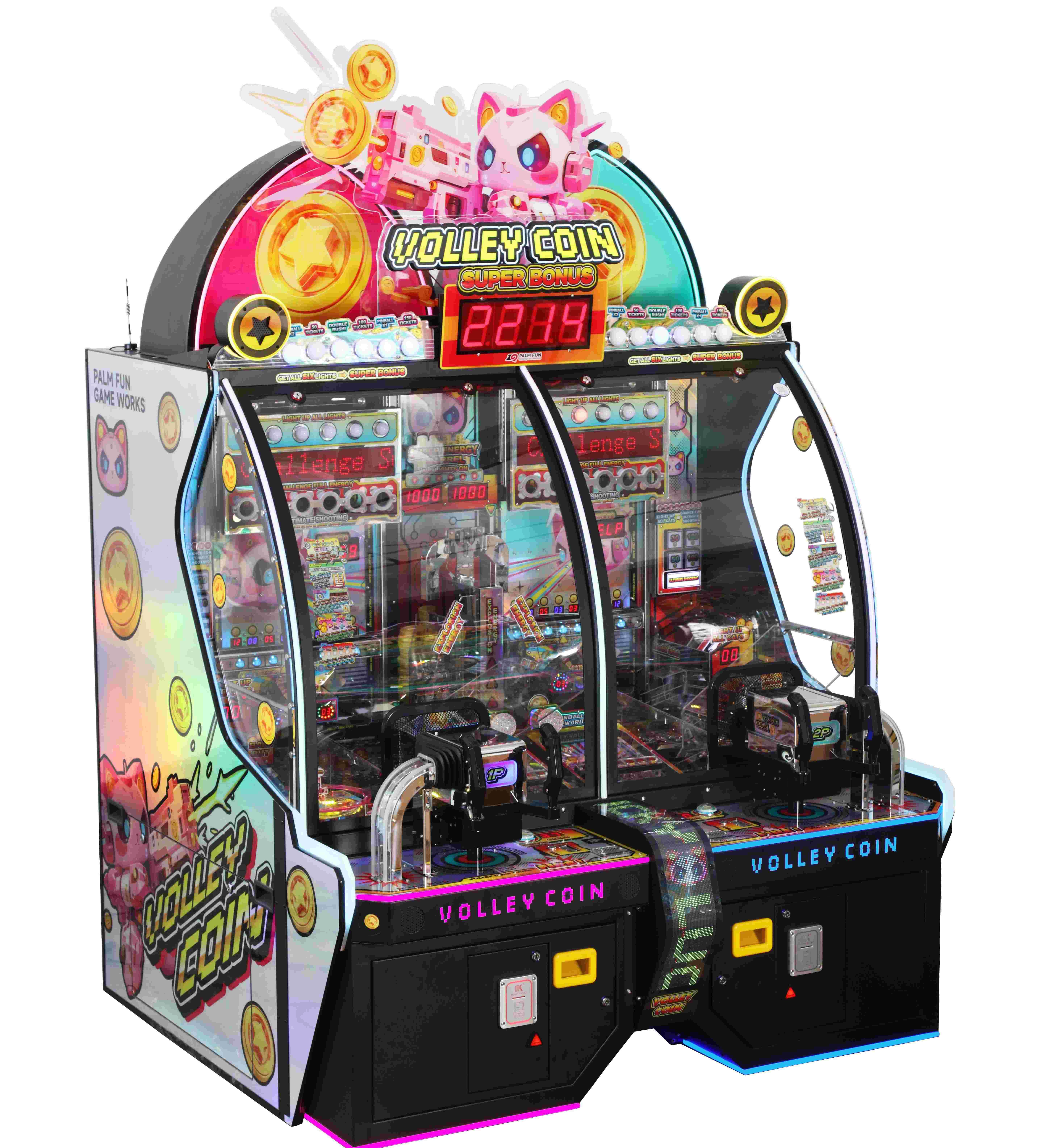
Hybrid Shooting & Pushing | Coin Pusher Arcade Ticket Redemption Machine
Volley Coin is an innovative arcade ticket redemption machine developed by Palm Fun Electronics. Combining the excitement of a fast-paced token shooter game with the proven earning power of a traditional coin pusher machine, Volley Coin offers a fresh and engaging gameplay experience that appeals to players of all ages.
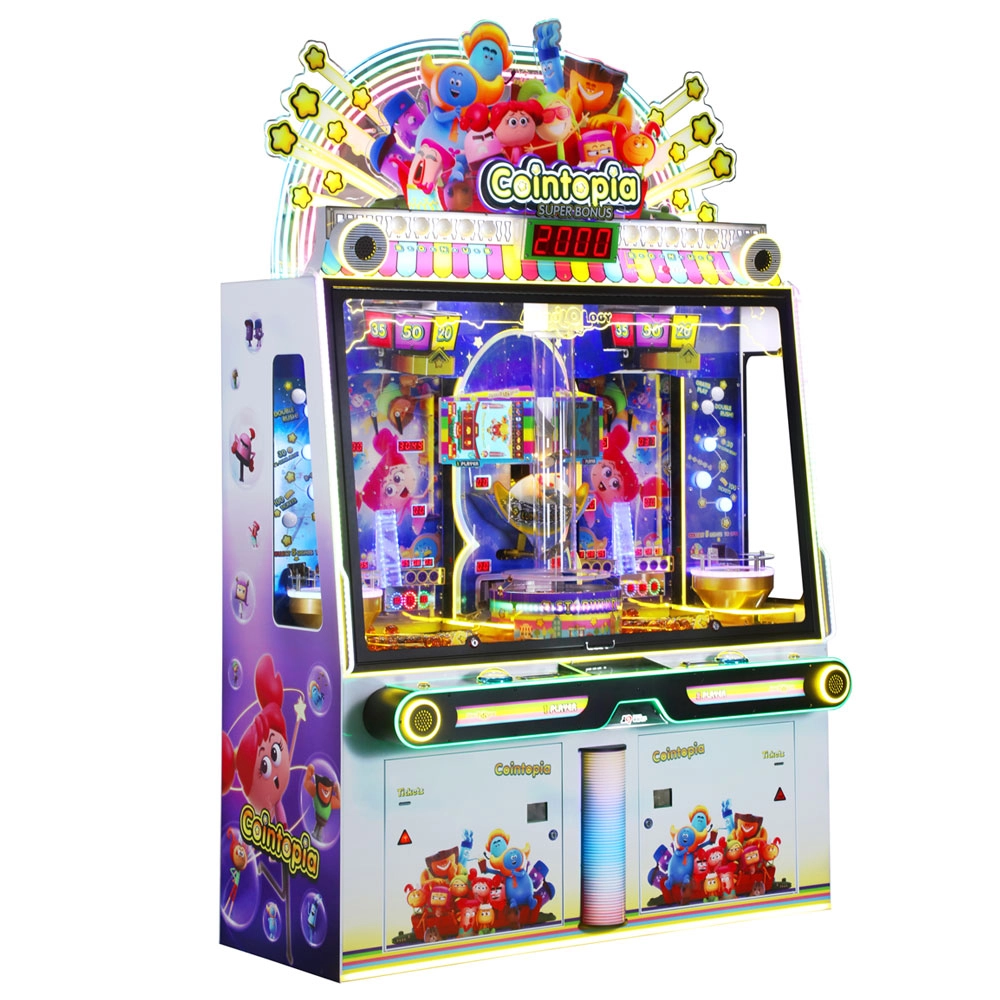
COINTOPIA, Have Fun Together With The Zodiac Buddies in an Utopia
COINTOPIA by PALM FUN is an exciting redemption game machine where players enjoy fun with zodiac buddies in a utopia setting. This ticket redemption machine offers engaging gameplay and rewarding experiences, perfect for family entertainment centers and arcades seeking top-quality redemption games.
Copyright © 2026 PALM FUN All Rights Reserved. | Privacy Policy • Terms and Conditions | Sitemap
palmfunarcade
Palm Fun Arcade Game
Whatsapp: +8618126837443
PalmFun Arcade
PalmFun_Arcade
PALM FUN Redemption Machine