


Avoiding common supply risks in redemption arcade ball game orders
- Where Redemption Game Supply Chains Commonly Break Down
- Ambiguous specifications create avoidable disputes
- Low purchase price can conceal total-cost exposure
- Practical Controls for Quality, Compliance, and Delivery
- Use staged validation instead of one final inspection
- Verify electrical and material responsibilities by destination market
- Control packaging and shipment milestones
- Building a More Resilient Procurement Plan
- Qualify the supplier before negotiating volume
- Make after-sales support part of the purchase order
- Connect acceptance criteria to operating performance
- How PALM FUN Supports Lower-Risk Arcade Equipment Projects
- Integrated product development and manufacturing capabilities
- Product range designed for commercial deployment
- Global reach and partnership-focused support
- Frequently Asked Questions
Redemption arcade ball game orders involve more than selecting an attractive cabinet and agreeing on a unit price. Project owners must control a chain of risks covering game specifications, mechanical durability, electrical safety, software behavior, packaging, customs documentation, delivery timing, installation, spare parts, and long-term service. A reliable procurement process converts the buyer’s commercial goals into measurable technical requirements, validates the machine before mass production, and establishes inspection points from component sourcing through final shipment. For operators building a family entertainment center, distributor networks, or a compact pinball arcade, the same principle applies: supply reliability directly affects launch dates, uptime, customer satisfaction, and return on investment.
Where Redemption Game Supply Chains Commonly Break Down
Ambiguous specifications create avoidable disputes
The first risk usually appears before the purchase order is signed. Terms such as “high quality,” “commercial grade,” “fast delivery,” or “custom design” are not sufficient acceptance criteria. A buyer should document cabinet dimensions, operating voltage and frequency, play duration, ball size and material, ticket or prize logic, display type, sound level, coin or card-reader configuration, environmental conditions, language requirements, branding locations, and expected daily utilization.
Mechanical details deserve equal attention. The specification should identify the structure of the ball path, target or scoring mechanism, access doors, lock type, hinges, wheel or motor ratings, sensor positions, emergency isolation method, and replaceable wear components. If a supplier interprets these requirements differently, a seemingly minor variation can change maintenance frequency or player experience. Drawings, photographs, electrical schematics, a bill of materials, and a signed approval sample provide stronger protection than informal messages.
Low purchase price can conceal total-cost exposure
A low unit quotation may exclude molds, artwork preparation, certification testing, software changes, export crating, installation guidance, replacement parts, or payment processing fees. It may also be based on a lighter cabinet, lower-duty motor, less durable switch, or generic power supply. Buyers should compare total landed cost rather than factory price alone. The calculation should include freight, duties, local compliance work, commissioning labor, expected consumables, warranty freight, and the financial impact of downtime.
Commercial operators should also model revenue assumptions. A redemption game machine that attracts players but requires frequent service can produce less profit than a higher-priced unit with stable uptime. Useful procurement metrics include expected plays per day, average play price, prize or ticket cost, maintenance minutes per operating week, spare-part lead time, and payback period. These metrics make it easier to evaluate competing offers on business value rather than visual appeal.
Practical Controls for Quality, Compliance, and Delivery
Use staged validation instead of one final inspection
Pre-production approval should confirm the cabinet appearance, artwork, control layout, game rules, sound effects, lighting, scoring, ticket output, and operator settings. During production, quality checkpoints should cover incoming components, welded or assembled frames, wiring, fasteners, moving mechanisms, displays, sensors, and final gameplay. A factory acceptance test should run multiple cycles under realistic operating conditions rather than relying only on a power-on demonstration.
Inspection records should identify the model, serial number, test date, inspector, measured result, and disposition of any defect. Photographs or videos can support remote approval, but they should supplement—not replace—an agreed inspection checklist. For larger orders, an independent inspection company may verify quantity, dimensions, appearance, function, packaging, and documentation before balance payment or release.
Verify electrical and material responsibilities by destination market
Compliance requirements vary by destination, product configuration, and local authority. Buyers should specify which party is responsible for testing, declarations, labels, technical files, and updates when a component changes. The ISO 9001 quality management standard provides a recognized framework for controlled processes, but certification alone does not prove that every delivered machine meets a buyer’s specific requirements.
Electrical design should be reviewed against applicable national rules and relevant equipment standards. The International Electrotechnical Commission standards portal is a useful starting point for identifying applicable electrical and electronic safety standards. Depending on the market, buyers may also need requirements related to electromagnetic compatibility, restricted substances, radio equipment, plugs, grounding, energy labeling, or fire safety. In the United States, the U.S. Consumer Product Safety Commission business guidance can help companies understand product safety responsibilities. Documentation should be reviewed before production, not requested only when goods are already at the port.
Control packaging and shipment milestones
Arcade cabinets are vulnerable to vibration, impact, moisture, abrasion, and forklift damage. The packaging plan should define internal bracing, corner protection, surface film, shock-sensitive components, moisture barriers, pallet dimensions, stacking limits, and crate markings. A supplier should provide packing photographs and confirm that doors, screens, protruding controls, and transparent panels are immobilized for transit.
A dependable delivery schedule includes more than an estimated shipping date. It should show purchase-order confirmation, artwork approval, prototype completion, production start, inspection, packing, booking, port cut-off, document release, and expected arrival. The contract should state what happens when a milestone is missed, how engineering changes are approved, and whether partial shipment is permitted. Buyers should keep a buffer for customs clearance, local transport, and venue installation because launch schedules rarely tolerate a single-point delay.
| Risk area | Weak control | Stronger buyer control | Evidence to request |
|---|---|---|---|
| Specification | Verbal description and catalog image | Signed technical file and approved artwork | Drawings, BOM, wiring diagram, acceptance criteria |
| Quality | Final visual check only | Incoming, in-process, and functional inspections | Inspection reports, test videos, defect records |
| Compliance | Unverified certificate claims | Destination-specific responsibility matrix | Declarations, test reports, labels, technical documents |
| Packaging | Standard carton with no transit analysis | Cabinet-specific protection and loading plan | Packing photos, crate specification, shipping marks |
| After-sales | General warranty promise | Defined response times and spare-parts list | Service procedure, parts prices, troubleshooting guide |
Building a More Resilient Procurement Plan
Qualify the supplier before negotiating volume
Supplier qualification should examine manufacturing capability, engineering resources, quality systems, export experience, product range, production capacity, and financial or operational continuity. A website and product catalog are useful initial references, but buyers should request factory photographs, process descriptions, sample documentation, customer references where available, and a clear explanation of who controls design changes.
For distributors, product-line compatibility matters. A supplier that can provide a coin pusher machine, ball-drop cabinet, ticket redemption unit, and complementary arcade games machines may simplify spare-parts management, training, branding, and shipping coordination. However, product breadth should never replace model-specific verification. Each machine still requires its own drawings, test procedure, maintenance schedule, and compliance review.
Make after-sales support part of the purchase order
Service risk is often underestimated because it appears after delivery. The order should define warranty duration, covered parts, exclusions, response time, remote diagnostic support, replacement procedure, and responsibility for freight. A practical spare-parts package may include sensors, motors, switches, fuses, power supplies, belts, locks, control boards, lighting modules, ticket dispensers, and commonly damaged cosmetic parts.
Technical training should cover safe isolation, cabinet access, sensor calibration, cleaning, jam removal, ticket configuration, software settings, and fault-code interpretation. A multilingual service manual with labeled photographs can reduce dependence on emergency calls. Buyers should also confirm whether firmware or configuration files are supplied, how backups are retained, and whether future updates can affect payout logic or operator settings.
Connect acceptance criteria to operating performance
Acceptance should measure more than whether the cabinet turns on. The test should verify repeated play cycles, accurate scoring, reliable ball detection, consistent ticket dispensing, stable lighting, sound control, coin or cashless payment response, access-panel security, and recovery after power interruption. If a project uses a central management system, network communication and remote reporting should be tested with the actual venue configuration.
Operators should record the baseline condition at installation: serial numbers, software versions, meter readings, configuration values, and photographs. This information supports warranty claims and helps identify whether a later problem originated from manufacturing, installation, environmental conditions, or operator handling. Preventive maintenance intervals should be based on usage volume and mechanism design rather than a generic calendar reminder.
How PALM FUN Supports Lower-Risk Arcade Equipment Projects
Integrated product development and manufacturing capabilities
Founded in 2015, PALM FUN specializes in high-quality mechanical lottery machines, coin pusher machines, raffle machines, and innovative gaming and lottery equipment. Our work covers research and development, industrial design, production, and sales, allowing project owners to coordinate product decisions with a single experienced manufacturing partner. Our 3,000-square-meter factory is supported by skilled development engineers focused on technology, reliability, and user experience.
Our portfolio supports operators seeking Coin Pusher Arcade Ticket Redemption Machine solutions, ball-based redemption concepts, mechanical prize interaction, and complementary Larva Series Coin Pusher Arcade equipment. Buyers reviewing High Quality Redemption Arcade MachinesManufacturer capabilities can evaluate how our engineering, production, and service approach aligns with their venue, distribution, and branding requirements.
Product range designed for commercial deployment
PALM FUN products are developed for the commercial gaming market, where visual attraction must be supported by repeatable mechanical action and maintainable construction. Our range includes redemption games, arcade games machines, coin-operated entertainment equipment, and arcade machines for sale. This breadth can help distributors assemble a coherent product mix while giving venue owners options for player engagement, ticket economics, floor layout, and investment scale.
Our engineering team works to enhance player interaction while considering operator requirements such as access to service areas, component replacement, game configuration, and long-term usability. Buyers should still complete destination-specific validation and agree on the exact model configuration, but a defined manufacturing platform can reduce uncertainty during customization and repeat orders.
Global reach and partnership-focused support
PALM FUN products are recognized and used in more than 50 countries. International reach helps inform packaging, documentation, product adaptation, and communication requirements across different commercial environments, although every project remains subject to its own local regulations and site conditions. Our objective is to build long-term partnerships by supporting product selection, order coordination, technical communication, and after-sales service.
For investors and distributors, the most effective next step is a structured technical review. Share the target market, venue type, quantity, payment system, electrical requirements, branding needs, delivery window, and expected operating volume. PALM FUN can then align suitable redemption equipment with the project’s commercial model and identify the documentation, prototype approval, inspection, spare-parts, and delivery controls required before production begins.
Contact PALM FUN or review our redemption game machines and related arcade equipment at palm-fun.com to start a specification-led purchasing discussion.
Frequently Asked Questions
What specifications should buyers confirm before ordering a redemption arcade ball game?
Buyers should document cabinet dimensions, operating voltage and frequency, play duration, ball size and material, ticket or prize logic, display type, sound level, payment configuration, language requirements, branding locations, expected daily utilization, mechanical details, access points, sensors, and replaceable wear components.
How can a buyer verify the quality of an arcade equipment supplier?
Supplier qualification should examine manufacturing capability, engineering resources, quality systems, export experience, production capacity, factory evidence, sample documentation, customer references where available, and the supplier’s process for controlling design changes. Buyers should also use staged inspections and a documented factory acceptance test.
What compliance documents may be required for imported amusement machines?
Requirements depend on the destination market and machine configuration. Buyers may need electrical safety, electromagnetic compatibility, restricted-substance, labeling, plug, grounding, fire-safety, or other local documentation. The purchase agreement should identify who is responsible for testing, declarations, labels, technical files, and updates after component changes.
How can buyers reduce damage during shipment of arcade cabinets?
The packaging plan should define internal bracing, corner protection, surface film, moisture barriers, pallet dimensions, stacking limits, crate markings, and protection for doors, screens, controls, and transparent panels. Packing photographs and a loading plan should be approved before shipment.
What should an after-sales agreement for a redemption machine include?
It should define warranty duration, covered parts, exclusions, technical response time, remote diagnostic support, replacement procedures, freight responsibility, spare-parts availability, service manuals, training, firmware or configuration-file access, and preventive-maintenance guidance.
Why is a prototype or pre-production sample important for a large order?
A prototype allows the buyer to confirm cabinet appearance, artwork, control layout, game rules, sound, lighting, scoring, ticket output, operator settings, and service access before mass production. It prevents misunderstandings from being replicated across the full order.
Recommended for you
The pirate coin pusher game machine Cost Guide | PALM FUN Ultimate Insights
How to Choose the commercial coin pusher supplier for arcades manufacturer and supplier ?
The Ultimate Guide to Winning Big at the Coin Pusher Arcade Game
Tips for Wholesale how do coin pushers make money in China
FAQs
How to guide the players to recognize tickets at the beginning setup of the redemption machines?
Never assume that your players already understand the purpose of lottery tickets(reward points). Even in venues that have been in operation for many years, it is still discovered during on-site interviews with players that many of them are not aware. Don't believe it? Just ask consumers at the venue. The machines, redemption counters, materials hung above the venue, and announcements by staff, among others, can all be channels for informing players about the purpose of lottery tickets(reward points). It is essential to do more promotion, create large displays and large cards, and clearly communicate the purpose of lottery tickets(reward points) to the players.
Why redemption ticket machines are popular?
2.Redemption machines are becoming the most important breakthrough to enhance the sustainable operation of indoor arcade game halls.
3.Players are of all ages and they continue to expand.
How to perform daily maintenance and servicing on redemption machines?
1. New machine entry performance, as it is relatively unstable in operation at this stage, requires dedicated supervision, timely follow-up, and improvements.
2. Redemption machines are relatively prone to collecting dust, which can lead to mechanical wear and corrosion. Dust can also cause issues with circuit boards, such as conductivity and optical sensor malfunctions. Thus, both internal and external cleanliness of redemption machines are equally important. Regular cleaning schedules for internal and daily cleaning for external components should be established.
3. Timely inspect the quality and durability of certain components. If issues are detected with imaging equipment, for example, replacements are necessary. A thorough understanding and mastery of the machine's performance can help extend its lifespan and ensure normal usage rates. Critical inspection areas include vulnerable parts such as motors, drive belts, gears of ticket dispensers, and sensors.
4. Frequent changes in prize point settings and payout rates are discouraged. Improvements in winning odds should be pursued through other methods and approaches.
5. All machines should have procedures for ticket removal and shredding to protect the ticket dispensers from damage.
6. Monitor changes in payout rates closely, as it directly impacts the cost control of the entire redemption machine system.
7. When employees add tickets, they should verify if the ticket sensors are unobstructed (blocked sensors can prevent ticket dispensing).
8. Have the protective paper on redemption machine's adhesive tape been removed? (Leaving it on can obstruct the ticket slot and ticket dispenser).
9. Responsible personnel should periodically and discreetly check the addition of tickets inside the redemption machines, ensuring that the added tickets match the registered ones.
The revenue proportion of redemption machines
What is the character of mechanical redemption machine?
You may also like
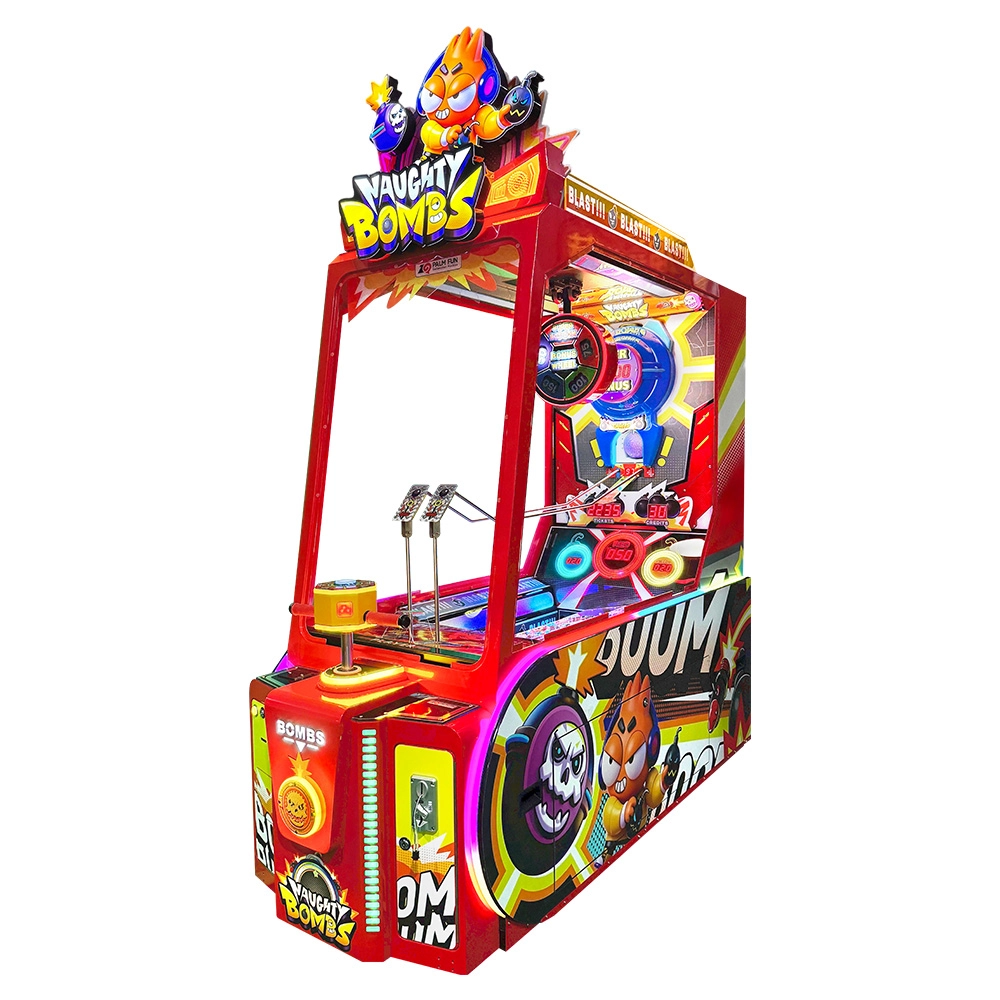
Naughty Bombs Ball Drop Redemption Arcade Game Machine
Naughty Bombs is a ball-drop redemption arcade game featuring rolling-ball gameplay, colored targets, ticket prizes, surprise bonus rewards, lighting and sound effects. Players use timing to launch and drop balls toward colored target areas. The product is presented for arcade, family entertainment center and other entertainment-venue projects, with customizable 110V / 220V AC voltage configuration.
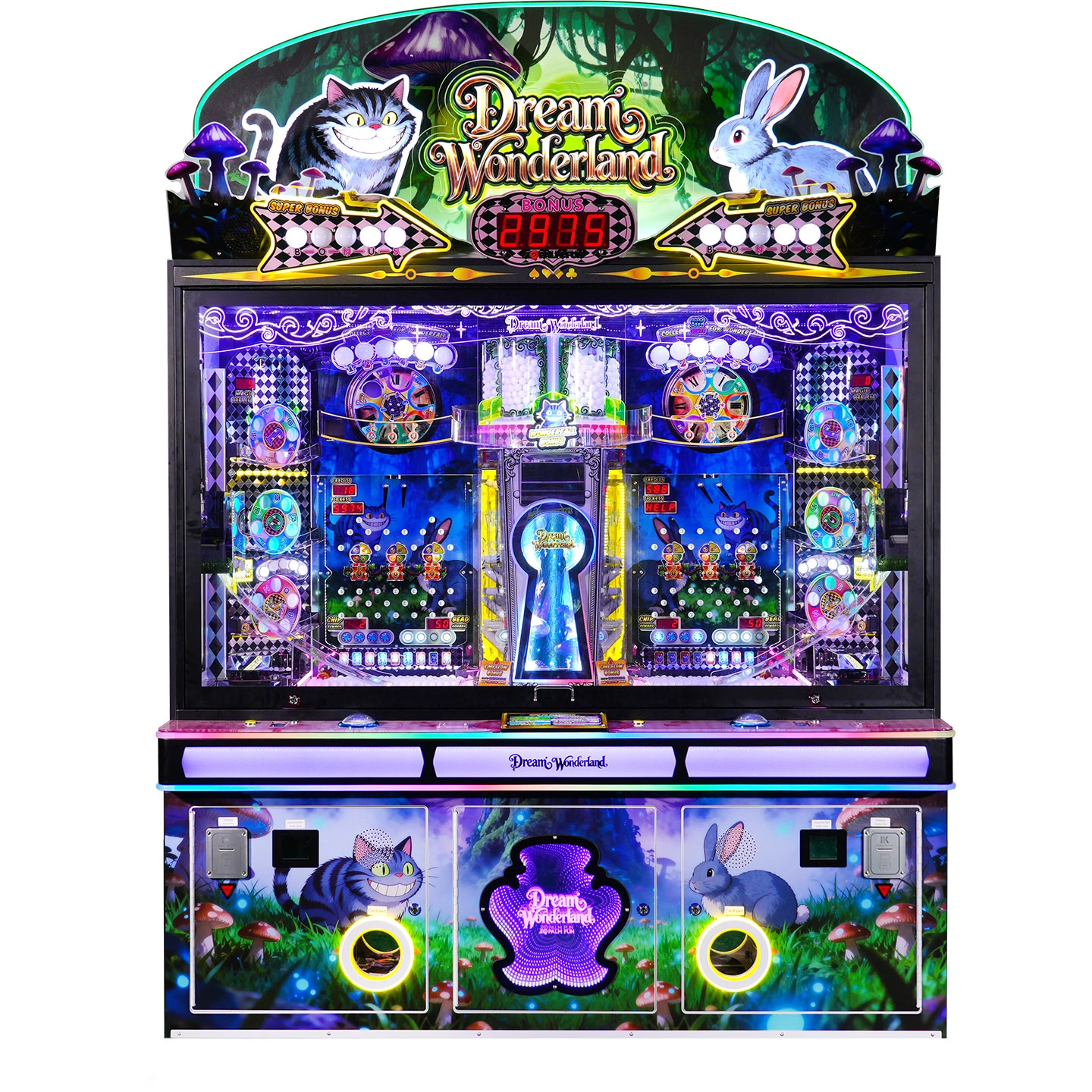
Dream Wonderland Marble Pusher Redemption Game
Enter Dream Wonderland — a magical marble pusher adventure filled with glowing lights, magic orbs, bonus wheels, collectible character cards, and exciting jackpot challenges.
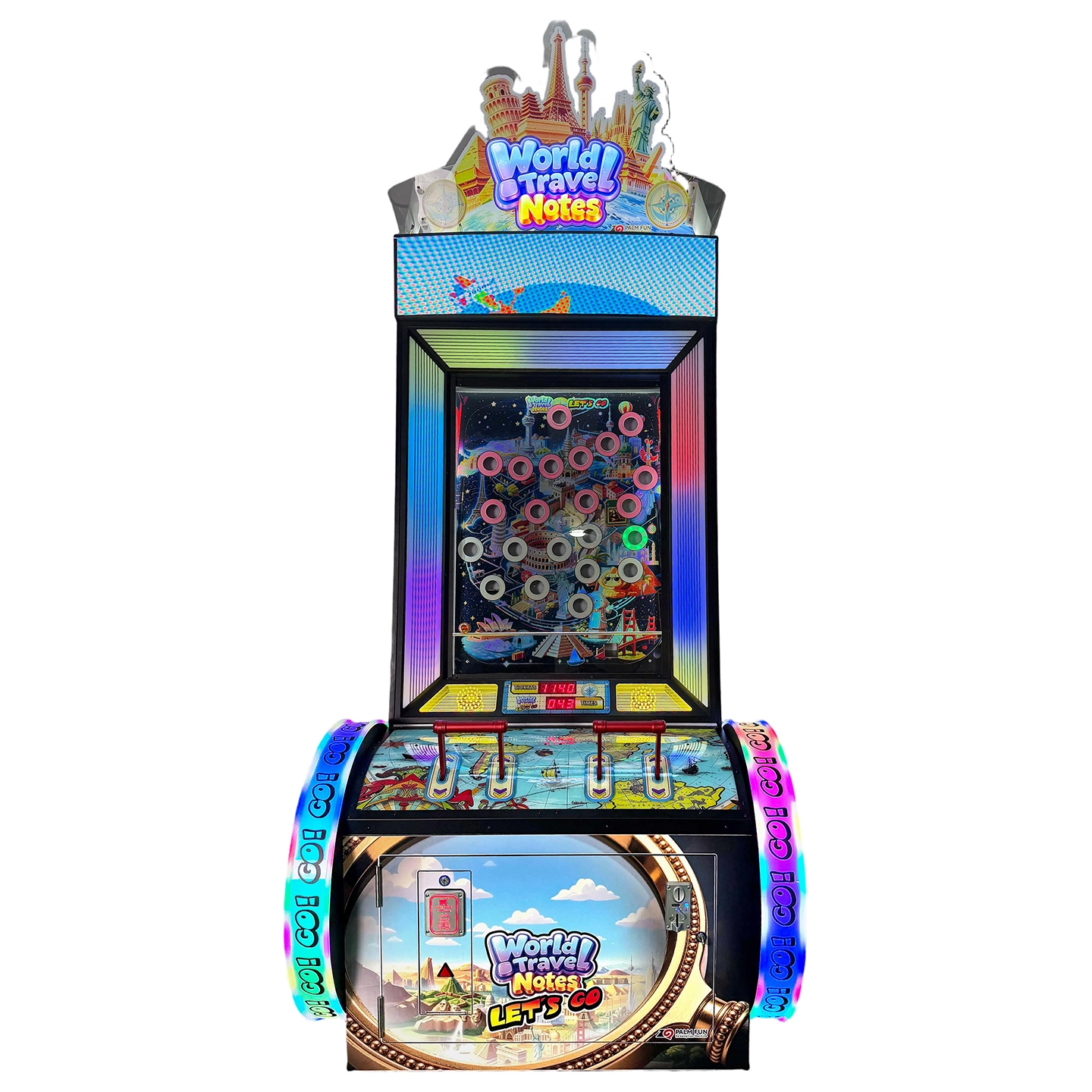
World Travel Notes – Balance Ball Redemption Arcade Game
World Travel Notes is a skill-based balance ball redemption game with a fun world-travel theme. Players use two handles to control the balance bar and guide the ball into each target hole. As the game progresses, the targets become more challenging, leading players toward the final grand prize. With colorful world-travel graphics, dynamic RGB lighting, a live score display, and progressive difficulty, World Travel Notes is designed to attract attention and encourage repeat play in arcades, FECs, shopping malls, and other entertainment venues.
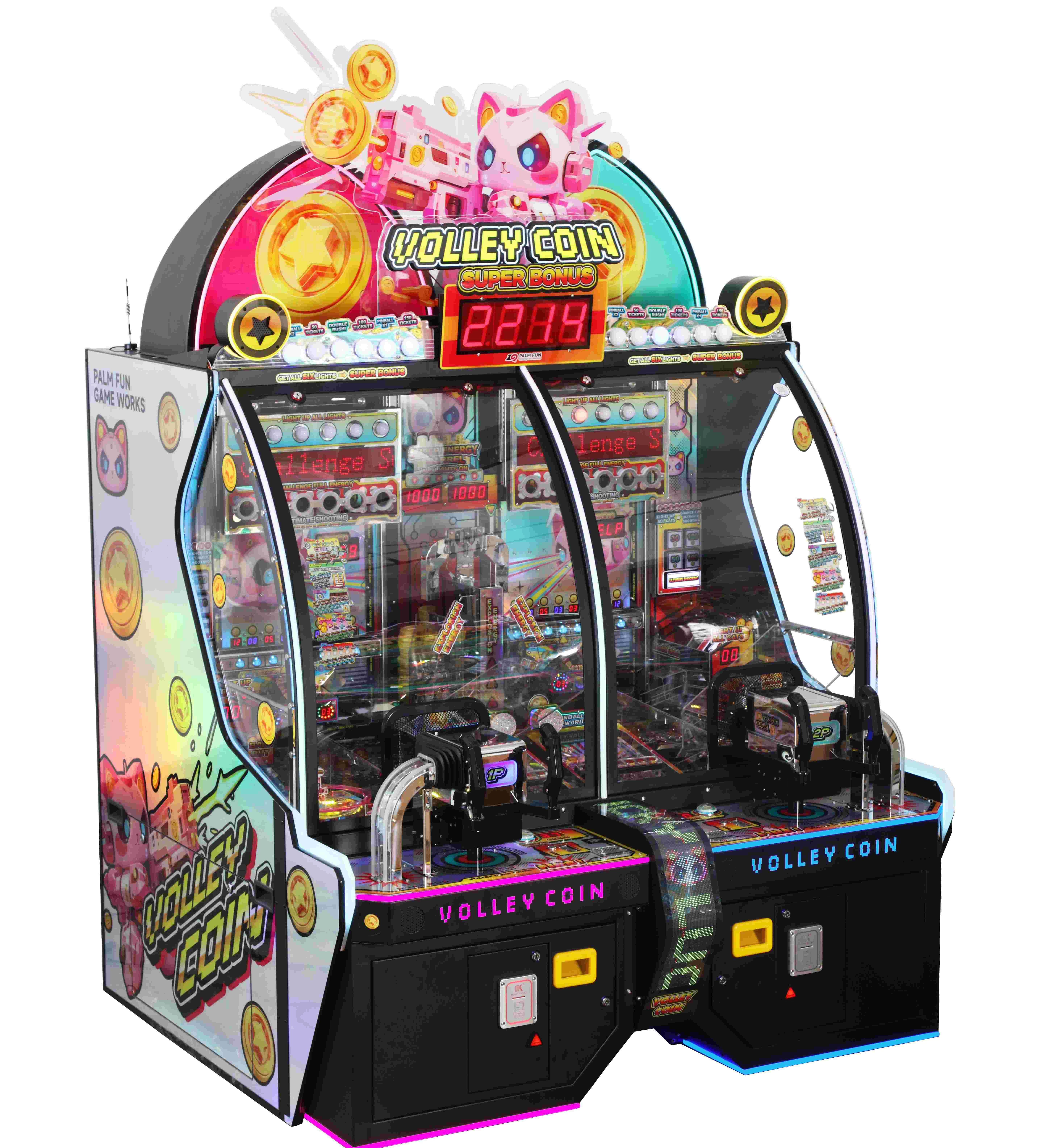
Hybrid Shooting & Pushing | Coin Pusher Arcade Ticket Redemption Machine
Volley Coin is an innovative arcade ticket redemption machine developed by Palm Fun Electronics. Combining the excitement of a fast-paced token shooter game with the proven earning power of a traditional coin pusher machine, Volley Coin offers a fresh and engaging gameplay experience that appeals to players of all ages.

Copyright © 2026 PALM FUN All Rights Reserved. | Privacy Policy • Terms and Conditions | Sitemap
palmfunarcade
Palm Fun Arcade Game
Whatsapp: +8618126837443
PalmFun Arcade
PalmFun_Arcade
PALM FUN Redemption Machine