








Common procurement risks for single player arcade and mitigation steps
- Where Arcade Equipment Purchasing Commonly Fails
- Specification ambiguity creates commercial and operational exposure
- Supplier capability is often judged from marketing material alone
- Compliance and market-entry requirements vary by destination
- Financial, Logistics, and Lifecycle Risks
- The lowest unit price may produce the highest landed cost
- Shipping damage and installation errors can delay opening
- Weak service planning increases downtime
- Mitigation Framework for a Reliable Equipment Purchase
- Use a weighted supplier evaluation instead of a price-only comparison
- Build acceptance testing into the purchase order
- Model revenue conservatively
- How PALM FUN Supports Lower-Risk Arcade Procurement
- Integrated development and manufacturing capability
- Product range aligned with redemption and family entertainment venues
- International experience and long-term partnership approach
- Frequently Asked Questions
- What should be included in a single-player arcade equipment quotation?
- How can a buyer verify an arcade machine manufacturer?
- What is the best way to reduce shipping damage?
- Which documents should be checked before importing amusement equipment?
- How should the return on an arcade machine be calculated?
- Why are spare parts and acceptance testing important?
Procurement risks for single-player arcade equipment usually arise from unclear specifications, unverified supplier capability, regulatory gaps, weak after-sales support, transportation damage, and unrealistic revenue assumptions. Buyers evaluating a pinball arcade cabinet or another amusement unit should assess the complete ownership cycle: product design, electrical safety, payment compatibility, ticket or prize logic, spare parts, installation, warranty response, and long-term serviceability. The same disciplined process applies to a single player arcade, coin-operated entertainment cabinet, redemption game machine, or mixed family entertainment center project. A documented technical specification, factory verification, compliance review, landed-cost model, and acceptance test can substantially reduce avoidable procurement losses.
Where Arcade Equipment Purchasing Commonly Fails
Specification ambiguity creates commercial and operational exposure
A quotation may describe a cabinet by a broad product name without defining the details that determine performance. Buyers should request a complete specification sheet covering external dimensions, weight, power input, rated consumption, display type, control components, audio system, cabinet materials, illumination, coin or card reader interface, ticket dispenser, game software, prize settings, and recommended operating environment. A product that appears inexpensive may require additional payment hardware, voltage conversion, network equipment, freight reinforcement, or local adaptation before it can enter service.
Game configuration also needs precise documentation. Questions should cover whether the software supports free play, paid play, card-based payment, coin operation, language selection, audit reports, ticket calibration, operator menus, and remote diagnostics. For a venue with limited floor space, the machine footprint and service clearance are as important as the cabinet width. A buyer should obtain an approved drawing showing front, rear, side, and maintenance access dimensions before finalizing the layout.
Supplier capability is often judged from marketing material alone
Professional photographs do not prove manufacturing consistency. Procurement teams should verify the supplier’s legal company information, factory address, production scope, engineering resources, quality system, export history, and references in comparable markets. A video tour is useful, but an independent audit, live factory inspection, or structured video inspection provides stronger evidence of assembly discipline and inventory control.
Quality verification should examine wiring routes, grounding points, soldering, connector locking, cabinet rigidity, moving mechanisms, protective edges, ventilation, and access to replaceable components. Buyers should request photographs of internal assemblies and a sample inspection report rather than relying only on a finished-product image. Where order volume is material, a pre-production sample or golden sample should be approved in writing and used as the benchmark for mass production.
Compliance and market-entry requirements vary by destination
Amusement equipment can involve electrical, mechanical, electromagnetic compatibility, consumer product, payment, and local fire-safety requirements. The applicable rules depend on the destination country, machine architecture, voltage, wireless functions, and operating venue. Buyers should identify the importer of record and confirm which documents are required before production begins. A certificate supplied by a manufacturer should be checked for the correct model, factory, test scope, and issuing laboratory.
International buyers can use the principles of ISO 9001 quality management systems as a framework for evaluating documented production controls, corrective actions, and traceability. For machinery-related hazards, the risk-assessment concepts described by ISO 12100 provide a useful reference for identifying crushing, trapping, sharp-edge, and unexpected-start risks. These references do not replace local legal advice or product-specific certification, but they improve the quality of supplier discussions.
Financial, Logistics, and Lifecycle Risks
The lowest unit price may produce the highest landed cost
A procurement comparison should separate the factory price from the total delivered investment. The cost model should include tooling, sample charges, export packing, inland transportation, ocean or air freight, insurance, customs duties, destination handling, installation, payment-system integration, spare parts, local labor, and taxes. A supplier offering a lower EXW price may become more expensive after freight, damage protection, commissioning, and replacement components are included.
Commercial terms also require attention. The purchase order should state currency, payment milestones, production lead time, inspection rights, delay remedies, packaging standards, warranty duration, spare-parts pricing, and ownership of approved artwork or software settings. A staged payment structure linked to design approval, production completion, inspection, and shipment gives the buyer more control than a large unrestricted advance payment.
Shipping damage and installation errors can delay opening
Large cabinets are vulnerable to impact, moisture, vibration, and incorrect lifting during transportation. Packaging specifications should define corner protection, internal bracing, moisture barriers, shock indicators where appropriate, pallet requirements, carton markings, and loading photographs. The supplier should provide a packing list that identifies cabinet quantity, loose accessories, spare parts, keys, manuals, and installation tools.
Before dispatch, the buyer should receive an installation manual and electrical requirements. The venue should confirm doorway clearance, elevator capacity, floor loading, outlet location, ventilation, and service access. On arrival, staff should photograph the packaging before opening, record visible damage, verify serial numbers, and complete a commissioning checklist. These records support insurance or freight claims and establish a clear basis for warranty decisions.
Weak service planning increases downtime
Single-unit venues often lack technical staff, so a minor failure can remove an important attraction from revenue generation. The contract should define how quickly the supplier acknowledges a support request, how troubleshooting is performed, which parts are stocked, and whether remote video assistance is available. A practical spare-parts package may include fuses, power supplies, switches, buttons, lamps, displays or display cables, readers, ticket dispensers, sensors, locks, and commonly used connectors, depending on the machine design.
Warranty language should distinguish manufacturing defects from misuse, unstable power, unauthorized modification, water exposure, and normal wear. It should also specify whether replacement parts are supplied free of charge, whether shipping is included, and how long technical support remains available after the warranty expires. A supplier that provides wiring diagrams, error-code explanations, maintenance schedules, and operator training can reduce dependence on emergency intervention.
| Procurement checkpoint | Evidence to request | Risk reduced | Recommended timing |
|---|---|---|---|
| Product specification | Approved drawing, electrical data, feature list, and sample photos | Unexpected installation cost and performance disputes | Before quotation approval |
| Quality capability | Factory records, inspection plan, sample test, and corrective-action process | Inconsistent assembly and early failures | Before deposit or mass production |
| Compliance | Destination-specific test reports, declarations, labels, and manuals | Import delays and venue compliance problems | Before purchase order |
| Logistics | Packing specification, loading photos, insurance terms, and packing list | Transit damage and missing components | Before shipment |
| After-sales support | Warranty terms, spare-parts list, service contacts, and response procedure | Extended downtime and unclear responsibility | Before final payment |
Mitigation Framework for a Reliable Equipment Purchase
Use a weighted supplier evaluation instead of a price-only comparison
A structured scorecard makes procurement decisions more transparent. Typical categories include product suitability, build quality, compliance documentation, customization capability, delivery reliability, warranty support, spare-parts availability, payment terms, and total cost of ownership. The weighting should reflect the project’s priorities. A high-volume family entertainment center may assign greater importance to throughput, service response, and component durability, while a small entertainment venue may emphasize footprint, visual appeal, and simple maintenance.
Every score should be supported by evidence. “Good quality” is not a verifiable criterion, but a completed sample test, documented inspection result, or reference installation is. Procurement teams should record open questions and require written answers so that later commercial discussions do not depend on informal messaging.
Build acceptance testing into the purchase order
Factory acceptance testing should verify power-up behavior, controls, screen performance, audio, lighting, payment activation, game reset, ticket output where applicable, fault recovery, cabinet stability, and key operating settings. The test should use the final production configuration rather than a demonstration sample with different components. Buyers can require a signed test report, photographs, or live video evidence before shipment.
Site acceptance testing should repeat the critical checks after installation. It should confirm that the machine works with the venue’s voltage, payment platform, network conditions, and operating procedures. Any defect should be logged with a responsible party and completion date. Retaining a small portion of the payment until agreed acceptance criteria are met can improve accountability, subject to the negotiated contract.
Model revenue conservatively
Projected return should be based on realistic utilization rather than the best daily performance observed during a launch period. The model should include expected plays per day, average price per play, operating days, prize or ticket expense, payment fees, electricity, rent or revenue share, staffing, maintenance, downtime, marketing, and depreciation. Sensitivity analysis should show what happens if utilization is lower than forecast or if a key component requires replacement.
Location fit matters as much as machine quality. A visually prominent unit near an entrance may attract more attention than an equivalent cabinet placed in a low-traffic corner. The operator should assess audience age, game difficulty, queue behavior, competitive attractions, visibility, and the relationship between play duration and revenue per square meter. Redemption economics must also be reviewed carefully so that prize costs and ticket settings remain commercially sustainable and compliant with local rules.
How PALM FUN Supports Lower-Risk Arcade Procurement
Integrated development and manufacturing capability
PALM FUN was founded in 2015 and specializes in high-quality mechanical lottery machines, coin pusher machines, raffle machines, and innovative gaming equipment. Our work covers research and development, product design, production, and sales, allowing project owners and distributors to discuss product requirements with a manufacturer that understands both engineering details and commercial deployment.
Our 3,000-square-meter factory is staffed by skilled development engineers focused on technology, reliability, and user experience. This structure supports practical communication around cabinet design, mechanical systems, control logic, visual presentation, and operator maintenance. Buyers can use our product information to compare Coin Pusher Arcade Ticket Redemption Machine solutions and assess which configuration fits a venue’s audience and revenue model.
Product range aligned with redemption and family entertainment venues
Our portfolio includes coin pusher machine products, redemption games, arcade games machines, and arcade machines for sale for distributors, amusement centers, retail venues, and project investors. The Larva Series Coin Pusher Arcade demonstrates how themed presentation and mechanical interaction can be combined to support player engagement, while broader product selection helps buyers build a balanced attraction mix instead of relying on one game format.
For buyers comparing suppliers, the relevant question is not only whether a machine looks attractive at launch. It is whether the manufacturer can provide consistent production, clear operating information, replacement support, and commercially useful communication after delivery. PALM FUN’s focus on quality and innovation is intended to help operators address those lifecycle requirements while adapting products to changing market demand.
International experience and long-term partnership approach
PALM FUN products are recognized and used in more than 50 countries worldwide. This international reach supports communication with distributors and project owners working across different market conditions, venue formats, and purchasing procedures. Our team aims to build long-term partnerships by providing comprehensive support and service rather than treating equipment delivery as the end of the relationship.
Buyers seeking a High Quality Redemption Arcade MachinesManufacturer should still complete destination-specific due diligence, including certification review, import requirements, venue safety assessment, and commercial forecasting. PALM FUN’s stated vision is to become a leading global manufacturer of redemption game machines, and our manufacturing, engineering, and product-development resources are organized around that objective. A direct technical discussion can help clarify configuration, order quantity, customization, lead time, packing, and after-sales requirements before a purchase decision is made.
Frequently Asked Questions
What should be included in a single-player arcade equipment quotation?
A complete quotation should include cabinet dimensions, weight, power requirements, game functions, payment interface, display and audio specifications, packaging, trade terms, lead time, warranty, spare parts, installation support, and destination-specific compliance documents.
How can a buyer verify an arcade machine manufacturer?
Buyers should verify the legal company identity, factory location, production capability, engineering team, quality records, export references, sample performance, inspection process, and after-sales procedures instead of relying only on catalog images or marketing claims.
What is the best way to reduce shipping damage?
The purchase order should define internal bracing, corner protection, moisture barriers, pallet requirements, loading photographs, insurance responsibility, and a packing list; the consignee should photograph packaging and equipment immediately upon arrival.
Which documents should be checked before importing amusement equipment?
The buyer should check the destination country’s applicable electrical, electromagnetic compatibility, mechanical, labeling, customs, fire-safety, and venue requirements, then verify that test reports and declarations match the exact model and manufacturer.
How should the return on an arcade machine be calculated?
Return projections should include realistic plays per day, price per play, operating days, prize or ticket costs, payment fees, electricity, rent or revenue share, labor, maintenance, downtime, marketing, and depreciation, with sensitivity testing for lower utilization.
Why are spare parts and acceptance testing important?
Spare parts and acceptance testing reduce downtime and clarify responsibility by confirming controls, payment, display, audio, lighting, ticket output, fault recovery, cabinet condition, and operating settings before shipment and after installation.
Contact PALM FUN through our official website to review redemption game machines, coin pusher machines, and arcade equipment for your next project.
Recommended for you
Installing Quarter Pushing Machines: Space and Power Requirements
The latest trends for coin operated arcade games
Wholesale punching bag machine arcade manufacturer and supplier in Asia
OEM/ODM soccer arcade machine Manufacturers and supplier in China
FAQs
How to place the redemption machines in a right place?
1,Ensure that the placement and layout of the equipment are distinct and centralized.
2,Keep noise levels low and avoid having a line of sight that spans too far to prevent players from easily taking in everything, which may slow down their movement.
3,Avoid clustering high-ticket payout machines and disperse machines of the same style.
4,Mix popular machines with less popular ones and avoid placing all popular machines together.
How to perform daily maintenance and servicing on redemption machines?
1. New machine entry performance, as it is relatively unstable in operation at this stage, requires dedicated supervision, timely follow-up, and improvements.
2. Redemption machines are relatively prone to collecting dust, which can lead to mechanical wear and corrosion. Dust can also cause issues with circuit boards, such as conductivity and optical sensor malfunctions. Thus, both internal and external cleanliness of redemption machines are equally important. Regular cleaning schedules for internal and daily cleaning for external components should be established.
3. Timely inspect the quality and durability of certain components. If issues are detected with imaging equipment, for example, replacements are necessary. A thorough understanding and mastery of the machine's performance can help extend its lifespan and ensure normal usage rates. Critical inspection areas include vulnerable parts such as motors, drive belts, gears of ticket dispensers, and sensors.
4. Frequent changes in prize point settings and payout rates are discouraged. Improvements in winning odds should be pursued through other methods and approaches.
5. All machines should have procedures for ticket removal and shredding to protect the ticket dispensers from damage.
6. Monitor changes in payout rates closely, as it directly impacts the cost control of the entire redemption machine system.
7. When employees add tickets, they should verify if the ticket sensors are unobstructed (blocked sensors can prevent ticket dispensing).
8. Have the protective paper on redemption machine's adhesive tape been removed? (Leaving it on can obstruct the ticket slot and ticket dispenser).
9. Responsible personnel should periodically and discreetly check the addition of tickets inside the redemption machines, ensuring that the added tickets match the registered ones.
The revenue proportion of redemption machines
How to select and match redemption machines?
2. the number of redemption game configuration: according to the characteristics of redemption machine, the proportion of redemption game configuration generally accounts for 30±5% of the whole field.
3. there are a lot of equipment on the market now, but less innovative, so the choice should be targeted in management and planning. We can divide redemption machines into children's, adults's, families, etc., according to different standards, with complete varieties and many styles, so as to give guests more choices and more changes. Specific can refer to the following:
① Inserting tokens in high frequency (mainly in mechanical redemption machines)
② Skill based games (mainly in mechanical redemption machines)
③ Games with edutainment significance (mainly in video redemption machines)
④ Entertaining games (mainly in video redemption machines)
How to guides works?
For example:
1. Proactively inquire and add tickets when a customer's machine is running low on tickets.
2. Assist players in organizing tickets when they are dispensed unevenly.
3. Offer storage tools such as storage bags and rubber bands when customers are arranging their tickets.
4. Provide free USB interfaces for charging near popular machines and rest areas.
5. Implement warm and clear reminders, guidance on ticket redemption, and directional signage, all designed to be straightforward. The more of these you provide, the more players will appreciate your thoughtfulness, without finding it bothersome.
You may also like
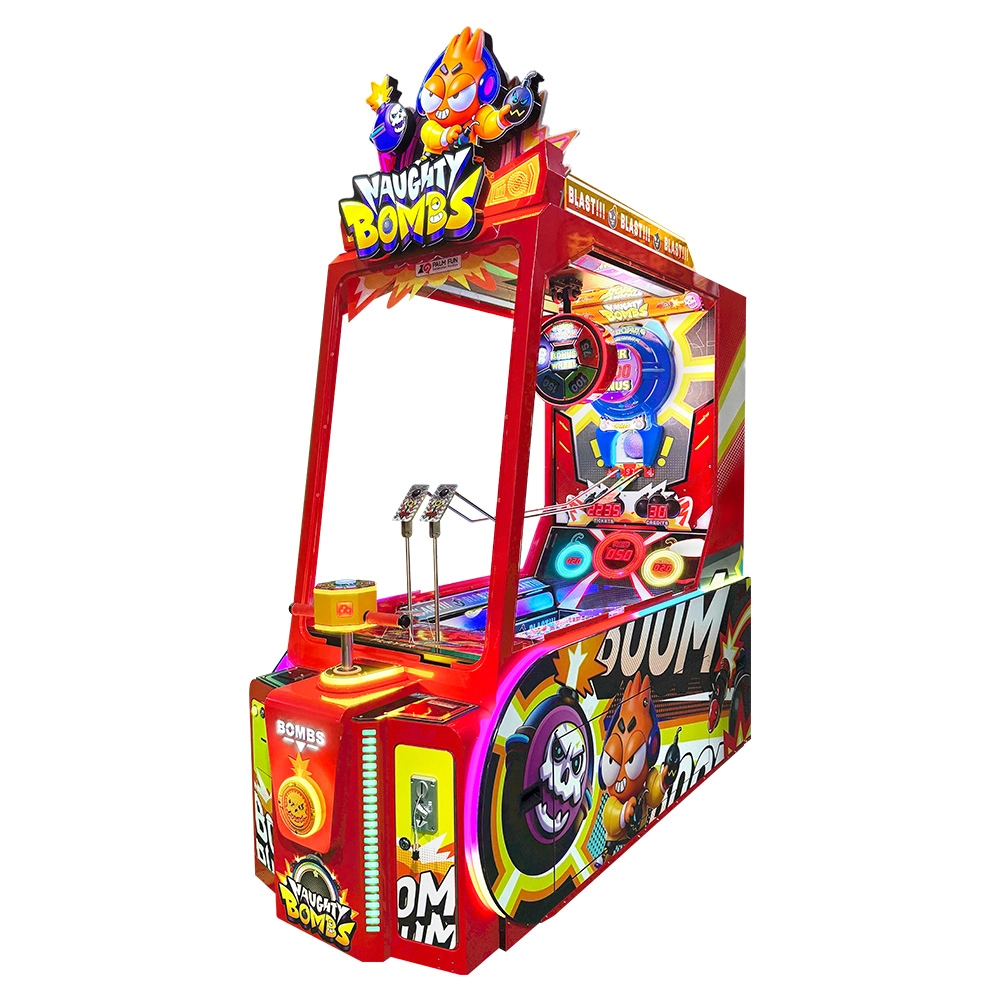
Naughty Bombs Ball Drop Redemption Arcade Game Machine
Naughty Bombs is a ball-drop redemption arcade game featuring rolling-ball gameplay, colored targets, ticket prizes, surprise bonus rewards, lighting and sound effects. Players use timing to launch and drop balls toward colored target areas. The product is presented for arcade, family entertainment center and other entertainment-venue projects, with customizable 110V / 220V AC voltage configuration.
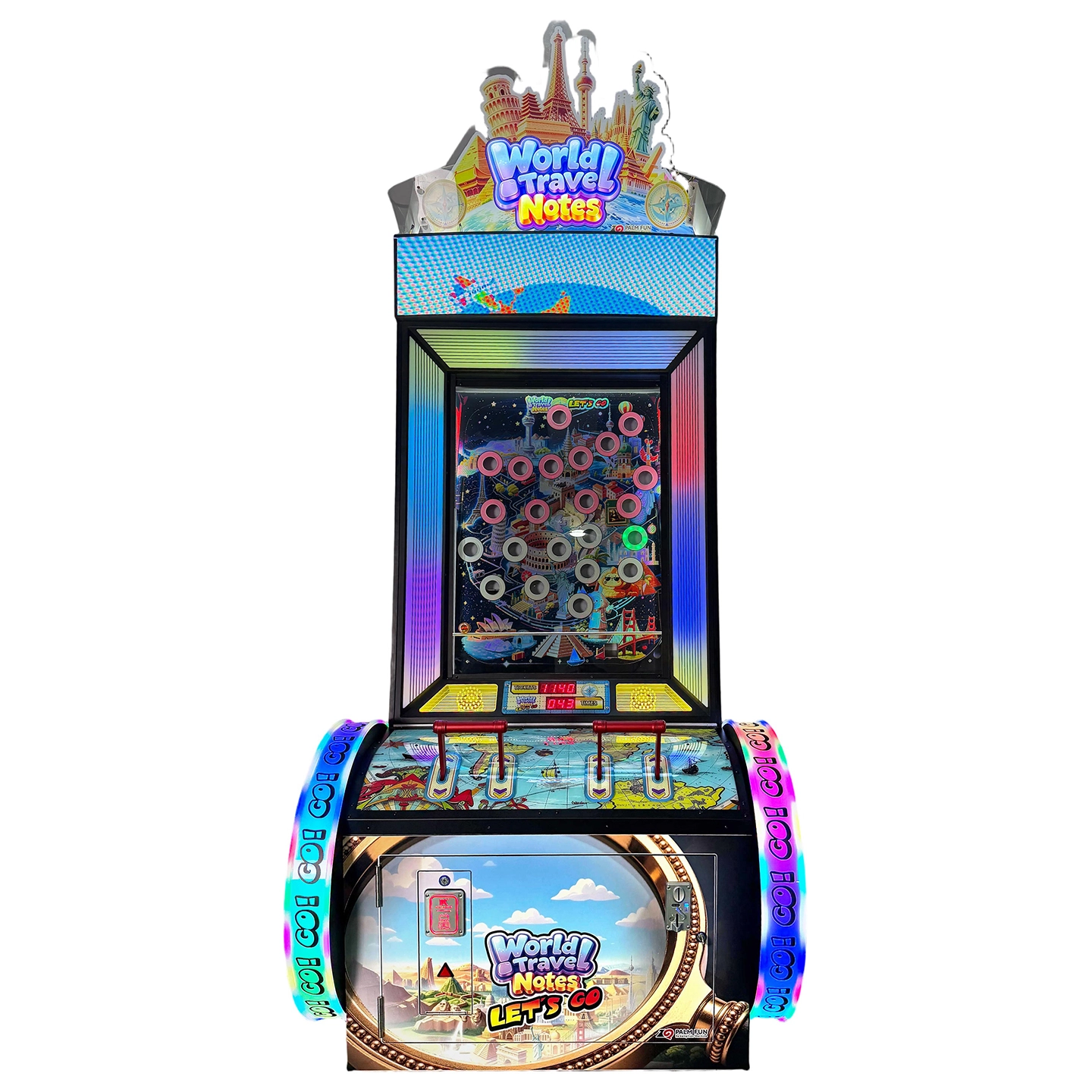
World Travel Notes – Balance Ball Redemption Arcade Game
World Travel Notes is a skill-based balance ball redemption game with a fun world-travel theme. Players use two handles to control the balance bar and guide the ball into each target hole. As the game progresses, the targets become more challenging, leading players toward the final grand prize. With colorful world-travel graphics, dynamic RGB lighting, a live score display, and progressive difficulty, World Travel Notes is designed to attract attention and encourage repeat play in arcades, FECs, shopping malls, and other entertainment venues.
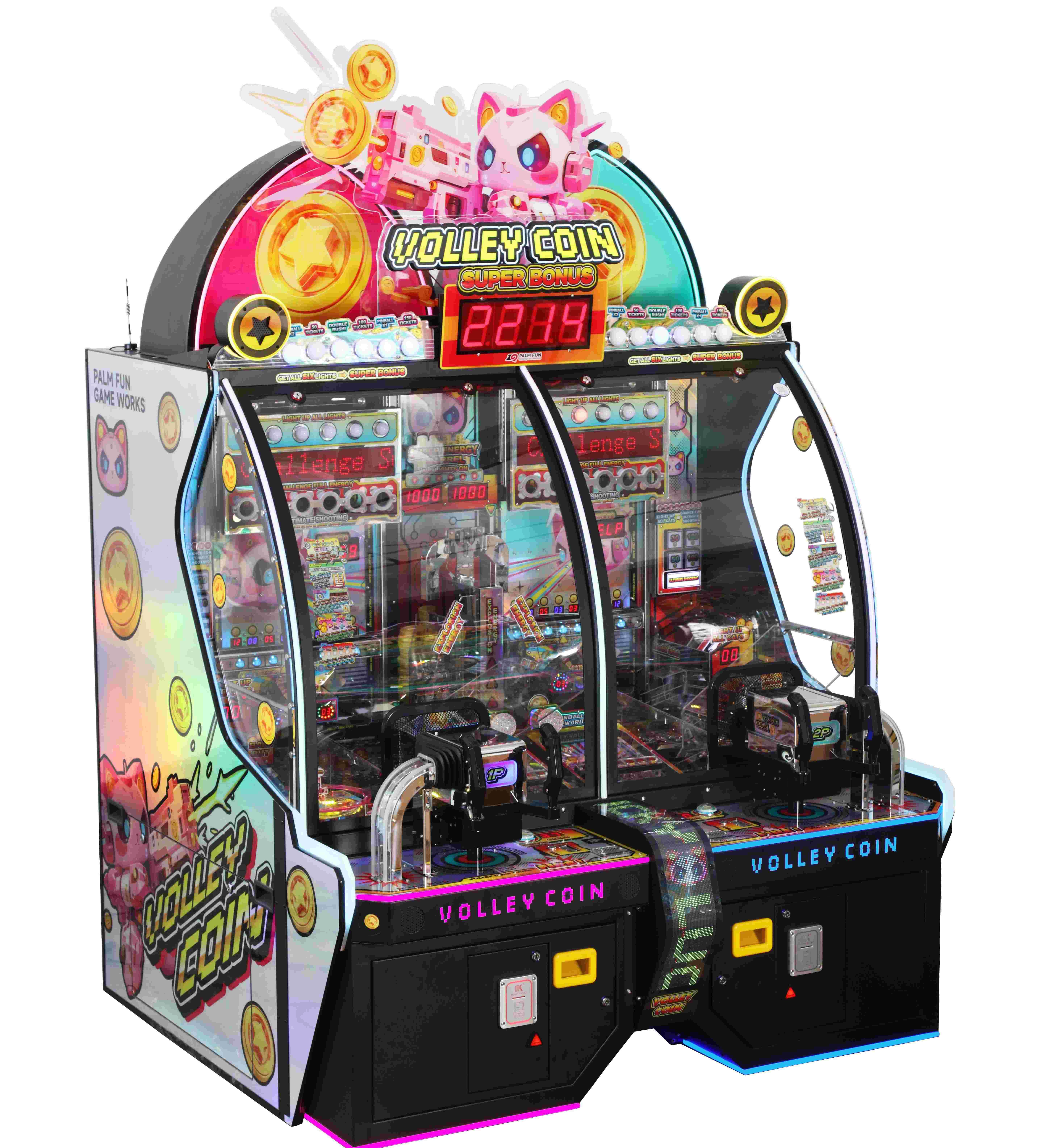
Hybrid Shooting & Pushing | Coin Pusher Arcade Ticket Redemption Machine
Volley Coin is an innovative arcade ticket redemption machine developed by Palm Fun Electronics. Combining the excitement of a fast-paced token shooter game with the proven earning power of a traditional coin pusher machine, Volley Coin offers a fresh and engaging gameplay experience that appeals to players of all ages.
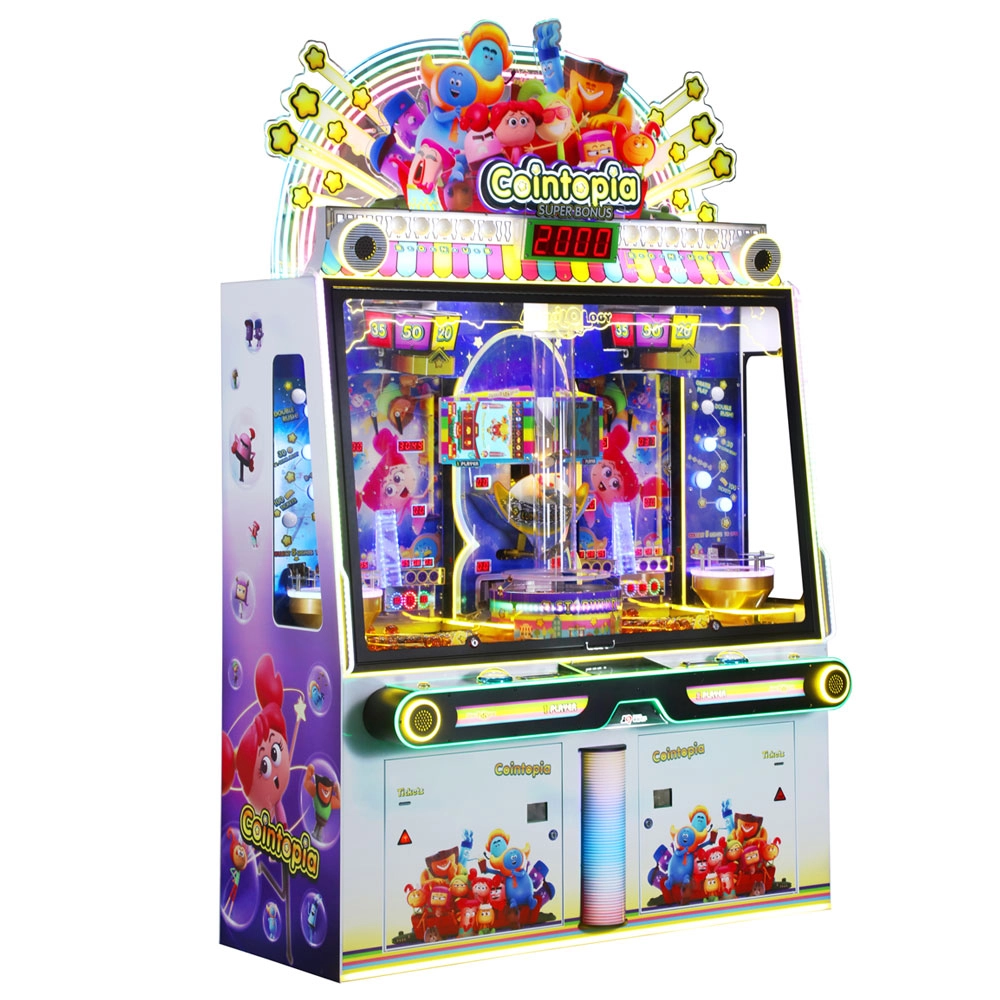
COINTOPIA, Have Fun Together With The Zodiac Buddies in an Utopia
COINTOPIA by PALM FUN is an exciting redemption game machine where players enjoy fun with zodiac buddies in a utopia setting. This ticket redemption machine offers engaging gameplay and rewarding experiences, perfect for family entertainment centers and arcades seeking top-quality redemption games.

Copyright © 2026 PALM FUN All Rights Reserved. | Privacy Policy • Terms and Conditions | Sitemap
palmfunarcade
Palm Fun Arcade Game
Whatsapp: +8618126837443
PalmFun Arcade
PalmFun_Arcade
PALM FUN Redemption Machine