







Factory Capacity & Quality Checklist for Large Coin Pusher Orders
- How to Assess a Supplier’s Production Readiness for Bulk Orders
- Confirm real factory capacity, not stated capacity
- Audit the production flow and traceability system
- Evaluate procurement resilience and change control
- Quality and Compliance Checklist for Coin-Operated Redemption Equipment
- Inspect mechanical reliability and serviceability
- Verify electrical safety and market-specific conformity
- Measure quality with acceptance criteria
- Shipment, Installation, and Total-Cost Controls
- Review packaging and logistics engineering
- Calculate ownership cost instead of comparing invoice prices alone
- Prepare installation and operator training
- Why PALM FUN Is Structured for International Redemption Projects
- Manufacturing and engineering resources
- Product range and commercial flexibility
- Global market experience and long-term support
- Final Approval Checklist for a Large Order
- Documents to secure before production
- Questions for the final factory meeting
- Frequently Asked Questions
- How can buyers verify whether a factory can handle a large coin pusher order?
- What quality documents should be requested before mass production?
- What should a pre-shipment inspection cover?
- How should operators compare the cost of different redemption cabinets?
- Why is a golden sample important in a bulk equipment order?
- What support should be included after delivery?
Large coin pusher orders require a structured evaluation of manufacturing capacity, product consistency, safety controls, delivery planning, and lifetime operating value. A reliable supplier should demonstrate repeatable assembly processes, documented inspections, stable component sourcing, realistic production schedules, export-ready packaging, and technical support for every coin pusher machine shipment. Buyers operating family entertainment centers, amusement parks, shopping-mall venues, and a modern pinball arcade should assess the factory behind the equipment rather than relying only on catalog images or an attractive quotation.
How to Assess a Supplier’s Production Readiness for Bulk Orders
Confirm real factory capacity, not stated capacity
Factory capacity is the supplier’s ability to produce the required quantity within the agreed specification and delivery window. It includes floor space, assembly stations, engineering resources, purchasing systems, testing personnel, warehouse capacity, and the ability to manage several customer projects simultaneously. A supplier may have a broad product catalog but limited practical throughput if key processes are outsourced or if final testing is performed only after a production backlog has developed.
Request a capacity statement that separates monthly theoretical output from confirmed available capacity for the project period. The document should identify the number of assembly lines, average takt time, working shifts, staffing levels, bottleneck processes, and planned maintenance periods. Buyers should also ask whether the supplier can reserve production slots after deposit, how engineering changes affect the schedule, and what contingency exists if a critical component is delayed.
Audit the production flow and traceability system
A professional manufacturing audit should follow the product from incoming materials to finished-goods loading. Inspectors should review incoming inspection, component labeling, subassembly, wiring, mechanical installation, software or game-setting configuration, functional testing, cosmetic inspection, and packing. Traceability is particularly important for amusement equipment because a repeat fault may affect dozens or hundreds of deployed units.
Each machine should be associated with a serial number or batch code that links to inspection results, component revisions, production dates, and corrective actions. A supplier using standardized work instructions can reproduce the approved sample more consistently than a workshop dependent on individual technician memory. Buyers should request photographs or videos of the actual production area and, where commercially practical, conduct a remote or third-party factory audit.
Evaluate procurement resilience and change control
Mechanical amusement equipment depends on motors, sensors, lighting modules, control boards, wiring harnesses, metal parts, acrylic panels, fasteners, coin mechanisms, and display components. A factory should identify which parts are standard, which are custom-made, and which have approved alternatives. A bill of materials with revision control reduces the risk of unapproved substitutions between the sample approval and mass production.
Change control should define who approves a modification to cabinet dimensions, electronics, artwork, firmware, payout settings, or prize interfaces. Even a small change can affect power consumption, service access, regulatory documentation, or operator revenue. The purchase contract should require written approval for material substitutions and specify whether replacement parts will remain available throughout the expected operating life.
Quality and Compliance Checklist for Coin-Operated Redemption Equipment
Inspect mechanical reliability and serviceability
The core mechanism must withstand repeated coin loading, vibration, impact, cleaning, and daily operator intervention. Buyers should examine the pusher plate, rails, shelves, coin paths, bearings, shafts, belts, gears, fasteners, and access doors. Look for uniform movement, correct alignment, secure fastening, protected pinch points, and easy access to wear components. A machine that performs well during a short demonstration may still require redesign if the service team cannot quickly remove a jam or replace a high-wear part.
Durability validation should include repeated-cycle testing under representative load conditions. The supplier should explain the test duration, test quantity, failure criteria, and corrective-action process. Useful records include motor temperature, abnormal noise, coin-feed reliability, sensor response, lighting stability, and cabinet vibration. Buyers should not accept vague claims such as “long life” without a defined test method or clear warranty terms.
Verify electrical safety and market-specific conformity
Electrical compliance depends on the destination market, voltage, plug configuration, radio functions, and local amusement regulations. Buyers should identify the applicable requirements before production begins and confirm that the proposed documentation matches the final configuration. The ISO/IEC 27001 standard overview is relevant to information-security management where connected systems or customer data are involved, but it is not a substitute for electrical or amusement-equipment certification.
For electrical safety, request schematics, power ratings, fuse specifications, grounding provisions, insulation details, emergency isolation arrangements, and test records. Depending on the destination, buyers may also need evidence related to CE requirements, UKCA, UL or ETL listing, EMC testing, RoHS substance restrictions, or national plug and energy rules. The International Electrotechnical Commission publishes international electrotechnical standards, while the U.S. Consumer Product Safety Commission business guidance provides useful regulatory context for products entering the United States. Certification should always be confirmed with the importer, testing laboratory, and local authority having jurisdiction.
Measure quality with acceptance criteria
Pre-shipment inspection becomes effective only when the purchase order contains measurable acceptance criteria. These may include cabinet dimensions, artwork color tolerance, coin compatibility, sound level, lighting function, game settings, ticket output, prize interface, voltage, current draw, and permitted cosmetic defects. A unit count alone is not a quality standard.
Buyers should define critical, major, and minor defects. A critical defect could involve exposed live wiring, unsafe grounding, or a mechanism that creates a foreseeable hazard. A major defect might include a nonfunctional coin acceptor, unstable game control, damaged cabinet structure, or failed ticket dispenser. Minor defects may include small surface marks that do not affect operation. The inspection plan should state sampling levels, rework rights, replacement obligations, and who pays for the reinspection.
| Procurement checkpoint | Evidence to request | Why it matters | Recommended buyer action |
|---|---|---|---|
| Capacity | Production plan, staffing, line layout, confirmed slot | Reduces late delivery risk | Approve a milestone schedule before deposit |
| Mechanical reliability | Cycle-test method, failure records, spare-parts list | Indicates expected uptime and service burden | Review test conditions against venue use |
| Electrical safety | Schematics, test reports, ratings, conformity documents | Supports safe installation and import clearance | Validate documents for the destination market |
| Mass-production consistency | Golden sample, inspection checklist, batch records | Limits variation across a large shipment | Sign off a reference unit and inspection protocol |
| Packaging | Drop or vibration rationale, carton specification, loading plan | Protects cabinets during multimodal transport | Approve packing photos and container layout |
| After-sales service | Warranty policy, remote support process, spare-parts pricing | Shortens downtime after installation | Purchase a recommended spare-parts package |
Shipment, Installation, and Total-Cost Controls
Review packaging and logistics engineering
Large arcade equipment is vulnerable to vibration, compression, moisture, and handling damage. The supplier should document cabinet protection, internal bracing, corner guards, moisture barriers, accessory cartons, and loading orientation. A shipping package designed for a single unit may not be suitable for a dense container load where doors, acrylic panels, or control decks can be exposed to pressure from adjacent equipment.
Confirm the packed dimensions, gross weight, carton markings, pallet requirements, container utilization, and unloading method before finalizing the purchase. The logistics plan should distinguish factory lead time from transit time, customs clearance, inland delivery, and venue installation. Buyers should also confirm whether replacement panels, keys, cables, manuals, and service tools are packed separately and clearly labeled.
Calculate ownership cost instead of comparing invoice prices alone
The total cost of ownership includes purchase price, freight, duties, installation, electricity, consumables, tickets or prizes, routine maintenance, replacement parts, payment-system integration, and downtime. A lower-priced unit can become more expensive if it has difficult service access, inconsistent coin handling, weak lighting components, or a long replacement-parts lead time.
Project owners should model expected plays per day, average coin value, prize or ticket cost, labor time, floor-space rent, and target payback period. For redemption games, revenue performance is also influenced by visibility, cabinet placement, perceived fairness, game speed, and the clarity of the reward path. A supplier should provide configurable operating parameters while making clear which settings are controlled by the operator and which are restricted by local law or venue policy.
Prepare installation and operator training
Before delivery, request an installation manual, wiring diagram, start-up checklist, troubleshooting guide, cleaning instructions, and preventive-maintenance schedule. The facility should verify floor loading, door clearance, power outlets, network requirements if applicable, ventilation, lighting, and emergency access. Operators need training on coin jams, ticket replenishment, sensor calibration, cabinet cleaning, error-code interpretation, and safe isolation before service.
For a larger rollout, a pilot deployment is often more valuable than immediate full-site installation. A small group of units can reveal local coin compatibility issues, player behavior, queue patterns, noise concerns, and service requirements. Findings from the pilot should be converted into a final production or configuration approval before the balance of the order is released.
Why PALM FUN Is Structured for International Redemption Projects
Manufacturing and engineering resources
PALM FUN was founded in 2015 and specializes in mechanical lottery machines, coin pusher machines, and raffle machines. Our work covers research and development, industrial design, production, and sales of innovative gaming and lottery equipment. Our 3,000-square-meter factory is supported by skilled development engineers focused on technology advancement, practical serviceability, and the player experience.
For buyers placing a large order, this combination of engineering and manufacturing capability supports a more controlled path from concept approval to production. Our team can discuss cabinet configuration, game presentation, lighting, coin-flow behavior, ticket or prize functions, artwork requirements, and market-specific project needs. Product selection may include the Coin Pusher Arcade Ticket Redemption Machine, the Larva Series Coin Pusher Arcade, and complementary single player arcade equipment for a diversified amusement floor.
Product range and commercial flexibility
Our portfolio is designed for operators seeking dependable redemption games, arcade games machines, and arcade machines for sale across different venue formats. Coin-operated attractions can be combined with skill-based play, mechanical lottery concepts, raffle formats, and themed cabinets to create a balanced revenue mix. A broader product range helps distributors build a coherent project proposal instead of sourcing every category from a separate factory.
PALM FUN places emphasis on product quality and innovation to respond to changing market preferences. Buyers can review product specifications, cabinet footprints, operating requirements, shipping details, and support expectations before making a purchasing decision. The High Quality Redemption Arcade Machines Manufacturer profile provides additional information about our company capabilities and product focus.
Global market experience and long-term support
PALM FUN products are recognized and used in more than 50 countries. International distribution requires attention to packaging, documentation, voltage configurations, communication, spare-parts planning, and post-delivery support. Our objective is to build long-term partnerships with distributors, operators, brand owners, and investors rather than treating each shipment as an isolated transaction.
Our support approach can include product selection, order coordination, technical documentation, shipment preparation, installation guidance, and after-sales communication. Buyers should still confirm all commercial terms, certifications, warranty coverage, configuration limits, and local compliance responsibilities in the purchase agreement. PALM FUN’s vision is to become a leading global manufacturer of redemption game machines, supported by continuous development and practical cooperation with customers.
Final Approval Checklist for a Large Order
Documents to secure before production
Before issuing final approval, the buyer should hold an accepted quotation, technical specification, signed golden sample record, commercial invoice terms, production schedule, inspection standard, warranty policy, packing specification, spare-parts list, installation documentation, and destination-market compliance plan. The contract should also address artwork ownership, software or configuration approval, payment milestones, delay remedies, replacement procedures, and responsibility for import clearance.
Questions for the final factory meeting
- Which production steps are completed in-house and which are outsourced?
- What is the confirmed monthly capacity for the approved configuration?
- How are component revisions and substitutions controlled?
- What tests are performed on every finished cabinet?
- Which parts are considered normal wear items?
- How quickly can remote troubleshooting begin after a service request?
- What spare-parts quantity is recommended for the first operating year?
- How will the supplier document and correct defects found after delivery?
A disciplined checklist converts a high-volume arcade purchase from a visual product comparison into a controlled business decision. Factory evidence, measurable acceptance criteria, realistic logistics planning, and service readiness are the foundations of reliable uptime and sustainable venue returns.
Frequently Asked Questions
How can buyers verify whether a factory can handle a large coin pusher order?
Request a capacity statement covering assembly stations, staffing, shifts, bottleneck processes, confirmed production slots, component availability, and contingency planning. A remote or third-party factory audit, production photographs, and a milestone schedule provide stronger evidence than a stated monthly output alone.
What quality documents should be requested before mass production?
Buyers should request the approved technical specification, bill of materials, golden sample record, inspection checklist, test reports, wiring diagrams, conformity documents relevant to the destination market, packaging specification, warranty terms, and spare-parts list.
What should a pre-shipment inspection cover?
Inspection should cover cabinet dimensions, artwork, mechanical movement, coin acceptance, sensors, lighting, sound, displays, ticket or prize functions, power consumption, grounding, fasteners, access doors, cosmetic condition, accessories, serial numbers, and packaging condition.
How should operators compare the cost of different redemption cabinets?
Compare total cost of ownership, including purchase price, freight, duties, installation, electricity, consumables, maintenance, spare parts, labor, payment integration, and downtime. Expected plays per day, floor-space cost, game speed, perceived fairness, and reward economics should also be included in the payback model.
Why is a golden sample important in a bulk equipment order?
A golden sample establishes the approved reference for dimensions, materials, artwork, functions, lighting, sound, game settings, and finish quality. It gives the factory and buyer a shared standard for production inspection and reduces variation across a large shipment.
What support should be included after delivery?
Post-delivery support should include installation instructions, wiring diagrams, troubleshooting guidance, preventive-maintenance information, remote technical communication, warranty procedures, and access to replacement parts. Operators should also receive training on jams, cleaning, calibration, and safe servicing.
Contact PALM FUN to review bulk coin pusher requirements or explore our redemption and arcade machine solutions for your next venue project.
Recommended for you
Wholesale miniature pac man arcade game manufacturer and supplier in Asia
Sample inspection & shipping plan for redemption arcade ball game imports
Arcade Games Manufacturer - PALM FUN
The latest trends for coin pusher game supplier wholesale | PALM FUN Ultimate Insights
FAQs
How to guides works?
For example:
1. Proactively inquire and add tickets when a customer's machine is running low on tickets.
2. Assist players in organizing tickets when they are dispensed unevenly.
3. Offer storage tools such as storage bags and rubber bands when customers are arranging their tickets.
4. Provide free USB interfaces for charging near popular machines and rest areas.
5. Implement warm and clear reminders, guidance on ticket redemption, and directional signage, all designed to be straightforward. The more of these you provide, the more players will appreciate your thoughtfulness, without finding it bothersome.
Effectively solve the pain points of the site and consume the amount of coins deposit.
So the stock quantity of pre-purchased tokens is an issue must be concerned, especially in the highly competitive current market. Only when the amusement park maintains a healthy cycle of token sales, consumption, stockpiling, consumption, and sales again can it ensure sustained growth and profitability.
What details should be paid attention to in the operation of redemption machines?
① Machine parameter adjustments.
② Equipment performance and gameplay.
③ Decoration and promotion of the area and equipment.
④ Machine placement locations.
⑤ Selection of prizes.
2. The primary operational techniques for redemption machines are in the attractiveness of the gameplay, maintaining a reasonable payout rate, and creating an engaging atmosphere. Depending on the season and market changes, promotional activities should be carried out with a balance, analysis, and follow-up. Therefore, you can consider the following operational methods:
① Collaborate with several venues or businesses to distribute promotional materials to enhance external visibility and interaction.
② Conduct targeted promotional activities to retain returning customers.
③ Organize regular member events to ensure member attraction and consistent customer base. For example, offering extra lottery rewards for a certain amount of tokens deposited or giving a certain number of lottery tickets(reward points) when a membership card is issued.
④ Strengthen interaction with neighboring businesses within the commercial district.
⑤ Organize selective activities for children and offer special deals for exchanging unique children-oriented prizes.
3. Setting parameters correctly:
4.New machine arrival -- Familiarizing with the game--Initial parameter control--Promotional --ctivities and advertising--Adjusting parameters based on the number of players--Multiple adjustments of parameters--Increased popularity--Profitability--Reinvestment.
Note: Data analysis should be conducted weekly to promptly understand the ticket payout probability for each redemption machine. In case of any abnormal situations, swift follow-up and troubleshooting are essential to identify the causes and rectify the issues.
How to select and match redemption machines?
2. the number of redemption game configuration: according to the characteristics of redemption machine, the proportion of redemption game configuration generally accounts for 30±5% of the whole field.
3. there are a lot of equipment on the market now, but less innovative, so the choice should be targeted in management and planning. We can divide redemption machines into children's, adults's, families, etc., according to different standards, with complete varieties and many styles, so as to give guests more choices and more changes. Specific can refer to the following:
① Inserting tokens in high frequency (mainly in mechanical redemption machines)
② Skill based games (mainly in mechanical redemption machines)
③ Games with edutainment significance (mainly in video redemption machines)
④ Entertaining games (mainly in video redemption machines)
How to place the redemption machines in a right place?
1,Ensure that the placement and layout of the equipment are distinct and centralized.
2,Keep noise levels low and avoid having a line of sight that spans too far to prevent players from easily taking in everything, which may slow down their movement.
3,Avoid clustering high-ticket payout machines and disperse machines of the same style.
4,Mix popular machines with less popular ones and avoid placing all popular machines together.
You may also like
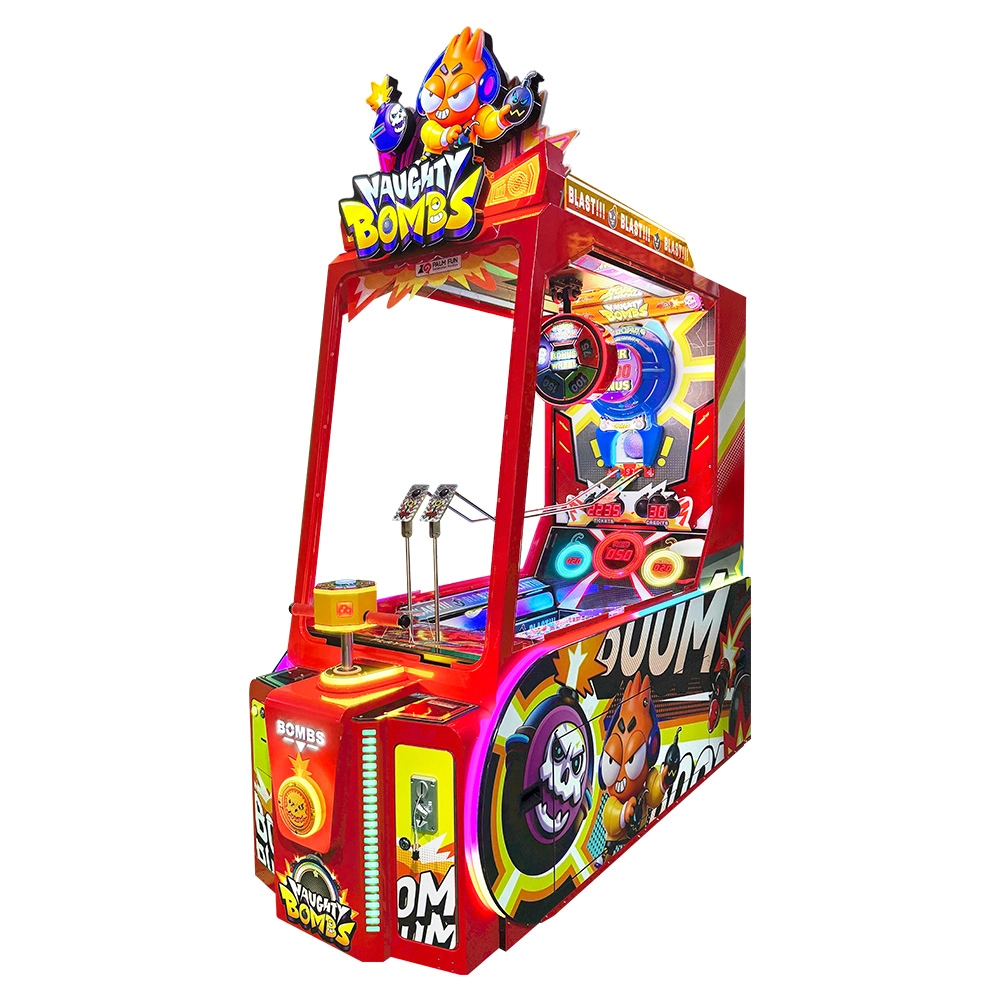
Naughty Bombs Ball Drop Redemption Arcade Game Machine
Naughty Bombs is a ball-drop redemption arcade game featuring rolling-ball gameplay, colored targets, ticket prizes, surprise bonus rewards, lighting and sound effects. Players use timing to launch and drop balls toward colored target areas. The product is presented for arcade, family entertainment center and other entertainment-venue projects, with customizable 110V / 220V AC voltage configuration.
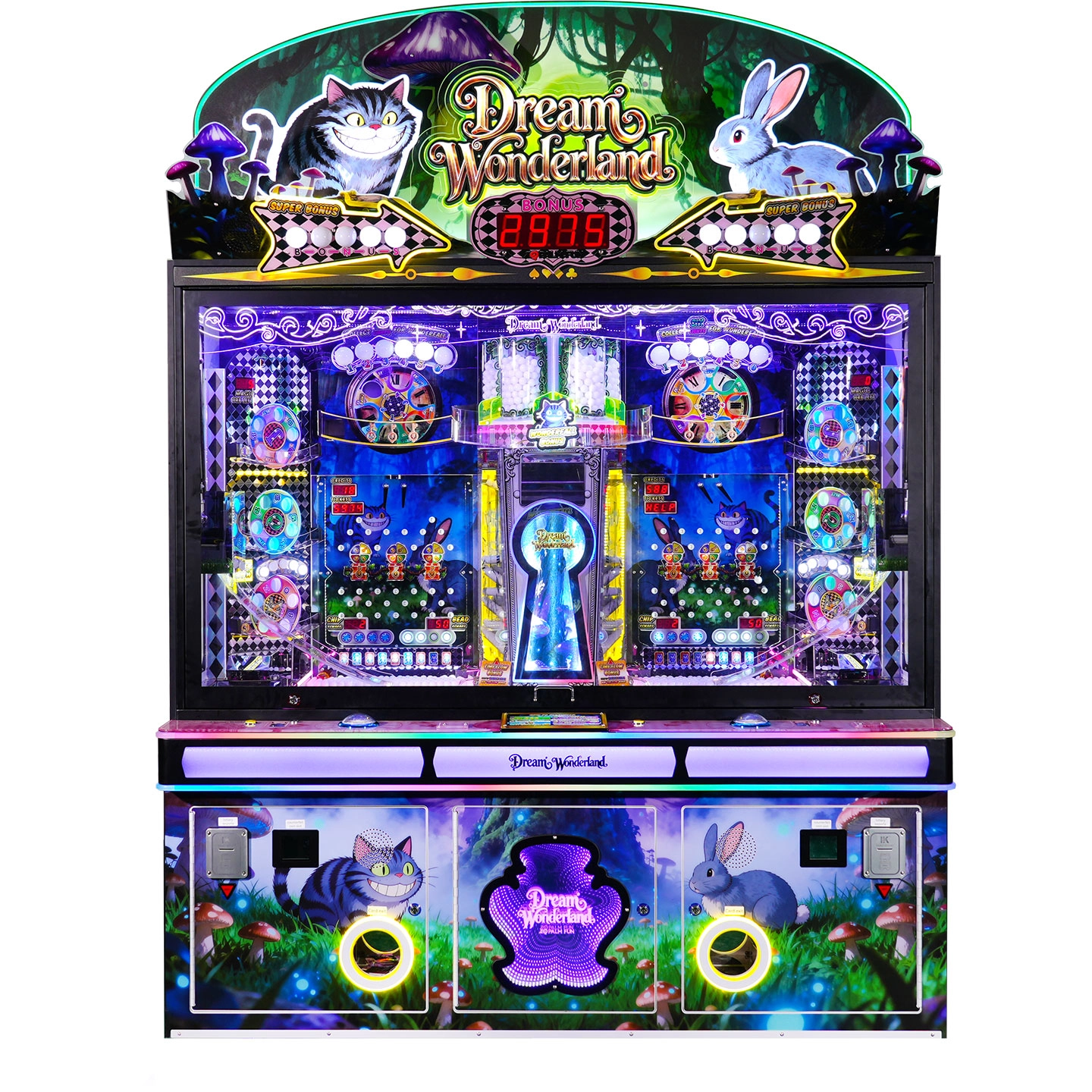
Dream Wonderland Marble Pusher Redemption Game
Enter Dream Wonderland — a magical marble pusher adventure filled with glowing lights, magic orbs, bonus wheels, collectible character cards, and exciting jackpot challenges.
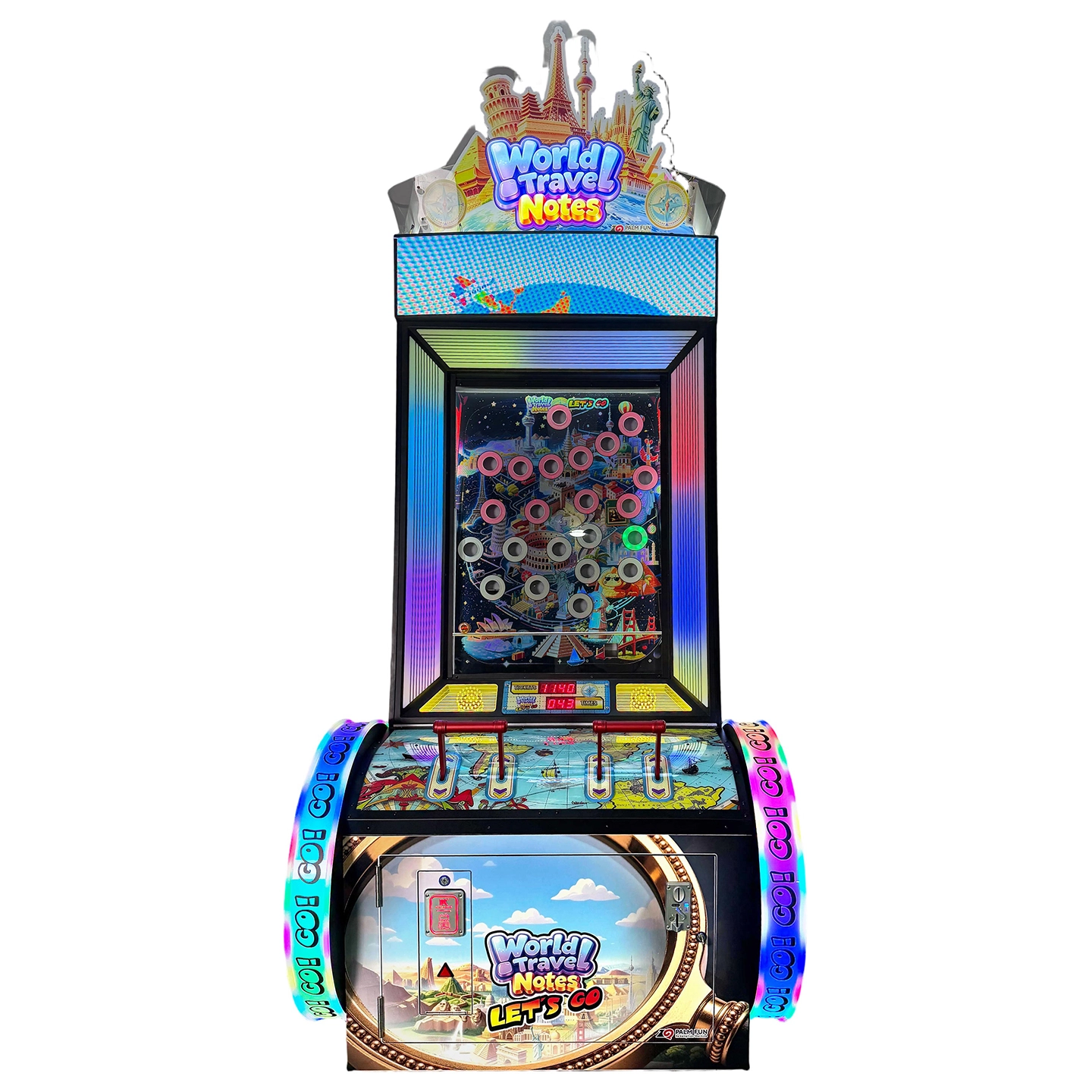
World Travel Notes – Balance Ball Redemption Arcade Game
World Travel Notes is a skill-based balance ball redemption game with a fun world-travel theme. Players use two handles to control the balance bar and guide the ball into each target hole. As the game progresses, the targets become more challenging, leading players toward the final grand prize. With colorful world-travel graphics, dynamic RGB lighting, a live score display, and progressive difficulty, World Travel Notes is designed to attract attention and encourage repeat play in arcades, FECs, shopping malls, and other entertainment venues.
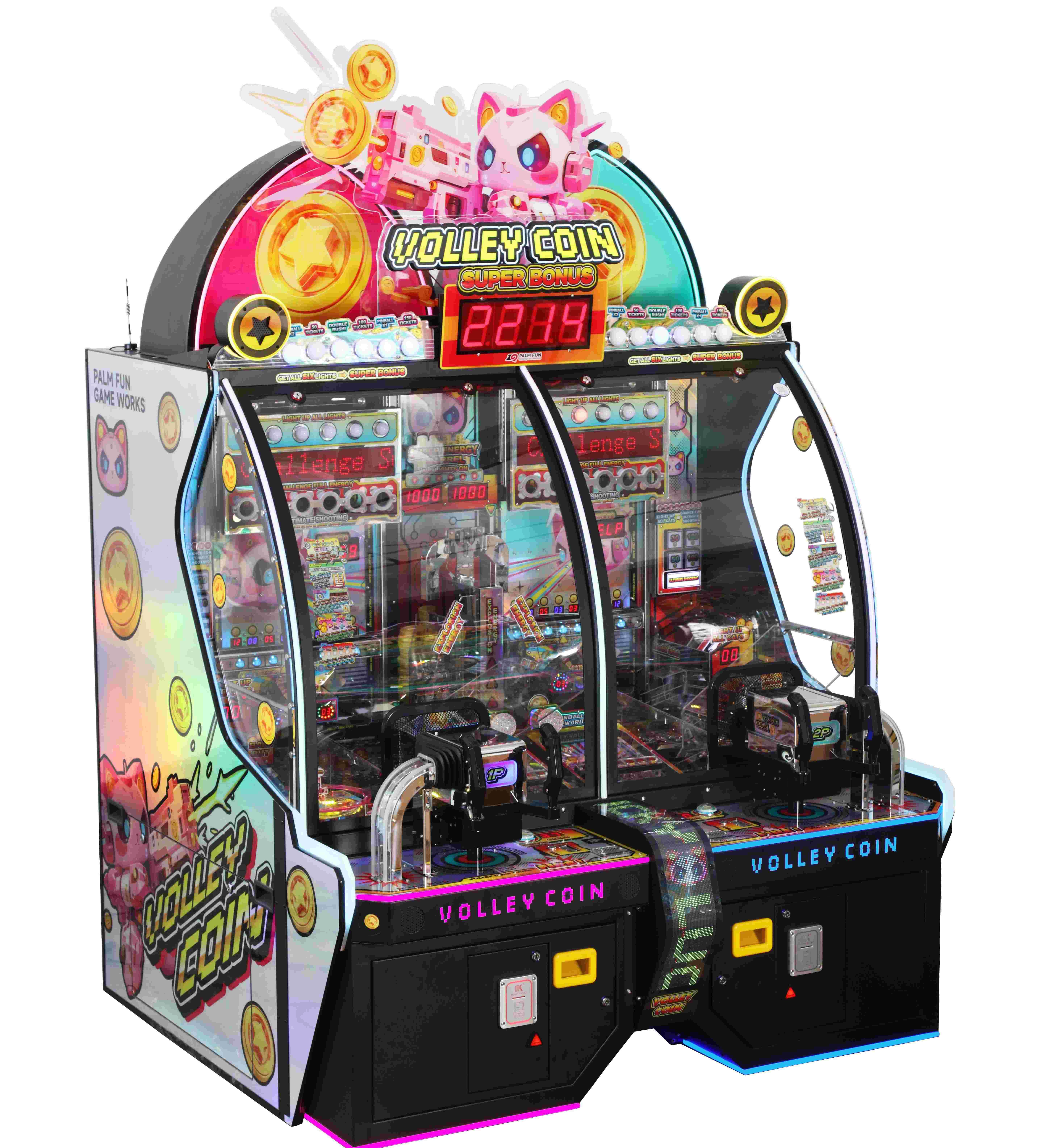
Hybrid Shooting & Pushing | Coin Pusher Arcade Ticket Redemption Machine
Volley Coin is an innovative arcade ticket redemption machine developed by Palm Fun Electronics. Combining the excitement of a fast-paced token shooter game with the proven earning power of a traditional coin pusher machine, Volley Coin offers a fresh and engaging gameplay experience that appeals to players of all ages.
Copyright © 2026 PALM FUN All Rights Reserved. | Privacy Policy • Terms and Conditions | Sitemap
palmfunarcade
Palm Fun Arcade Game
Whatsapp: +8618126837443
PalmFun Arcade
PalmFun_Arcade
PALM FUN Redemption Machine