








Manufacturer audit checklist for redemption arcade ball game
- How to Qualify a Redemption Arcade Equipment Manufacturer
- Verify legal identity, factory ownership, and production scope
- Assess engineering capability and product development control
- Review operational evidence instead of relying on showroom demonstrations
- Technical, Safety, and Commercial Acceptance Checklist
- Inspect mechanical construction and player-facing durability
- Audit electrical safety and applicable market requirements
- Confirm game logic, redemption control, and revenue settings
- Commercial Due Diligence Before Placing the Order
- Validate total cost of ownership and site readiness
- Examine contract terms, quality gates, and shipment protection
- Measure supplier support and long-term partnership potential
- Why PALM FUN Belongs on the Qualified Supplier Shortlist
- Established product development and manufacturing platform
- Product range aligned with operator and distributor needs
- How to complete the final supplier decision
- Frequently Asked Questions
For buyers evaluating a redemption arcade ball game, a manufacturer audit should verify much more than cabinet appearance or quoted price. The review should cover factory ownership, engineering competence, mechanical durability, electrical safety, ticket and prize logic, documentation, spare parts, production controls, shipment protection, and after-sales response. A reliable audit helps operators determine whether a supplier can deliver a commercially viable redemption game machine that withstands repeated public use, supports predictable maintenance, and complies with the requirements of the target market. The following checklist is designed for arcade investors, family entertainment centers, distributors, shopping mall operators, and project owners comparing pinball arcade equipment and related redemption games.
How to Qualify a Redemption Arcade Equipment Manufacturer
Verify legal identity, factory ownership, and production scope
Begin with supplier identity. Request the registered Guangzhou Palm Fun Electronics Co., Ltd., business license, factory address, export records, and the name of the entity responsible for warranty obligations. A trading company may offer useful sourcing services, but buyers should understand whether the quoted supplier designs and manufactures the machine or subcontracts the entire project. The audit should distinguish between an original equipment manufacturer, a contract assembler, and a reseller because each model presents different levels of control over engineering changes, quality assurance, and spare-parts availability.
Factory ownership is not automatically proof of quality, so the physical production scope also requires verification. Ask for a live video inspection or an on-site audit showing assembly stations, electrical testing areas, finished-goods storage, packaging operations, and quality records. The facility should have identifiable processes for incoming inspection, component assembly, functional testing, defect correction, and final release. Buyers should also confirm whether the production capacity shown is dedicated to amusement equipment or shared with unrelated products that may affect lead times.
Assess engineering capability and product development control
A serious supplier should be able to explain the machine’s game flow, ball-launch mechanism, target or ramp construction, sensor arrangement, ticket calculation, control board, display system, and service access points. Engineering drawings, wiring diagrams, component specifications, and revision histories provide stronger evidence than promotional photographs. Ask how design changes are approved and recorded. Uncontrolled substitutions can alter motor torque, sensor accuracy, sound levels, payout behavior, or cabinet safety after the sample has been approved.
Request a bill of materials or at least a controlled list of critical components. Particular attention should be given to motors, solenoids, belts, bearings, switches, optical sensors, power supplies, display modules, ticket dispensers, and control boards. A manufacturer should identify approved alternatives and explain whether replacements are interchangeable. For distributors, this information supports local service training and reduces the risk of a machine becoming unusable because one proprietary component is unavailable.
Review operational evidence instead of relying on showroom demonstrations
A showroom demonstration normally represents a clean, carefully prepared unit. The audit should therefore include evidence from machines operating in real venues, preferably with photographs, maintenance records, uptime information, and customer references that can be independently contacted. Ask how many units of the same model have been produced, how long the design has been in commercial operation, and which markets have accepted it.
Testing should reproduce actual usage. A buyer can request a continuous-play demonstration, repeated ball cycles, ticket dispensing tests, cabinet impact checks, and recovery after power interruption. The supplier should explain the expected service interval for wear parts and the procedure for clearing jams. For a family entertainment center, reliability during weekends and school holidays matters more than an attractive first impression.
Technical, Safety, and Commercial Acceptance Checklist
Inspect mechanical construction and player-facing durability
The cabinet should be checked for material thickness, joint strength, leveling feet, caster quality, ventilation, door hinges, lock points, and access-panel design. Transparent panels require particular attention because scratches, cracks, loose fasteners, and difficult cleaning procedures can reduce perceived quality and increase labor costs. Ball paths, ramps, targets, guides, and return channels should be inspected for alignment and areas where balls can accumulate.
Every moving assembly should be evaluated for noise, vibration, heat generation, and accessibility. A durable commercial machine generally uses serviceable components and provides sufficient clearance for technicians to replace a belt, sensor, motor, or switch without removing the entire playfield. Buyers should document the tools required for routine maintenance and confirm whether replacement procedures are available in English and in the distributor’s local language.
Audit electrical safety and applicable market requirements
Electrical evidence should include rated voltage, frequency, current consumption, grounding method, fuse specifications, power-entry protection, cable routing, and emergency shutoff behavior where applicable. The supplier should explain how the equipment is tested before shipment and whether the final machine is configured for the destination country. A certificate for one component does not automatically certify the assembled amusement machine, so the buyer should ask which documents apply to the complete product.
Relevant requirements vary by jurisdiction and machine design. The International Electrotechnical Commission standards catalogue can help buyers identify applicable electrical safety standards, while the ISO 9001 quality management overview explains the purpose of a controlled quality system. For materials placed on the European market, buyers should also review the official European Commission RoHS Directive information. These references do not replace a local compliance assessment, but they provide a sound basis for asking precise questions about conformity, technical files, and supplier declarations.
Confirm game logic, redemption control, and revenue settings
Redemption equipment requires transparent control of play value. The audit should document game duration, ball quantity, skill elements, ticket output, bonus conditions, attract mode, operator settings, and accounting functions. Buyers need to know whether ticket values can be adjusted by authorized staff and whether the settings are protected by a key switch, password, or service menu. A machine that cannot be configured for local ticket pricing may create operational problems when moved between venues.
Ask for a clear explanation of how tickets are counted and what happens during a jam, partial dispense, communication failure, or power outage. If an electronic ticket system is used, confirm compatibility with the venue’s redemption counter or card-based access platform. If physical tickets are used, inspect the dispenser path and test low-ticket, high-ticket, and empty-roll conditions. The supplier should provide a method for reconciling meter readings with cashless or coin-operated transactions.
| Audit area | Evidence to request | Commercial risk reduced | Acceptance approach |
|---|---|---|---|
| Factory quality control | Inspection plan, test records, defect log, final checklist | Inconsistent units and hidden assembly defects | Review sample records and observe final testing |
| Electrical safety | Ratings, wiring diagram, test method, declarations where applicable | Shock, fire, installation, and market-compliance risk | Match documents to the exact finished model |
| Mechanical reliability | Wear-part list, endurance test, maintenance procedure | Downtime and high technician labor | Perform repeated-cycle and jam-recovery tests |
| Redemption controls | Setting guide, meter functions, ticket-dispense logic | Incorrect payout and revenue leakage | Verify operator access and fault recovery |
| After-sales support | Warranty terms, response process, spare-parts quotation | Extended downtime and unsupported equipment | Obtain named contacts and service time targets |
Commercial Due Diligence Before Placing the Order
Validate total cost of ownership and site readiness
The purchase price is only one part of the investment. Buyers should calculate freight, import duties, local delivery, installation, payment-system integration, floor preparation, electrical work, replacement parts, consumables, and technician training. Confirm the packed dimensions and gross weight early because a machine that fits the showroom may not pass through the building entrance, elevator, or service corridor.
Site planning should cover power outlets, circuit capacity, ventilation, customer circulation, queue space, lighting, noise, and visibility from the prize counter. A high-engagement ball game benefits from placement in a visible traffic area, but the cabinet must not obstruct emergency routes or create trip hazards. The supplier should provide dimensional drawings, power data, recommended clearance, and installation instructions before the final layout is approved.
Examine contract terms, quality gates, and shipment protection
The purchase contract should identify the exact model, configuration, voltage, language, branding, accessories, spare-parts package, packaging standard, inspection procedure, delivery date, warranty period, and remedy for nonconforming goods. Photographs alone are insufficient for acceptance because they rarely define internal wiring, payout settings, or component substitutions. A pre-shipment inspection should include serial-number records, a video of the tested machine, a checklist signed by the supplier, and an agreed process for reporting transit damage.
Packaging deserves its own audit. Check whether fragile panels are protected from point impact, whether moving parts are secured, whether moisture barriers are used for long-distance transport, and whether shock-sensitive components are isolated. The buyer should request loading photographs and confirm that manuals, keys, cables, spare parts, and certificates are packed in a labeled document pouch. These details frequently determine whether installation begins on schedule.
Measure supplier support and long-term partnership potential
Ask who handles technical questions after delivery, how quickly replacement parts can be quoted, whether remote troubleshooting is available, and how software or control-board revisions are managed. A robust support program includes exploded diagrams, wiring maps, fault codes, preventive-maintenance schedules, troubleshooting videos, and a recommended spare-parts inventory. Distributors should also assess whether the manufacturer can provide product training, marketing images, localized manuals, and private-label assistance.
References should be relevant to the buyer’s intended application. A supplier experienced in small indoor arcades may not have the same capability for large family entertainment centers, franchised venues, or export distribution. Compare response quality during the quotation stage: clear technical answers, consistent specifications, and timely documents often indicate stronger project discipline than the lowest initial offer.
Why PALM FUN Belongs on the Qualified Supplier Shortlist
Established product development and manufacturing platform
PALM FUN was founded in 2015 and specializes in mechanical lottery machines, coin pusher machines, raffle machines, and innovative gaming equipment. Our work covers research and development, design, production, and sales, allowing project owners to evaluate product concepts and manufacturing execution through one coordinated supplier. Our 3,000-square-meter factory supports organized assembly, testing, and product development activities, while our development engineers focus on technology, play value, and user experience.
For buyers comparing Coin Pusher Arcade Ticket Redemption Machine options, our product portfolio reflects the importance of mechanical interaction, visual attraction, and redemption functionality. The Larva Series Coin Pusher Arcade extends that category with ball-drop and ticket-redemption elements. These product types can complement a broader arcade mix that includes shooting games, prize-oriented attractions, and other commercial amusement equipment.
Product range aligned with operator and distributor needs
Our portfolio includes single player arcade equipment, coin-operated attractions, redemption games, and arcade games machines designed for commercial entertainment environments. Buyers reviewing arcade machines for sale can compare cabinet footprint, player capacity, game mechanics, ticket logic, visual theme, and service access across categories instead of evaluating one isolated machine.
PALM FUN’s manufacturing focus is supported by international market recognition, with products used and popular in more than 50 countries. This geographic reach is relevant to distributors because it indicates experience with varied venue types, electrical configurations, shipping conditions, and customer expectations. Our objective is to develop long-term partnerships through product support and service rather than treating each order as a one-time transaction. Buyers seeking a High Quality Redemption Arcade MachinesManufacturer should still complete the full technical and commercial audit, but PALM FUN provides the company profile, product breadth, and engineering foundation appropriate for that review.
How to complete the final supplier decision
After documentation review, score each supplier against the same weighted criteria: product reliability, compliance evidence, payout control, serviceability, lead time, total cost of ownership, warranty clarity, and communication quality. A practical procurement process uses a sample approval, written acceptance criteria, pre-shipment inspection, and a post-installation review after the first operating period. This creates an auditable trail and makes supplier performance measurable.
PALM FUN aims to become a leading global manufacturer of redemption game machines while continuing to improve mechanical entertainment and lottery equipment. For investors and operators, the most valuable supplier is not necessarily the one with the lowest quote; it is the manufacturer able to deliver consistent units, explain the technology, support installation, and protect revenue over the equipment lifecycle.
Frequently Asked Questions
What should buyers verify first when auditing a redemption arcade ball game manufacturer?
Buyers should first verify the supplier’s legal identity, factory address, production scope, engineering capability, quality-control process, and responsibility for warranty support. This establishes whether the supplier is an original manufacturer, contract assembler, or reseller.
Which technical documents should a manufacturer provide before purchase?
The supplier should provide applicable electrical ratings, wiring diagrams, component specifications, game-setting information, maintenance procedures, spare-parts lists, inspection records, warranty terms, and relevant conformity or material declarations for the exact finished model.
How can operators test the reliability of a ball-based redemption game?
Operators can request repeated-play demonstrations, continuous-cycle testing, ball-return checks, ticket-dispensing tests, power-interruption recovery, jam clearing, and inspection of moving parts, sensors, motors, belts, ramps, and service access points.
What should be included in the purchase contract?
The contract should identify the exact model, voltage, configuration, language, branding, accessories, spare parts, packaging, inspection procedure, delivery schedule, warranty period, and remedies for nonconforming goods or transit damage.
Why is after-sales support important for redemption equipment?
After-sales support affects uptime and operating revenue. Buyers should confirm technical response channels, spare-parts availability, troubleshooting documentation, remote assistance, warranty procedures, software or control-board revision management, and technician training.
What is PALM FUN’s manufacturing experience?
PALM FUN was founded in 2015 and specializes in mechanical lottery machines, coin pusher machines, raffle machines, and innovative gaming equipment. The company operates a 3,000-square-meter factory, has development engineers, and reports product recognition in more than 50 countries.
Recommended for you
Buy Custom Arcade Machine | Enhance Fun with PALM FUN
OEM & ODM Customization Options for Larva Game Cabinets
Wholesale coun pusher manufacturer and supplier in Asia
How to start a How much does it cost to start an arcade business? business in US
FAQs
Why redemption ticket machines are popular?
2.Redemption machines are becoming the most important breakthrough to enhance the sustainable operation of indoor arcade game halls.
3.Players are of all ages and they continue to expand.
How to choose the exchange gifts of the tickets(reward points)?
2. Gifts should be diverse. This refers to the variety of items available, providing players with more choices. Everyone's preferences are different, especially adults who have higher expectations for gifts. The venue should strive to meet the diverse needs of these players.
3. Gifts should be fashionable. The younger generation that follows trends is very interested in the hottest items of the moment. If the venue can keep up with the latest trends, it can attract the majority of consumers.
4. Gifts should be innovative. Especially during holidays and seasons, it's a good idea to try out new approaches, creating a competitive advantage with unique offerings. For example, the current trend of combining pop culture and blind box culture.
How to select and match redemption machines?
2. the number of redemption game configuration: according to the characteristics of redemption machine, the proportion of redemption game configuration generally accounts for 30±5% of the whole field.
3. there are a lot of equipment on the market now, but less innovative, so the choice should be targeted in management and planning. We can divide redemption machines into children's, adults's, families, etc., according to different standards, with complete varieties and many styles, so as to give guests more choices and more changes. Specific can refer to the following:
① Inserting tokens in high frequency (mainly in mechanical redemption machines)
② Skill based games (mainly in mechanical redemption machines)
③ Games with edutainment significance (mainly in video redemption machines)
④ Entertaining games (mainly in video redemption machines)
Effectively solve the pain points of the site and consume the amount of coins deposit.
So the stock quantity of pre-purchased tokens is an issue must be concerned, especially in the highly competitive current market. Only when the amusement park maintains a healthy cycle of token sales, consumption, stockpiling, consumption, and sales again can it ensure sustained growth and profitability.
The revenue proportion of redemption machines
You may also like
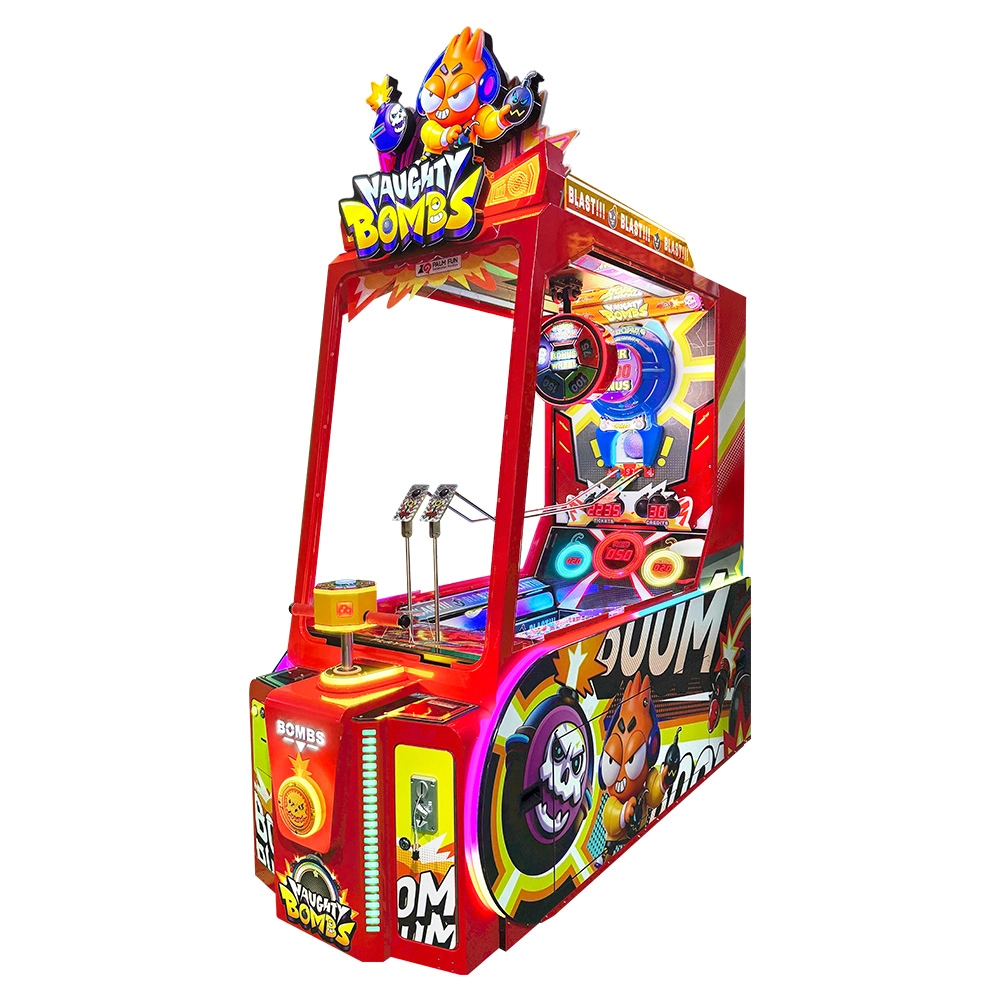
Naughty Bombs Ball Drop Redemption Arcade Game Machine
Naughty Bombs is a ball-drop redemption arcade game featuring rolling-ball gameplay, colored targets, ticket prizes, surprise bonus rewards, lighting and sound effects. Players use timing to launch and drop balls toward colored target areas. The product is presented for arcade, family entertainment center and other entertainment-venue projects, with customizable 110V / 220V AC voltage configuration.
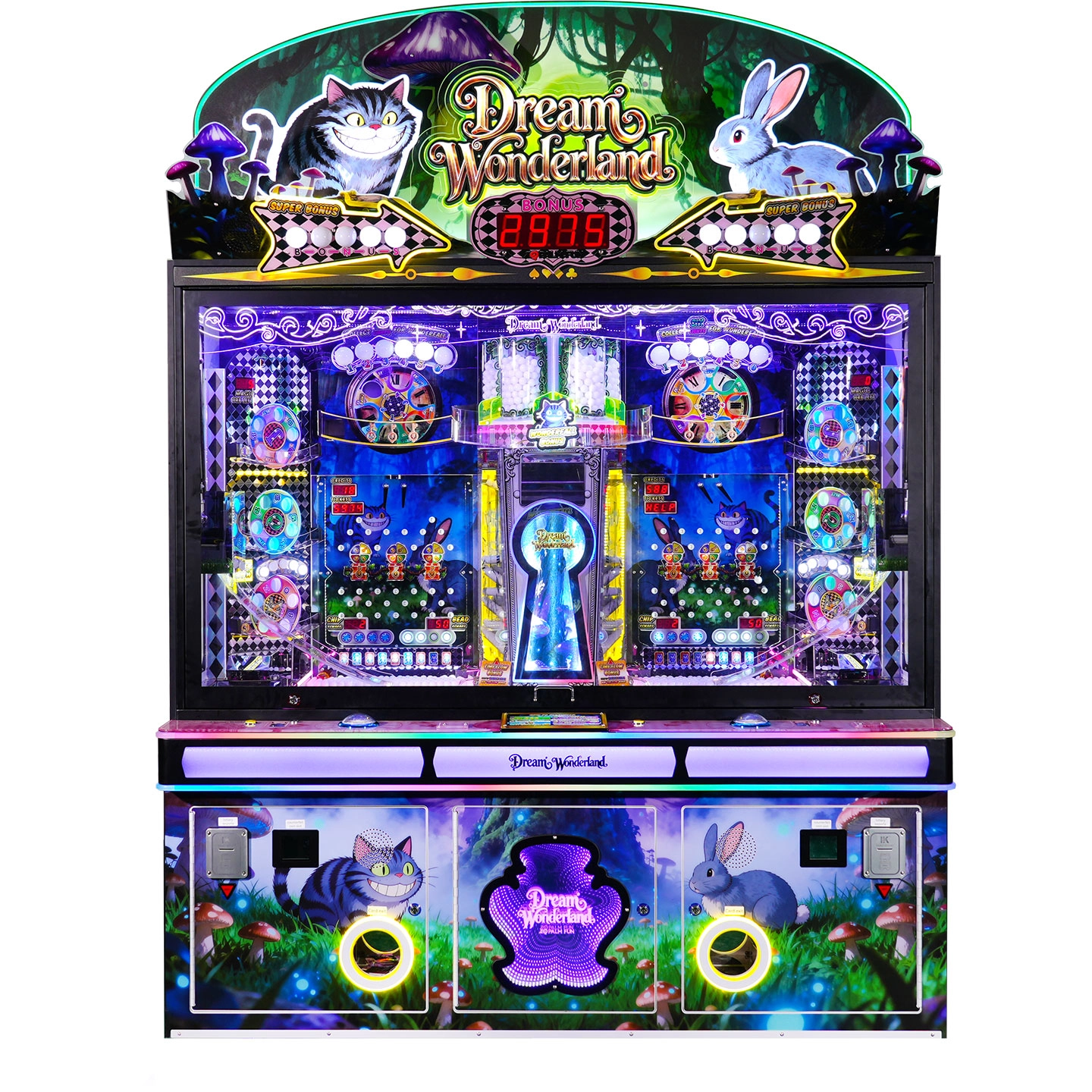
Dream Wonderland Marble Pusher Redemption Game
Enter Dream Wonderland — a magical marble pusher adventure filled with glowing lights, magic orbs, bonus wheels, collectible character cards, and exciting jackpot challenges.
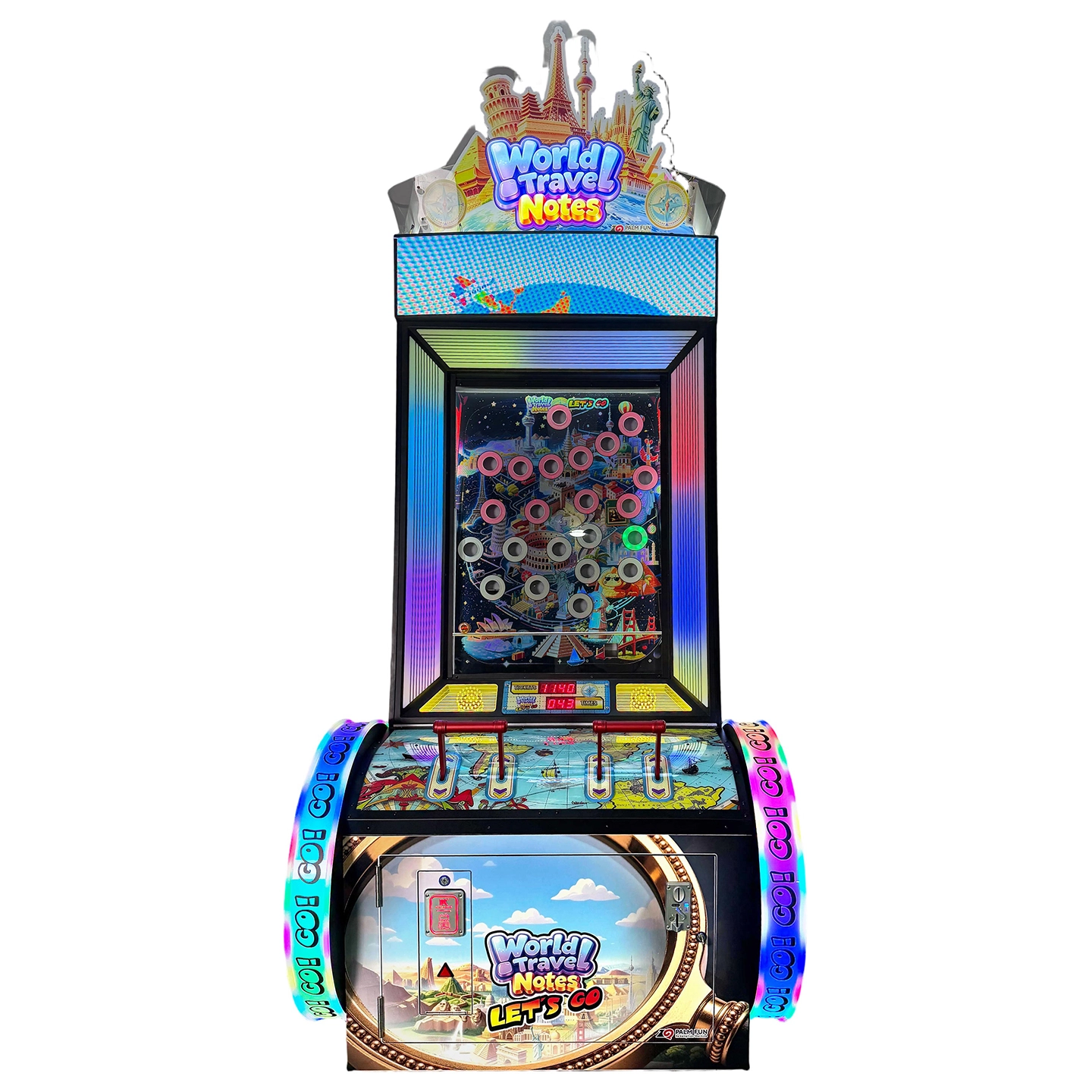
World Travel Notes – Balance Ball Redemption Arcade Game
World Travel Notes is a skill-based balance ball redemption game with a fun world-travel theme. Players use two handles to control the balance bar and guide the ball into each target hole. As the game progresses, the targets become more challenging, leading players toward the final grand prize. With colorful world-travel graphics, dynamic RGB lighting, a live score display, and progressive difficulty, World Travel Notes is designed to attract attention and encourage repeat play in arcades, FECs, shopping malls, and other entertainment venues.
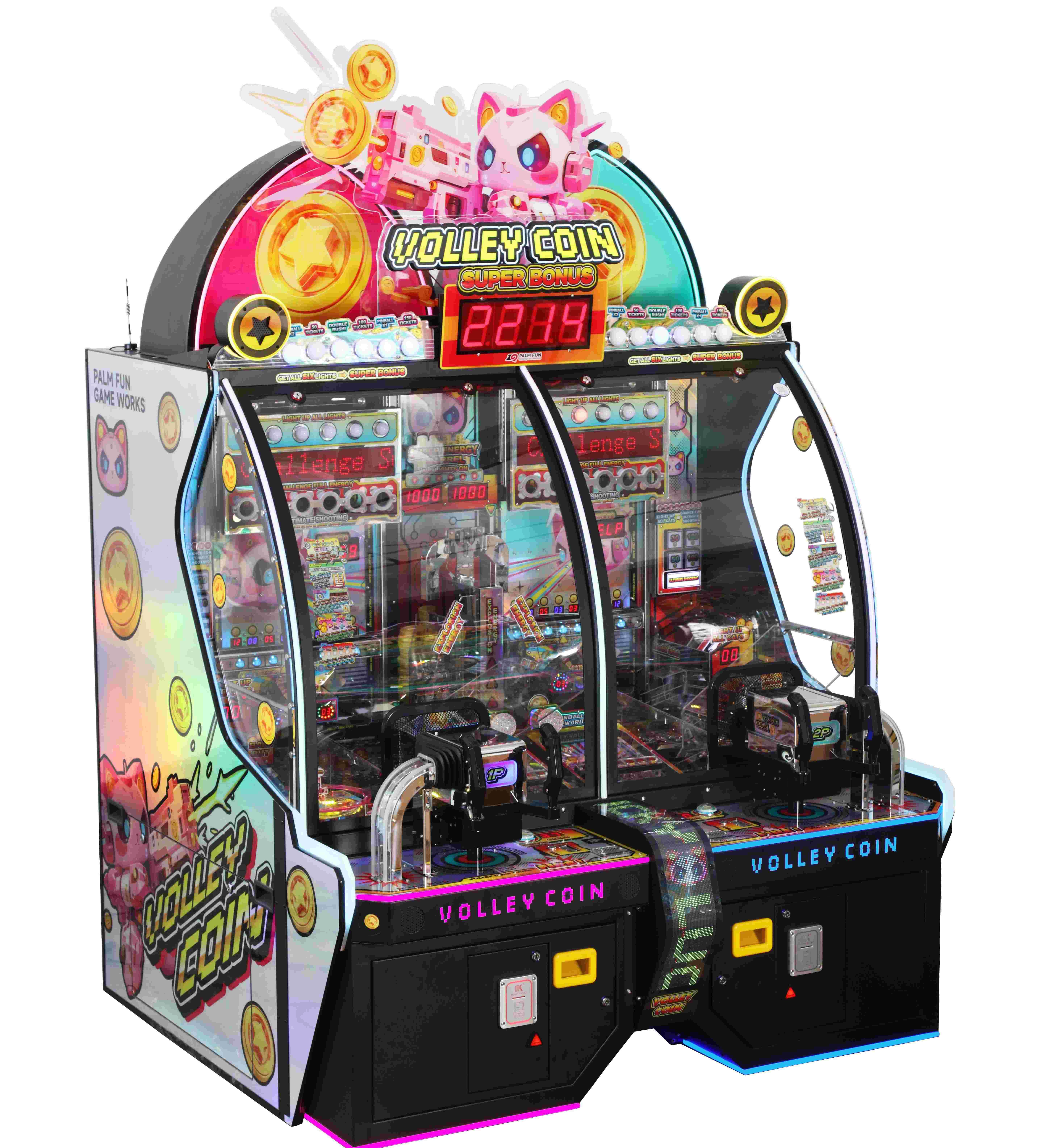
Hybrid Shooting & Pushing | Coin Pusher Arcade Ticket Redemption Machine
Volley Coin is an innovative arcade ticket redemption machine developed by Palm Fun Electronics. Combining the excitement of a fast-paced token shooter game with the proven earning power of a traditional coin pusher machine, Volley Coin offers a fresh and engaging gameplay experience that appeals to players of all ages.

Copyright © 2026 PALM FUN All Rights Reserved. | Privacy Policy • Terms and Conditions | Sitemap
palmfunarcade
Palm Fun Arcade Game
Whatsapp: +8618126837443
PalmFun Arcade
PalmFun_Arcade
PALM FUN Redemption Machine