








Quality Assurance: Testing and Certification for Larva Game Machines
Comprehensive guide to quality assurance, testing protocols, and global certification pathways for Larva series coin pusher and redemption cabinets—covering mechanical endurance, electronic safety, EMC/EMI compliance, environmental stress screening, regulatory labeling, factory acceptance testing, and supplier audit best practices to minimize downtime, ensure regulatory acceptance, and maximize lifetime value for operators and distributors.
- Verification protocols for Larva-series amusement cabinets
- Core functional verification and acceptance criteria
- Mechanical endurance and lifecycle validation
- Ticketing, payout fairness, and accounting integrity
- Regulatory compliance and safety testing for electronic amusement machines
- Electrical safety, EMC, and international electro-technical standards
- Third-party safety certification and lab selection
- Material compliance and environmental directives
- Quality control methods and production-stage testing
- Incoming inspection and supplier qualification
- In-line testing and statistical process control
- Final acceptance and site-level commissioning
- Data-driven QA: measurement, analytics, and continuous improvement
- Operational telemetry and failure analytics
- Software lifecycle, firmware integrity, and security testing
- Quality KPIs and ROI impact for operators
- PALM FUN capabilities: ensuring compliant, durable Larva coin pusher products
- Manufacturing discipline and certified processes
- Product portfolio and compliance-ready offerings
- Global reach, after-sales and partnership model
- How PALM FUN supports procurement and project owners
- Frequently Asked Questions
Comprehensive guide to quality assurance, testing protocols, and global certification pathways for Larva series coin pusher and redemption cabinets—covering mechanical endurance, electronic safety, EMC/EMI compliance, environmental stress screening, regulatory labeling, factory acceptance testing, and supplier audit best practices to minimize downtime, ensure regulatory acceptance, and maximize lifetime value for operators and distributors.
Verification protocols for Larva-series amusement cabinets
Core functional verification and acceptance criteria
Buyers should require documented functional acceptance tests that map to procurement specifications: ticket dispensing accuracy, coin mechanism reliability, actuator and motor torque thresholds, sensor calibration tolerances, display and sound performance, and ticket/coin accounting reconciliation. Supplier-provided Factory Acceptance Test (FAT) reports must include pass/fail criteria, test vectors, and raw log extracts for traceability. A formal Acceptance Test Procedure (ATP) reduces disputes at delivery and supports warranty claims.
Mechanical endurance and lifecycle validation
Redemption fixtures must be validated for mean time between failures (MTBF) and cycle endurance. Typical mechanical qualification includes accelerated cycle testing on pushers and drops, cable flex testing, and vibration fatigue runs that simulate multi-year floor use. Procurement teams should insist on documented sample-sampling plans for batch qualification and confirm that wear-parts (belts, gears, coin trays) meet defined lifecycles measured in cycles or operating hours.
Ticketing, payout fairness, and accounting integrity
Operators demand provable fairness and revenue accountability. Test regimes must validate ticket dispensers, sensors, and ticket-to-credit mapping across firmware revisions. Evidence of audit trails, non-repudiation logs, and secure firmware update mechanisms mitigates fraud and supports regulatory compliance where prize distribution is regulated as a lottery or sweepstakes.
Regulatory compliance and safety testing for electronic amusement machines
Electrical safety, EMC, and international electro-technical standards
Global markets require compliance to recognized standards: electrical safety and hazard mitigation per internationally-accepted frameworks (for example, ISO 9001 for quality systems and guidance), product-level safety standards overseen by IEC bodies (IEC), and region-specific marking such as CE for the European Union (CE marking). Electromagnetic compatibility (EMC) testing versus EN/IEC emissions and immunity standards should be performed in accredited labs to ensure the device does not create or suffer from radio interference on venue floors.
Third-party safety certification and lab selection
Selecting an accredited testing laboratory (e.g., UL or equivalent) is critical. Third-party testing provides impartial safety verification and is frequently required by venue insurance policies. Referencing established safety houses such as UL provides recognized marks for North American markets and can accelerate commercial acceptance.
Material compliance and environmental directives
Material-level compliance is essential for global distribution: RoHS and REACH compliance for restricted substances, flame-retardant rating per UL 94 for plastics, and energy efficiency labeling where applicable. Documentation of bill-of-materials (BOM) and supplier declarations simplifies import inspections and reduces hold times at customs.
Quality control methods and production-stage testing
Incoming inspection and supplier qualification
Effective incoming quality control (IQC) begins with supplier audits, material traceability, and incoming sampling plans that follow AQL principles. Critical electrical components (PSUs, motor controllers, sensors) should have qualifying test certificates and lot traceability to minimize counterfeit risk. Buyers should require material certificates (CoC) and inspection reports before release to the assembly line.
In-line testing and statistical process control
Manufacturers should implement automated in-line checks where possible (power-up self-tests, burn-in cycles, automated optical inspection for PCB assemblies) and use statistical process control (SPC) to track defect trends. This approach reduces field failures and shortens mean time to repair (MTTR) when issues arise after deployment.
Final acceptance and site-level commissioning
Factory Acceptance Testing (FAT) should be followed by Site Acceptance Testing (SAT) during installation. SAT validates real-world performance under venue power conditions, network connectivity for telemetry or ticket accounting systems, and integration with venue management systems. A formal SAT report with signed acceptance certificates protects both buyer and supplier interests.
Data-driven QA: measurement, analytics, and continuous improvement
Operational telemetry and failure analytics
Embedding operational telemetry in machines supports predictive maintenance: logging uptime, error codes, and event sequences. Aggregated fleet data enables identification of early-life failures and recurring component issues. Manufacturers and operators can tune maintenance schedules and spare-part stocking to align with empirically observed failure modes.
Software lifecycle, firmware integrity, and security testing
Redemption systems increasingly rely on embedded software for gameplay, ticket accounting, and remote updates. Secure boot, signed firmware, and verified update channels reduce attack surfaces. Penetration testing and code audits are recommended for systems exposing network interfaces or remote management features.
Quality KPIs and ROI impact for operators
Relevant KPIs include uptime percentage, average time to repair, ticket payout variance, and cost-per-occupied-hour. Strong QA reduces unplanned downtime and improves life-cycle economics. Buyers should request KPI baselines and warranty terms tied to measurable performance.
| Test Domain | Traditional Approach | Modern/AI-driven Enhancement |
|---|---|---|
| Functional Testing | Manual scripted checks and operator observation | Automated test rigs with machine vision and anomaly detection via ML |
| Predictive Maintenance | Reactive repairs based on failure reports | Telemetry-based models predicting component end-of-life |
| EMC/Compliance Cycle | Discrete lab tests at certification milestones | Pre-compliance scans during development and digital twin simulations |
| Quality Trend Analysis | Monthly manual defect aggregation | Real-time dashboards and root-cause clustering |
PALM FUN capabilities: ensuring compliant, durable Larva coin pusher products
Manufacturing discipline and certified processes
Founded in 2015, PALM FUN specializes in high-quality mechanical lottery machines, coin pusher machines, and raffle machines. The company maintains a 3,000 m2 factory with formal quality management processes designed to align with internationally recognized frameworks. Our development engineers implement design-for-reliability, life-cycle testing, and traceable BOM controls so that finished units meet operator expectations for uptime and maintainability.
Product portfolio and compliance-ready offerings
PALM FUN's catalog includes market-proven designs ranging from compact single-station play units to large multi-player redemption complexes such as the pinball arcade variant and the single player arcade configuration. For venues seeking hybrid experiences, our Coin Pusher Arcade Ticket Redemption Machine and the Larva Series Coin Pusher Arcade combine mechanical engagement with reliable ticketing systems. Buyers can request pre-shipment FAT evidence and compliance documentation tailored to target markets.
Global reach, after-sales and partnership model
Products are distributed in 50+ countries with support for local certification paths, spare-parts provisioning, and technical training programs. As a High Quality Redemption Arcade MachinesManufacturer, PALM FUN emphasizes long-term partnerships: structured warranty terms, remote diagnostic tooling, and options for telemetry subscriptions that help operators optimize uptime and revenue per machine.
How PALM FUN supports procurement and project owners
For project owners and distributors, PALM FUN supplies complete technical packs (schematics, firmware change logs, test certificates) to accelerate customs clearance and venue acceptance. Our engineering team supports customized ATPs, on-site commissioning, and joint KPI definitions to ensure installations meet financial and operational targets.
Authoritative guidance on safety and standards referenced in this document includes recognized resources such as Wikipedia: Video arcade, ISO 9001, the International Electrotechnical Commission (IEC), the European Commission guidance on CE marking, and UL testing and certification services.
Procurement checklists and template ATPs are available on request to support buyer due diligence, pre-shipment verification, and site-level commissioning plans.
Contact PALM FUN’s sales team to review product specifications, test evidence, and available certification packages for target markets.
Frequently Asked Questions
What certifications are typically required for redemption game machines when exporting to the EU and North America?
For the EU, CE marking is the baseline and typically requires conformity with applicable directives for electromagnetic compatibility and product safety; for North America, UL or equivalent safety certification is commonly required. Additionally, RoHS/REACH declarations for restricted substances and documented quality management evidence (e.g., ISO 9001) accelerate customs clearance and venue acceptance.
How long does full compliance testing and certification usually take before shipment?
Lead times vary by scope and market: basic safety and EMC testing in accredited labs commonly requires 4–8 weeks including scheduling; full certification cycles with design iterations or corrective actions can extend to 12 weeks or more. Early engagement with testing houses and pre-compliance scans shorten total time to market.
What should buyers include in a Factory Acceptance Test (FAT) for coin pusher cabinets?
FAT should include functional checklists (mechanics, motors, sensors), burn-in cycles, ticket/coin accounting reconciliation, firmware version confirmation, and signed pass/fail logs. Include clear acceptance criteria, measurement tolerances, and a remediation plan for failing items to avoid disputes on arrival.
How can operators reduce field downtime and maintenance costs for redemption machines?
Implementing telemetry-enabled monitoring, stocking critical wear parts, and following supplier-recommended preventive maintenance schedules reduce unplanned outages. Insist on burn-in testing prior to shipment and use statistical process control data to predict component replacements and align spare-part inventory with actual failure patterns.
Are there special considerations for software and firmware in certification processes?
Yes. Firmware must be controlled through secure update mechanisms, with signed firmware and an audit trail for releases. Software changes can trigger re-testing if they affect safety or EMC behaviors. Penetration testing and secure booting are recommended for machines exposing network interfaces or remote management features.
Recommended for you
How to start a arcade machine marvel vs capcom business in China
Wholesale classic arcade game station manufacturer and supplier in Asia
OEM vs ODM: Custom Options for Parallel Universe Ball Drop
Customizing Roll Ball Arcade Games for Branding and Events
FAQs
How to choose the exchange gifts of the tickets(reward points)?
2. Gifts should be diverse. This refers to the variety of items available, providing players with more choices. Everyone's preferences are different, especially adults who have higher expectations for gifts. The venue should strive to meet the diverse needs of these players.
3. Gifts should be fashionable. The younger generation that follows trends is very interested in the hottest items of the moment. If the venue can keep up with the latest trends, it can attract the majority of consumers.
4. Gifts should be innovative. Especially during holidays and seasons, it's a good idea to try out new approaches, creating a competitive advantage with unique offerings. For example, the current trend of combining pop culture and blind box culture.
How to guide the players to recognize tickets at the beginning setup of the redemption machines?
Never assume that your players already understand the purpose of lottery tickets(reward points). Even in venues that have been in operation for many years, it is still discovered during on-site interviews with players that many of them are not aware. Don't believe it? Just ask consumers at the venue. The machines, redemption counters, materials hung above the venue, and announcements by staff, among others, can all be channels for informing players about the purpose of lottery tickets(reward points). It is essential to do more promotion, create large displays and large cards, and clearly communicate the purpose of lottery tickets(reward points) to the players.
Effectively solve the pain points of the site and consume the amount of coins deposit.
So the stock quantity of pre-purchased tokens is an issue must be concerned, especially in the highly competitive current market. Only when the amusement park maintains a healthy cycle of token sales, consumption, stockpiling, consumption, and sales again can it ensure sustained growth and profitability.
How to perform daily maintenance and servicing on redemption machines?
1. New machine entry performance, as it is relatively unstable in operation at this stage, requires dedicated supervision, timely follow-up, and improvements.
2. Redemption machines are relatively prone to collecting dust, which can lead to mechanical wear and corrosion. Dust can also cause issues with circuit boards, such as conductivity and optical sensor malfunctions. Thus, both internal and external cleanliness of redemption machines are equally important. Regular cleaning schedules for internal and daily cleaning for external components should be established.
3. Timely inspect the quality and durability of certain components. If issues are detected with imaging equipment, for example, replacements are necessary. A thorough understanding and mastery of the machine's performance can help extend its lifespan and ensure normal usage rates. Critical inspection areas include vulnerable parts such as motors, drive belts, gears of ticket dispensers, and sensors.
4. Frequent changes in prize point settings and payout rates are discouraged. Improvements in winning odds should be pursued through other methods and approaches.
5. All machines should have procedures for ticket removal and shredding to protect the ticket dispensers from damage.
6. Monitor changes in payout rates closely, as it directly impacts the cost control of the entire redemption machine system.
7. When employees add tickets, they should verify if the ticket sensors are unobstructed (blocked sensors can prevent ticket dispensing).
8. Have the protective paper on redemption machine's adhesive tape been removed? (Leaving it on can obstruct the ticket slot and ticket dispenser).
9. Responsible personnel should periodically and discreetly check the addition of tickets inside the redemption machines, ensuring that the added tickets match the registered ones.
What is the character of mechanical redemption machine?
You may also like
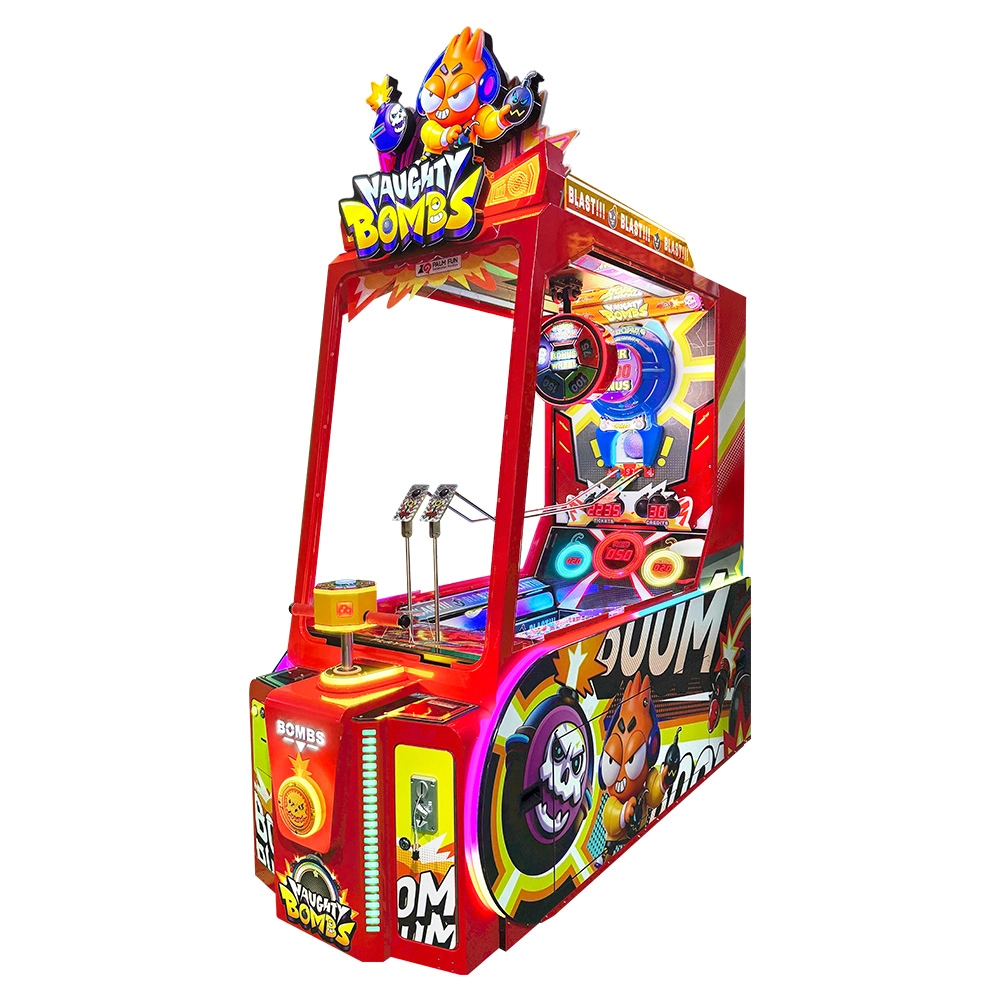
Naughty Bombs Ball Drop Redemption Arcade Game Machine
Naughty Bombs is a ball-drop redemption arcade game featuring rolling-ball gameplay, colored targets, ticket prizes, surprise bonus rewards, lighting and sound effects. Players use timing to launch and drop balls toward colored target areas. The product is presented for arcade, family entertainment center and other entertainment-venue projects, with customizable 110V / 220V AC voltage configuration.
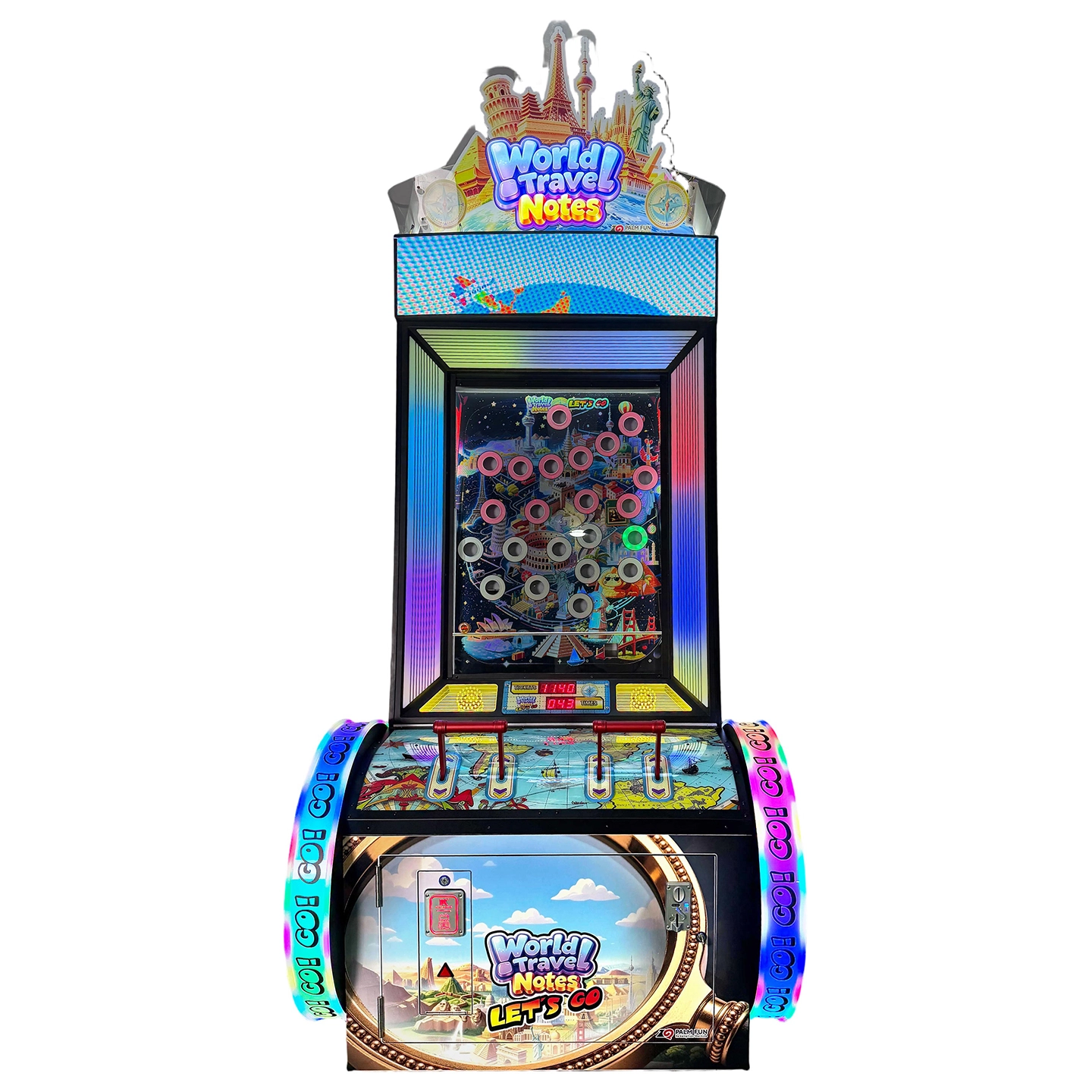
World Travel Notes – Balance Ball Redemption Arcade Game
World Travel Notes is a skill-based balance ball redemption game with a fun world-travel theme. Players use two handles to control the balance bar and guide the ball into each target hole. As the game progresses, the targets become more challenging, leading players toward the final grand prize. With colorful world-travel graphics, dynamic RGB lighting, a live score display, and progressive difficulty, World Travel Notes is designed to attract attention and encourage repeat play in arcades, FECs, shopping malls, and other entertainment venues.
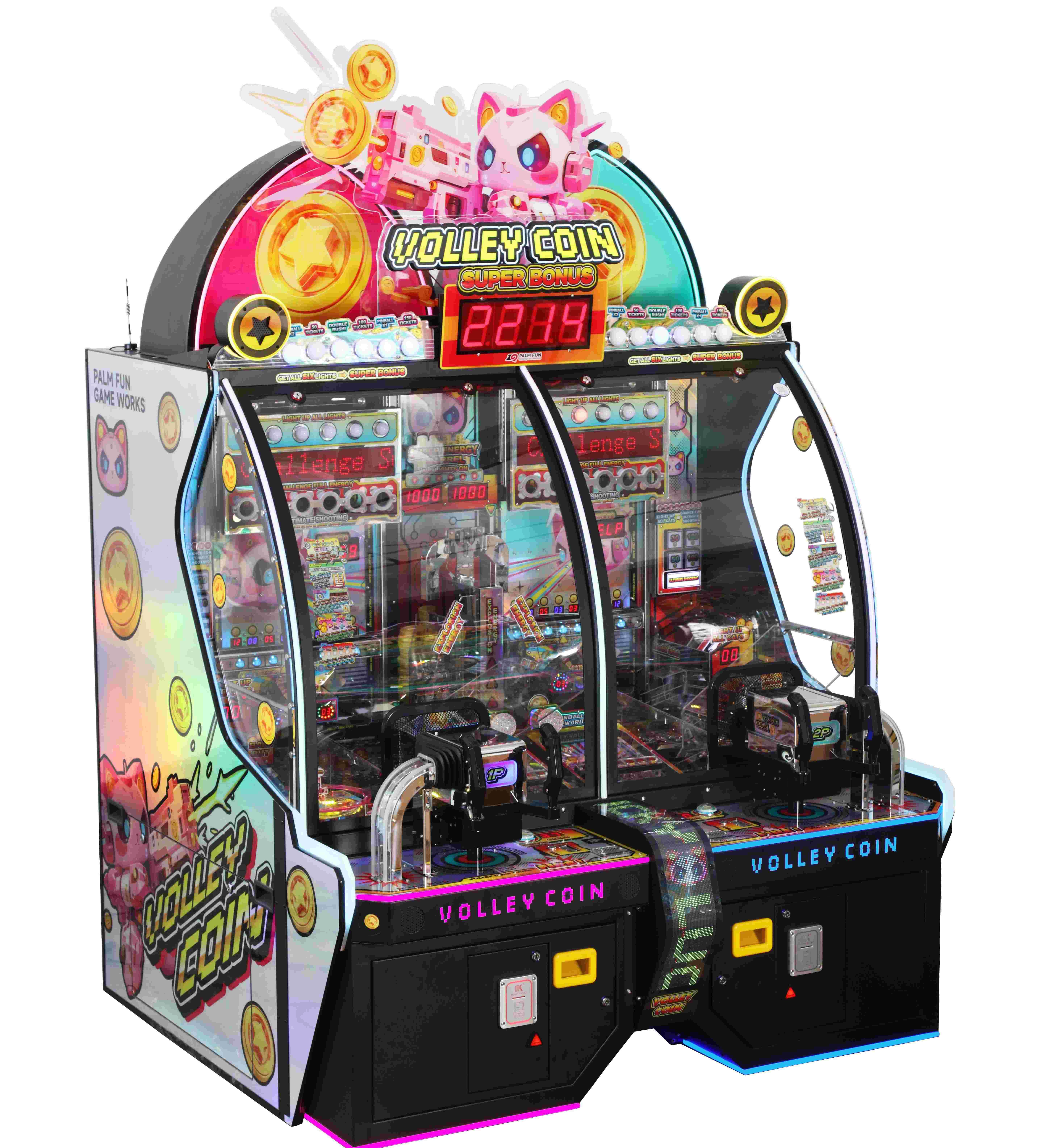
Hybrid Shooting & Pushing | Coin Pusher Arcade Ticket Redemption Machine
Volley Coin is an innovative arcade ticket redemption machine developed by Palm Fun Electronics. Combining the excitement of a fast-paced token shooter game with the proven earning power of a traditional coin pusher machine, Volley Coin offers a fresh and engaging gameplay experience that appeals to players of all ages.
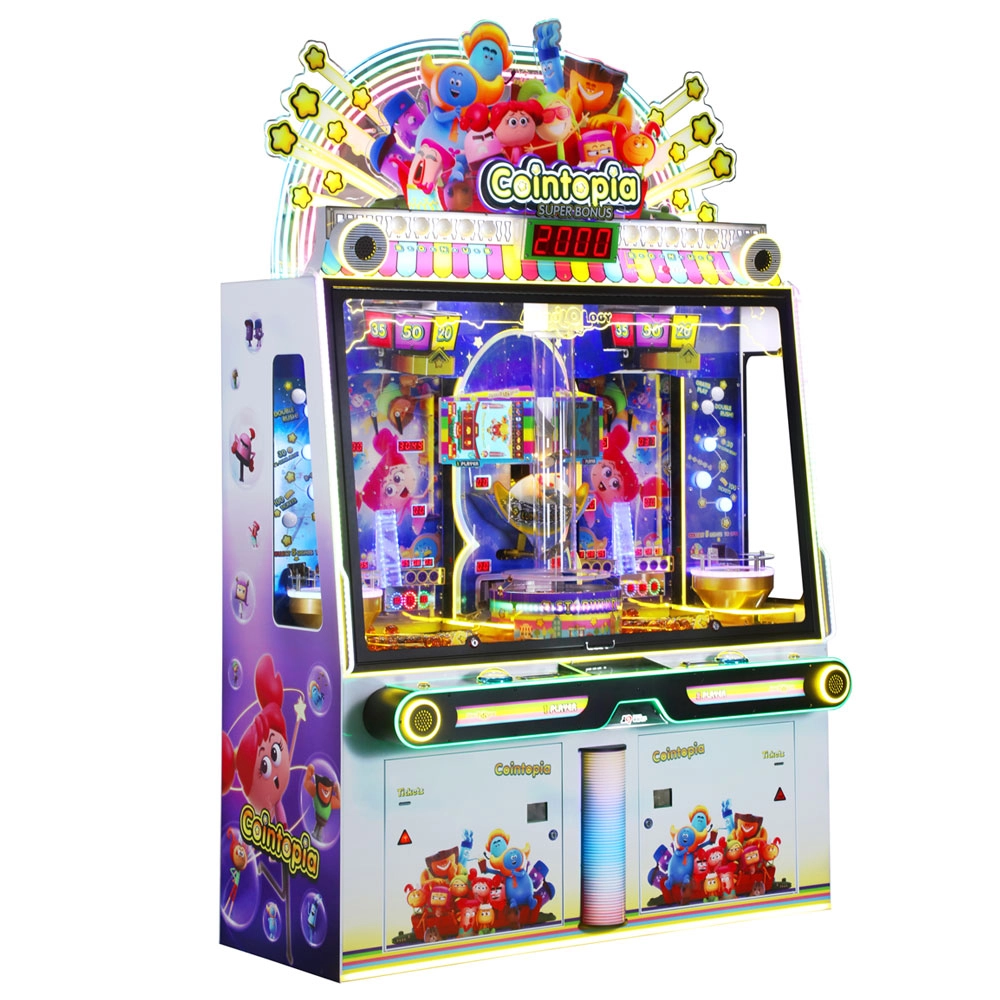
COINTOPIA, Have Fun Together With The Zodiac Buddies in an Utopia
COINTOPIA by PALM FUN is an exciting redemption game machine where players enjoy fun with zodiac buddies in a utopia setting. This ticket redemption machine offers engaging gameplay and rewarding experiences, perfect for family entertainment centers and arcades seeking top-quality redemption games.

Copyright © 2026 PALM FUN All Rights Reserved. | Privacy Policy • Terms and Conditions | Sitemap
palmfunarcade
Palm Fun Arcade Game
Whatsapp: +8618126837443
PalmFun Arcade
PalmFun_Arcade
PALM FUN Redemption Machine