








Redemption arcade ball game ROI: ticket vs prize revenue models
- How Redemption Arcade Ball Games Create Commercial Value
- Ticket-based play builds repeat visits and basket value
- Direct-prize systems simplify the customer proposition
- Revenue model selection should follow the venue profile
- ROI Calculation: Ticket Revenue Versus Prize Revenue
- The core operating equation
- Illustrative comparison for investment screening
- Utilization, uptime, and payback sensitivity
- Procurement and Operational Controls That Protect Margin
- Evaluate the complete equipment specification
- Control prize economics and customer fairness
- Build a service and reporting plan before delivery
- Why PALM FUN Supports Scalable Redemption Projects
- Manufacturing capability aligned with commercial requirements
- Product categories for varied venue economics
- International reputation and partnership support
- Frequently Asked Questions
Redemption arcade ball games can generate revenue through two primary mechanisms: awarding tickets that players exchange for merchandise, or delivering prizes directly through a controlled payout system. The stronger model depends on venue traffic, local regulations, prize purchasing costs, game difficulty, operator labor, floor space, and the customer journey surrounding each machine. For buyers evaluating a pinball arcade concept or a broader redemption game machine portfolio, the correct ROI decision is not based on cabinet price alone. It requires a complete contribution-margin analysis covering play price, repeat sessions, ticket liability, prize inventory, maintenance, utilization, payment systems, and the machine’s ability to support a profitable redemption ecosystem.
How Redemption Arcade Ball Games Create Commercial Value
Ticket-based play builds repeat visits and basket value
In a ticket economy, players pay for attempts and receive tickets according to performance. Tickets may be physical or digital, and they are later exchanged for merchandise at a redemption counter or kiosk. This structure gives operators control over perceived reward value. A low-cost item can require a high ticket count, while High Quality merchandise can encourage players to save tickets across multiple visits. The model therefore supports repeat visitation, cross-play between machines, and higher spending per guest when the venue offers a well-designed prize ladder.
The commercial advantage is not simply the price charged per game. A successful ticket operation can increase the total value of a customer visit by connecting gameplay with prize browsing, food and beverage purchases, birthday-party packages, and other attractions. The business must nevertheless account for ticket redemption cost. A prize wall stocked without sales data can tie up working capital, create slow-moving inventory, and weaken the relationship between the ticket price and the actual cost of goods sold.
Direct-prize systems simplify the customer proposition
A direct-prize format awards a visible outcome such as a toy, capsule, coupon, or merchandise item after a successful play or a defined sequence of plays. This approach is easy for first-time visitors to understand and can work particularly well in locations with short dwell times, including shopping centers, cinemas, convenience venues, and tourist attractions. The prize is part of the game’s visual merchandising, so a well-lit cabinet and transparent payout logic can attract attention without requiring a separate redemption counter.
The trade-off is reduced flexibility. Operators must define prize cost, replenishment frequency, payout probability, and maximum exposure before deployment. If the direct reward is too easy to win, gross revenue may be consumed by merchandise expense. If it is too difficult, customer satisfaction and repeat play can decline. A reliable configuration balances entertainment value, perceived fairness, and a sustainable payout ratio rather than maximizing short-term collections.
Revenue model selection should follow the venue profile
Family entertainment centers and large arcades often favor ticket accumulation because the model encourages guests to move among multiple attractions. A compact entertainment zone may prefer direct prizes because it has limited back-of-house storage and fewer employees available to manage a prize counter. Hospitality, retail, and roadside operators should also consider who replenishes prizes, who resolves payout disputes, and how cashless payments or card readers integrate with the existing operating system.
Game positioning matters as well. A mechanical ball-drop cabinet, skill-based pusher, or compact redemption unit may appeal to different age groups and spending patterns than a competitive sports simulator or a traditional flipper-based cabinet. For example, a single player arcade format can serve as an individual skill attraction, while a ticket-enabled mechanical game can become part of a broader reward loop.
ROI Calculation: Ticket Revenue Versus Prize Revenue
The core operating equation
A practical monthly contribution calculation begins with gross play revenue and subtracts variable prize expense, payment processing, routine maintenance, and allocated floor-space cost. The basic formula is: monthly contribution equals plays per day multiplied by price per play multiplied by operating days, minus prize cost, transaction fees, service expense, and other directly attributable costs. Payback period is then calculated by dividing the fully installed project cost by monthly contribution.
Ticket-based operations require a more detailed ticket-liability calculation. The operator should estimate the average tickets issued per play, the percentage of tickets redeemed, the wholesale cost of redeemed merchandise, and the timing difference between ticket issuance and prize collection. A venue may issue many tickets that are never redeemed, but that unredeemed balance should not be treated as pure profit without considering customer expectations, accounting policy, local rules, and future redemption behavior.
Direct-prize equipment requires a payout-rate calculation. If the average play price is $1.00, the expected merchandise cost per play is $0.20, and other variable costs total $0.08, the machine produces an estimated $0.72 contribution before fixed costs. These figures are illustrative assumptions, not universal benchmarks. Each project should replace them with local payment fees, supplier quotations, prize purchase prices, labor rates, and observed utilization.
Illustrative comparison for investment screening
| Metric | Ticket redemption format | Direct-prize format | Buyer implication |
|---|---|---|---|
| Customer reward | Tickets exchanged for merchandise | Prize delivered through the game or operator | Tickets support a broader venue ecosystem; direct prizes simplify the offer |
| Inventory control | Centralized prize wall and replenishment | Prize stock positioned at each unit or service point | Ticket systems usually improve centralized purchasing control |
| Labor requirement | Counter, kiosk, or prize-management labor may be required | Lower redemption-counter workload in many locations | Direct prizes can suit small teams and unattended areas |
| Revenue optimization | Tiered prizes, bundles, and multi-game engagement | Difficulty and payout configuration | Ticket models offer more merchandising flexibility |
| Main financial risk | Excess inventory and poorly controlled ticket cost | Overpayment, weak prize appeal, or low repeat play | Controls must match the selected revenue architecture |
The table describes structural differences rather than guaranteed performance. Operators should run conservative, expected, and upside scenarios. A conservative model may use lower daily plays, higher downtime, and increased prize cost. The expected case should reflect comparable machines already operating in the venue. The upside case can include event traffic, seasonal peaks, and promotional campaigns, but it should not be used to justify an investment that fails under normal utilization.
Utilization, uptime, and payback sensitivity
Utilization is usually the most influential variable in a redemption cabinet ROI model. A machine with an attractive theoretical margin can underperform if it is placed in a low-visibility corner, has confusing instructions, or experiences frequent jams. Buyers should request evidence of component reliability, service access, spare-part availability, and preventive-maintenance requirements. Uptime should be measured as a commercial metric because every hour of downtime removes potential plays while still consuming floor space and capital.
Location testing can improve forecasting. Before committing to a large rollout, project owners can place a small number of units in high-traffic and secondary zones, record plays per hour, monitor repeat users, and compare performance by daypart. The results can guide cabinet placement, pricing, difficulty, prize settings, and future purchasing. This approach is more reliable than applying a generic industry average to every venue.
Procurement and Operational Controls That Protect Margin
Evaluate the complete equipment specification
A procurement review should cover cabinet dimensions, power requirements, payment compatibility, display visibility, sound controls, ball or token handling, ticket dispenser performance, access panels, and software or mechanical adjustment options. Buyers should verify whether the unit supports the payment ecosystem already used by the venue, including coins, bills, cards, QR payments, or proprietary game cards. Retrofitting a machine after installation can cost more than selecting the correct configuration at the beginning.
Safety and compliance should be assessed according to the destination market. Electrical components, wiring, grounding, electromagnetic compatibility, and materials should be reviewed against applicable local requirements. ISO publishes standards information through its official standards catalogue, while the International Electrotechnical Commission provides internationally recognized electrical and electronic standards through its IEC standards platform. These resources do not replace local certification or legal advice, but they help buyers structure a responsible technical due-diligence process.
Control prize economics and customer fairness
Prize cost should be managed as a percentage of revenue, not as an afterthought. Operators need a purchasing policy covering wholesale price, minimum order quantity, shipping, breakage, seasonal demand, and product safety. Merchandise should be segmented into entry-level, mid-tier, and High Quality categories so that different spending levels have a visible reward. For ticket programs, digital or printed ticket controls should be reconciled with machine meters and redemption records to identify abnormal issuance, jams, or unauthorized adjustments.
Game rules and payout messaging should be understandable. The history and operating context of amusement arcades shows how game entertainment has evolved across skill, chance, and redemption formats, but local law may classify machines differently depending on prize value, payout logic, and jurisdiction. Project owners should obtain local legal guidance before commercial deployment, especially when prizes have cash-equivalent value or when the game combines chance and skill.
Build a service and reporting plan before delivery
Supplier evaluation should include warranty scope, response time, troubleshooting documentation, spare parts, remote support, training, packaging, and installation guidance. A low purchase price is not a strong result if a failed ticket sensor or ball path keeps the unit offline for weeks. Operators should also define the reporting cadence: daily plays, revenue, ticket output, prize cost, faults, downtime, and net contribution are the most useful starting indicators.
Payment and customer data should be handled responsibly. Where a cashless system records personal or payment information, the venue should review its data-protection obligations and processor agreements. For card-payment security guidance, buyers can consult the PCI Security Standards Council PCI DSS information. A machine supplier may provide hardware integration, but the operator remains responsible for selecting compliant payment partners and implementing appropriate controls.
Why PALM FUN Supports Scalable Redemption Projects
Manufacturing capability aligned with commercial requirements
PALM FUN was founded in 2015 and specializes in high-quality mechanical lottery machines, coin pusher machines, raffle machines, and innovative gaming and lottery equipment. Our team supports research and development, product design, manufacturing, and sales, allowing project owners and distributors to evaluate the equipment through a complete supplier relationship rather than a single transaction.
Our state-of-the-art factory covers 3,000 square meters and includes skilled development engineers focused on technology advancement and user experience. This engineering orientation is relevant to ROI because cabinet attraction, mechanical consistency, service access, and player usability all influence utilization. A machine that is visually compelling but difficult to maintain can create avoidable operating losses; therefore, production quality and practical serviceability must be evaluated together.
Product categories for varied venue economics
Our portfolio includes coin pusher machine solutions, redemption games, arcade games machines, and arcade machines for sale for operators with different floor plans and revenue strategies. The Coin Pusher Arcade Ticket Redemption Machine can be considered where mechanical interaction, ticket rewards, and repeat play are central to the attraction. The Larva Series Coin Pusher Arcade offers another route for buyers seeking a ball-drop and ticket-redemption experience with strong visual appeal.
Our mechanical lottery and raffle equipment can support venues that want prize-led engagement, while coin-operated and ticket-enabled attractions can be combined into a diversified floor mix. Buyers should select products based on target age group, expected dwell time, available staffing, prize strategy, and local compliance requirements rather than choosing solely by cabinet appearance.
International reputation and partnership support
PALM FUN products are recognized and popular in more than 50 countries worldwide. Our objective is to build long-term partnerships with clients by providing comprehensive support and services for competitive gaming markets. This includes project communication, product selection, manufacturing coordination, and after-sales support aligned with the buyer’s deployment plan.
For distributors, investors, and facility owners comparing a High Quality Redemption Arcade MachinesManufacturer, the supplier’s ability to support repeat orders, regional market requirements, documentation, and product consistency is as important as the initial quotation. PALM FUN’s vision is to become the world’s leading manufacturer of redemption game machines, with a product-development approach centered on innovation, quality, and long-term customer value.
Contact PALM FUN to review suitable redemption games and coin pusher machine solutions for your venue, or visit PALM FUN to explore arcade machines for sale and discuss a project-specific ROI plan.
Frequently Asked Questions
Is a ticket-based or direct-prize redemption game more profitable?
Neither model is universally more profitable. Ticket systems can increase repeat visits and support a broader prize ecosystem, while direct-prize formats can simplify operations and reduce redemption-counter labor. The better choice depends on venue traffic, staffing, prize cost, local rules, and customer behavior.
How is redemption arcade game ROI calculated?
Monthly contribution is estimated by multiplying plays per day by price per play and operating days, then subtracting prize cost, payment fees, maintenance, and other directly attributable expenses. Payback period is calculated by dividing fully installed project cost by monthly contribution.
What costs should buyers include in a redemption machine ROI model?
The model should include equipment price, shipping, installation, payment integration, prize or ticket expense, transaction fees, maintenance, spare parts, labor, floor-space allocation, downtime, and applicable compliance or certification costs.
How can operators control ticket redemption costs?
Operators should monitor tickets issued, tickets redeemed, prize wholesale cost, redemption rates, inventory turnover, and the performance of each prize tier. A structured prize-purchasing policy and regular reconciliation between machine meters and redemption records help protect margin.
What should buyers check before purchasing a redemption game machine?
Buyers should review cabinet dimensions, power requirements, payment compatibility, safety and electrical documentation, adjustment options, component reliability, warranty coverage, spare-parts availability, service response, packaging, installation guidance, and supplier support for the destination market.
Why is machine uptime important to redemption arcade ROI?
Uptime directly affects the number of paid plays a machine can generate. A cabinet that frequently jams or remains out of service can lose revenue while still occupying valuable floor space and consuming invested capital, so reliability and service access should be included in supplier evaluation.
Recommended for you
How to start a best arcade machine business in China
Integrating Cashless Payments and Loyalty with Pinball Arcade
Wholesale commercial arcade games manufacturer and supplier in Asia
Supplier Evaluation Checklist for Parallel Universe Ball Drop Games
FAQs
How to guide the players to recognize tickets at the beginning setup of the redemption machines?
Never assume that your players already understand the purpose of lottery tickets(reward points). Even in venues that have been in operation for many years, it is still discovered during on-site interviews with players that many of them are not aware. Don't believe it? Just ask consumers at the venue. The machines, redemption counters, materials hung above the venue, and announcements by staff, among others, can all be channels for informing players about the purpose of lottery tickets(reward points). It is essential to do more promotion, create large displays and large cards, and clearly communicate the purpose of lottery tickets(reward points) to the players.
What details should be paid attention to in the operation of redemption machines?
① Machine parameter adjustments.
② Equipment performance and gameplay.
③ Decoration and promotion of the area and equipment.
④ Machine placement locations.
⑤ Selection of prizes.
2. The primary operational techniques for redemption machines are in the attractiveness of the gameplay, maintaining a reasonable payout rate, and creating an engaging atmosphere. Depending on the season and market changes, promotional activities should be carried out with a balance, analysis, and follow-up. Therefore, you can consider the following operational methods:
① Collaborate with several venues or businesses to distribute promotional materials to enhance external visibility and interaction.
② Conduct targeted promotional activities to retain returning customers.
③ Organize regular member events to ensure member attraction and consistent customer base. For example, offering extra lottery rewards for a certain amount of tokens deposited or giving a certain number of lottery tickets(reward points) when a membership card is issued.
④ Strengthen interaction with neighboring businesses within the commercial district.
⑤ Organize selective activities for children and offer special deals for exchanging unique children-oriented prizes.
3. Setting parameters correctly:
4.New machine arrival -- Familiarizing with the game--Initial parameter control--Promotional --ctivities and advertising--Adjusting parameters based on the number of players--Multiple adjustments of parameters--Increased popularity--Profitability--Reinvestment.
Note: Data analysis should be conducted weekly to promptly understand the ticket payout probability for each redemption machine. In case of any abnormal situations, swift follow-up and troubleshooting are essential to identify the causes and rectify the issues.
How to place the redemption machines in a right place?
1,Ensure that the placement and layout of the equipment are distinct and centralized.
2,Keep noise levels low and avoid having a line of sight that spans too far to prevent players from easily taking in everything, which may slow down their movement.
3,Avoid clustering high-ticket payout machines and disperse machines of the same style.
4,Mix popular machines with less popular ones and avoid placing all popular machines together.
How to select and match redemption machines?
2. the number of redemption game configuration: according to the characteristics of redemption machine, the proportion of redemption game configuration generally accounts for 30±5% of the whole field.
3. there are a lot of equipment on the market now, but less innovative, so the choice should be targeted in management and planning. We can divide redemption machines into children's, adults's, families, etc., according to different standards, with complete varieties and many styles, so as to give guests more choices and more changes. Specific can refer to the following:
① Inserting tokens in high frequency (mainly in mechanical redemption machines)
② Skill based games (mainly in mechanical redemption machines)
③ Games with edutainment significance (mainly in video redemption machines)
④ Entertaining games (mainly in video redemption machines)
The revenue proportion of redemption machines
You may also like
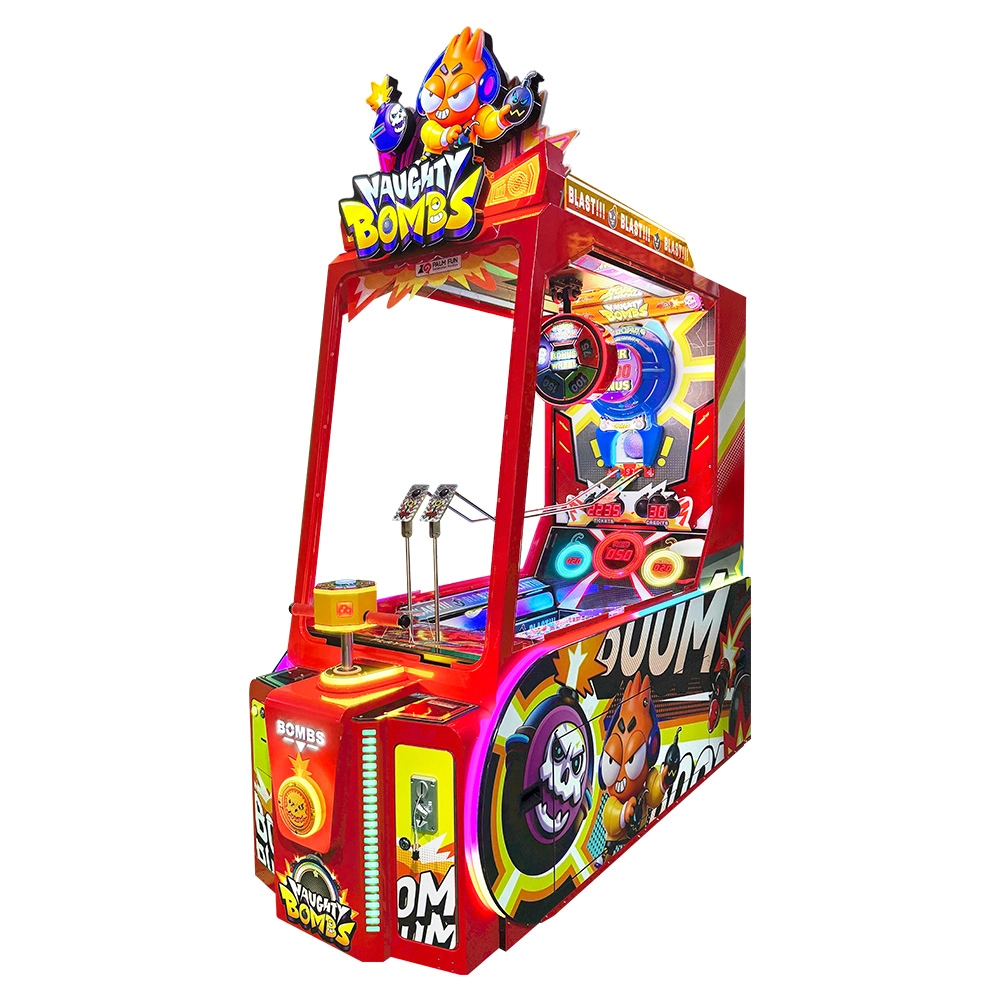
Naughty Bombs Ball Drop Redemption Arcade Game Machine
Naughty Bombs is a ball-drop redemption arcade game featuring rolling-ball gameplay, colored targets, ticket prizes, surprise bonus rewards, lighting and sound effects. Players use timing to launch and drop balls toward colored target areas. The product is presented for arcade, family entertainment center and other entertainment-venue projects, with customizable 110V / 220V AC voltage configuration.
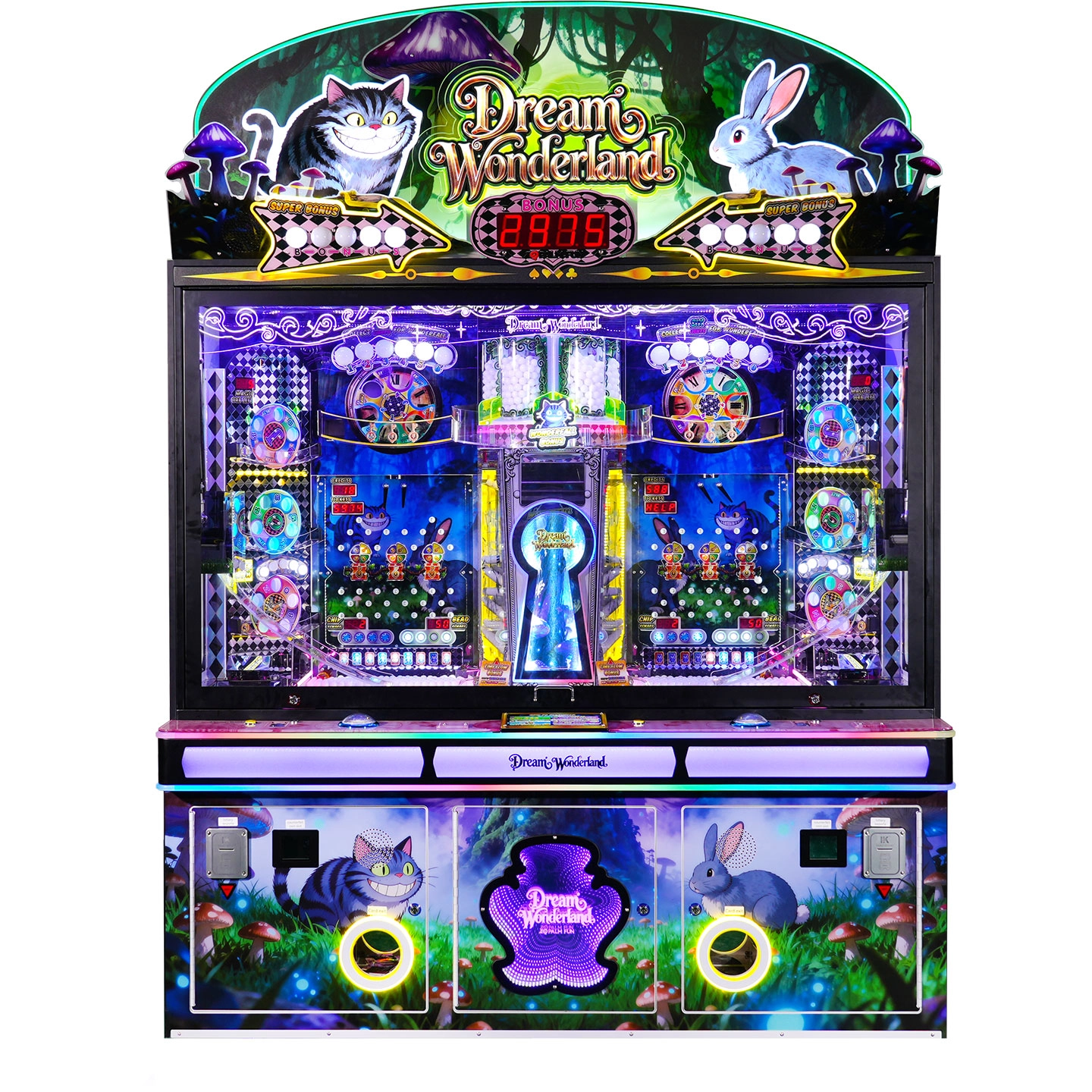
Dream Wonderland Marble Pusher Redemption Game
Enter Dream Wonderland — a magical marble pusher adventure filled with glowing lights, magic orbs, bonus wheels, collectible character cards, and exciting jackpot challenges.
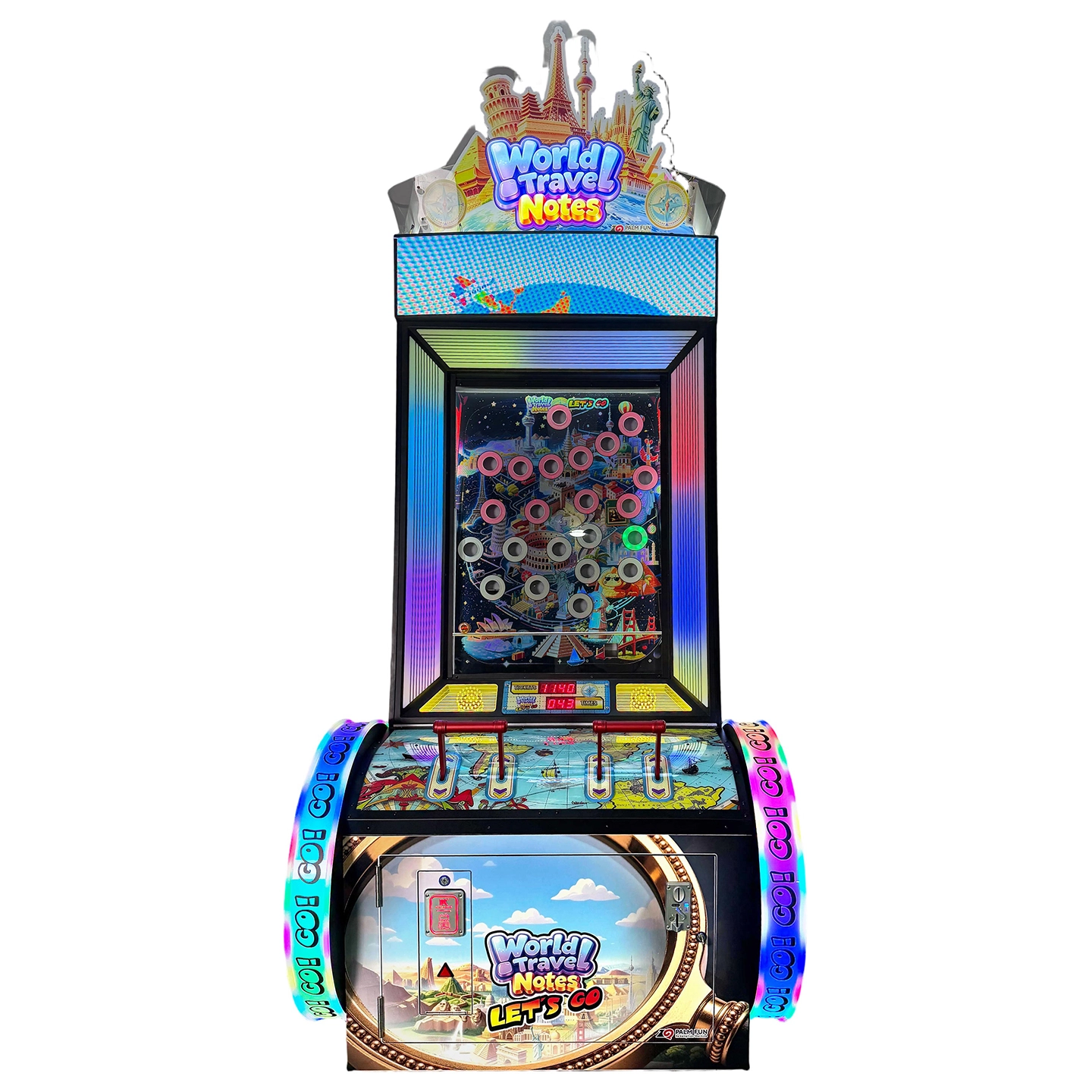
World Travel Notes – Balance Ball Redemption Arcade Game
World Travel Notes is a skill-based balance ball redemption game with a fun world-travel theme. Players use two handles to control the balance bar and guide the ball into each target hole. As the game progresses, the targets become more challenging, leading players toward the final grand prize. With colorful world-travel graphics, dynamic RGB lighting, a live score display, and progressive difficulty, World Travel Notes is designed to attract attention and encourage repeat play in arcades, FECs, shopping malls, and other entertainment venues.
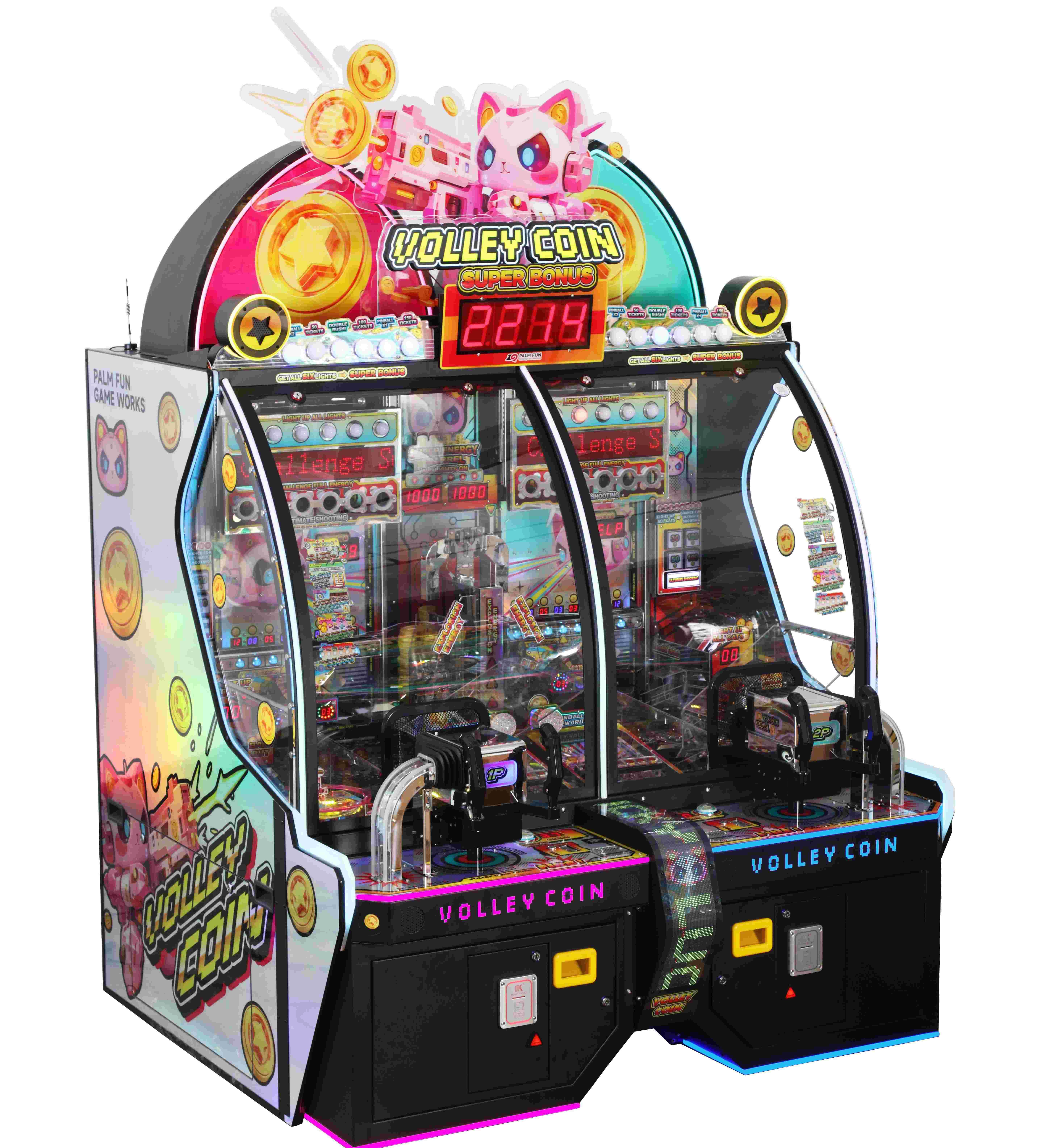
Hybrid Shooting & Pushing | Coin Pusher Arcade Ticket Redemption Machine
Volley Coin is an innovative arcade ticket redemption machine developed by Palm Fun Electronics. Combining the excitement of a fast-paced token shooter game with the proven earning power of a traditional coin pusher machine, Volley Coin offers a fresh and engaging gameplay experience that appeals to players of all ages.

Copyright © 2026 PALM FUN All Rights Reserved. | Privacy Policy • Terms and Conditions | Sitemap
palmfunarcade
Palm Fun Arcade Game
Whatsapp: +8618126837443
PalmFun Arcade
PalmFun_Arcade
PALM FUN Redemption Machine