








Single player arcade ROI: calculating cost-per-play for bulk buyers
- Unit-level profitability modeling for single-player amusement cabinets
- Core cost-per-play formula and required inputs
- Depreciation, useful life, and residual assumptions
- Sensitivity analysis and break-even mapping
- Operational factors that materially drive per-play economics
- Maintenance regimes and spare-parts planning
- Location optimization and traffic conversion
- Pricing strategies, token economics, and ticket redemption effects
- Procurement, deployment logistics and lifecycle planning for bulk buyers
- Volume purchasing, warranty structuring and total landed cost
- Shipping, customs, and regulatory compliance
- Refurbishment, secondary markets, and end-of-life value recapture
- Why select OEM capabilities and design-for-maintainability matters
- Design choices that reduce operational expenditure
- Data-driven operations and remote diagnostics
- Comparative ROI methods: manual accounting vs. data-driven projections
- PALM FUN: manufacturing scale, product lines and support that reduce lifecycle costs
- Manufacturing capabilities and engineering depth
- Product portfolio relevant to bulk deployments
- Service, spare-parts, and lifecycle partnerships
- How PALM FUN reduces cost-per-play in practice
- Frequently Asked Questions
High-resolution guidance for procurement teams and location operators on calculating per-play economics of single-player mechanical entertainment units—this brief synthesizes unit acquisition cost, installation and logistics, expected utilization, component-level upkeep, ticketing and price elasticity, and depreciation to compute realistic cost-per-play estimates for bulk buyers of flipper-style entertainment cabinets; includes comparative workflows, verifiable industry references for quality and market standards, and procurement recommendations to lower lifecycle cost while maximizing throughput.
Unit-level profitability modeling for single-player amusement cabinets
Core cost-per-play formula and required inputs
Buyers should base cost-per-play on a deterministic formula: (Total Landed Cost + Total Lifecycle Opex - Residual Value) ÷ Estimated Number of Plays over Service Life. Inputs that materially change outputs include unit purchase price, inbound freight and customs, installation labor, warranty and extended support fees, spare-parts consumption rate, and realistic utilization (plays/day). Use conservative occupancy curves rather than peak-hour assumptions to avoid overestimating revenue.
Depreciation, useful life, and residual assumptions
Useful life for mechanically driven entertainment tables commonly ranges from 5 to 8 years for high-usage venues and 7–12 years for low-traffic installations. Select a depreciation schedule aligned to the operator’s replacement policy: straight-line is simple, but units with high mechanical wear benefit from accelerated schedules that better reflect component fatigue and maintenance spikes.
Sensitivity analysis and break-even mapping
Perform sensitivity runs on three variables—plays per day, price per play, and mean-time-between-failure (MTBF)—to derive a break-even heatmap. A 10–20% drop in utilization typically has a larger impact on ROI than a 10% change in per-play price because fixed costs and depreciation remain constant. Present results as scenarios (conservative/expected/aggressive) for board-level approvals.
Operational factors that materially drive per-play economics
Maintenance regimes and spare-parts planning
Mechanical attractions require predictable spare-parts consumption: flippers, switches, coin/ticket mechanisms, and light assemblies. Establish a parts-kitting strategy for tier-1 venues (local technician visits within 24–48 hours) and tier-2 (depot-based repairs). Negotiated spare-parts bundles and firmware remote-diagnostics can reduce Mean Time To Repair (MTTR) and avoid extended downtime that inflates cost-per-play.
Location optimization and traffic conversion
Placement—entryway islands, near food courts, or within redemption zones—changes dwell time and spontaneous conversion rates. Use conversion benchmarks from comparable venues (mall arcades, family entertainment centers, cinema lobbies) to forecast daily plays. Where possible, instrument units with people counters or integrate with POS to validate forecasts against footfall metrics.
Pricing strategies, token economics, and ticket redemption effects
Price-per-attempt should reflect perceived value and redemption velocity. Token bundles or bundled-play discounts can increase throughput but reduce average revenue per play (ARPP); however, higher throughput may lower unit cost per engagement. For redemption-integrated units, account for prize-cost inflations and ticket-velocity when modelling gross margin.
Procurement, deployment logistics and lifecycle planning for bulk buyers
Volume purchasing, warranty structuring and total landed cost
Bulk procurement enables favorable terms: stepped pricing, longer warranty coverage, dedicated field-support SLAs, and on-site training for in-house technicians. Ensure quotes include duty/tariff estimates and clear Incoterms. Negotiated service level agreements that include spare-parts and field labor can reduce the average per-play cost by decreasing downtime and unexpected repairs.
Shipping, customs, and regulatory compliance
Large shipments require HS-code classification, safety compliance labeling, and sometimes electrical certification for target markets. Buyers should verify conformity with local product safety standards and consider pre-shipment inspection and certification to speed customs clearance. Reference best practices from quality standards such as ISO 9001 (ISO) and industry association guidelines like IAAPA for international deployments.
Refurbishment, secondary markets, and end-of-life value recapture
Plan for refurbishment cycles at approximately mid-life to restore cosmetic and mechanical performance. Refurbished units can be resold into lower-tier markets or redeployed in promotional events to recapture residual value—this lowers net lifecycle cost and improves total return on investment.
Why select OEM capabilities and design-for-maintainability matters
Design choices that reduce operational expenditure
Modular assemblies, standardized fasteners, and widely available electronics reduce repair time and spare-parts SKUs. Engineering for serviceability—such as front-access mechanisms and diagnostic LEDs—enables faster fixes and reduces the labor component of lifecycle costs for multi-site operators.
Data-driven operations and remote diagnostics
Remote health telemetry and play counters allow operators to shift from scheduled maintenance to condition-based interventions, lowering unnecessary part replacements and minimizing downtime. Integration of simple IoT modules can deliver rapid ROI when managing hundreds of single-play cabinets across multiple venues.
Comparative ROI methods: manual accounting vs. data-driven projections
Traditional spreadsheet models depend heavily on assumptions and manual data collection; modern approaches use telemetry and POS integration to produce near-real-time cost-per-play metrics that reflect actual usage and failure patterns. For institutional buyers, invest in pilots that validate telemetry assumptions before full roll-out.
| Method | Required Inputs | Typical Accuracy | Time to Implement | Best Use Case |
|---|---|---|---|---|
| Traditional Manual Model | Invoice costs, estimated plays, manual maintenance logs | ±20–40% | 1–3 weeks | Small deployments & early-stage budgeting |
| Telemetry-Enhanced Projection | Unit telemetry, POS integration, remote diagnostics | ±5–15% | 4–12 weeks (pilot + scale) | Large-scale rollouts requiring operational optimization |
| AI/Forecasting Augmented Model | Historical data, footfall, pricing elasticity models | ±3–10% | 8–16 weeks (data training + validation) | Portfolio-level optimization for multi-site operators |
PALM FUN: manufacturing scale, product lines and support that reduce lifecycle costs
Manufacturing capabilities and engineering depth
Founded in 2015, PALM FUN specializes in high-quality mechanical lottery machines, coin pusher machines, and raffle machines. Our R&D and manufacturing processes emphasize modular construction and serviceability to minimize MTTR and lower spare-parts inventories. Our 3,000 square meter factory and a team of skilled development engineers enable consistent build quality and faster product iteration.
Product portfolio relevant to bulk deployments
Our range includes single-play mechanical tables, coin-driven pushers, and combined ticket redemption units designed for high throughput and easy maintenance. Buyers evaluating single-player flipper-style cabinets should review model specifications such as target demo, footprint, and electrical requirements; explore our flipper offering at pinball arcade and a compact single-player configuration at single player arcade.
Service, spare-parts, and lifecycle partnerships
We offer volume pricing, extended warranty packages, field-support training, and spare-parts kits to reduce downtime. For hybrid redemption deployments, consider options like our Coin Pusher Arcade Ticket Redemption Machine or the compact Larva Series Coin Pusher Arcade for modular scalability. Buyers seeking supplier credentials and corporate background can review our company profile at High Quality Redemption Arcade MachinesManufacturer.
How PALM FUN reduces cost-per-play in practice
We focus on three levers that materially improve unit economics: (1) durable mechanical design to extend MTBF, (2) pre-configured spare-kits and field training to decrease MTTR, and (3) optional telemetry modules for operators who want to migrate to condition-based maintenance and real-time performance dashboards. These measures raise uptime and conversion while lowering maintenance-driven cost-per-play.
For independent verification of market norms and operational guidance, consult industry overviews such as Pinball (Wikipedia), venue and operator best practices from IAAPA, and general venue typology from Amusement arcade (Wikipedia).
Contact the PALM FUN commercial team for deployment calculators, sample P&L models, and a tailored quote for coin pusher machine, redemption games, and arcade games machines in bulk.
Frequently Asked Questions
How is cost-per-play calculated for a single-player mechanical entertainment unit?
Cost-per-play = (Total Landed Cost + Total Lifecycle Operating Expenses - Residual Value) ÷ Estimated Number of Plays over Service Life; include purchase price, freight, installation, maintenance, spare-parts, and depreciation in inputs.
What inputs most influence ROI sensitivity for single-player units?
Plays per day (utilization), price per play, and mean-time-between-failure (MTBF) are the most influential; a moderate drop in utilization typically impacts ROI more than a similar percentage change in price-per-play.
What procurement levers reduce average per-play cost in bulk purchases?
Negotiated volume discounts, extended warranty and bundled spare-parts, field-support SLAs, on-site technician training, and pre-shipment inspections to avoid customs delays materially reduce lifecycle costs.
How should buyers plan for maintenance and spare-parts?
Adopt a tiered support strategy: maintain on-site kits for high-traffic locations, contract depot repairs for lower-use sites, and prioritize modular designs with standardized parts to shorten MTTR and reduce inventory SKUs.
Can telemetry and remote diagnostics improve cost-per-play accuracy?
Yes; telemetry enables condition-based maintenance, accurate play-counting, and better forecasting, improving accuracy from ±20–40% in manual models to ±5–15% with telemetry and further with AI forecasting.
Recommended for you
Why choose PALM FUN as your pinball storm supplier manufacturer supplier
Find the Best Arcade Game Machine Suppliers | PALM FUN

The Ultimate Guide to Coin Dozer Machines | PALM FUN Electronics
Integrating Cashless Payments and Loyalty with Pinball Arcade
FAQs
How to choose the exchange gifts of the tickets(reward points)?
2. Gifts should be diverse. This refers to the variety of items available, providing players with more choices. Everyone's preferences are different, especially adults who have higher expectations for gifts. The venue should strive to meet the diverse needs of these players.
3. Gifts should be fashionable. The younger generation that follows trends is very interested in the hottest items of the moment. If the venue can keep up with the latest trends, it can attract the majority of consumers.
4. Gifts should be innovative. Especially during holidays and seasons, it's a good idea to try out new approaches, creating a competitive advantage with unique offerings. For example, the current trend of combining pop culture and blind box culture.
Research & Development, how hard is the birth of one new redemption machines?
How to select and match redemption machines?
2. the number of redemption game configuration: according to the characteristics of redemption machine, the proportion of redemption game configuration generally accounts for 30±5% of the whole field.
3. there are a lot of equipment on the market now, but less innovative, so the choice should be targeted in management and planning. We can divide redemption machines into children's, adults's, families, etc., according to different standards, with complete varieties and many styles, so as to give guests more choices and more changes. Specific can refer to the following:
① Inserting tokens in high frequency (mainly in mechanical redemption machines)
② Skill based games (mainly in mechanical redemption machines)
③ Games with edutainment significance (mainly in video redemption machines)
④ Entertaining games (mainly in video redemption machines)
Why redemption ticket machines are popular?
2.Redemption machines are becoming the most important breakthrough to enhance the sustainable operation of indoor arcade game halls.
3.Players are of all ages and they continue to expand.
How to place the redemption machines in a right place?
1,Ensure that the placement and layout of the equipment are distinct and centralized.
2,Keep noise levels low and avoid having a line of sight that spans too far to prevent players from easily taking in everything, which may slow down their movement.
3,Avoid clustering high-ticket payout machines and disperse machines of the same style.
4,Mix popular machines with less popular ones and avoid placing all popular machines together.
You may also like
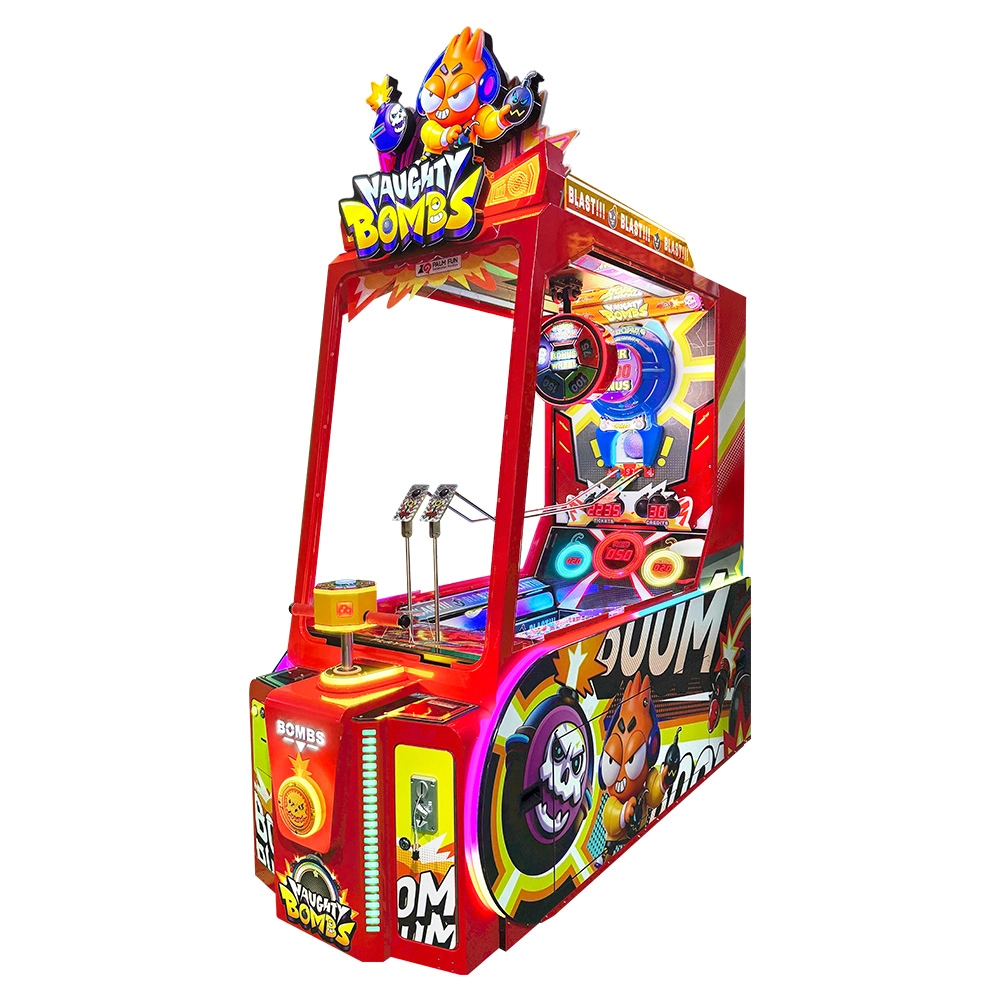
Naughty Bombs Ball Drop Redemption Arcade Game Machine
Naughty Bombs is a ball-drop redemption arcade game featuring rolling-ball gameplay, colored targets, ticket prizes, surprise bonus rewards, lighting and sound effects. Players use timing to launch and drop balls toward colored target areas. The product is presented for arcade, family entertainment center and other entertainment-venue projects, with customizable 110V / 220V AC voltage configuration.
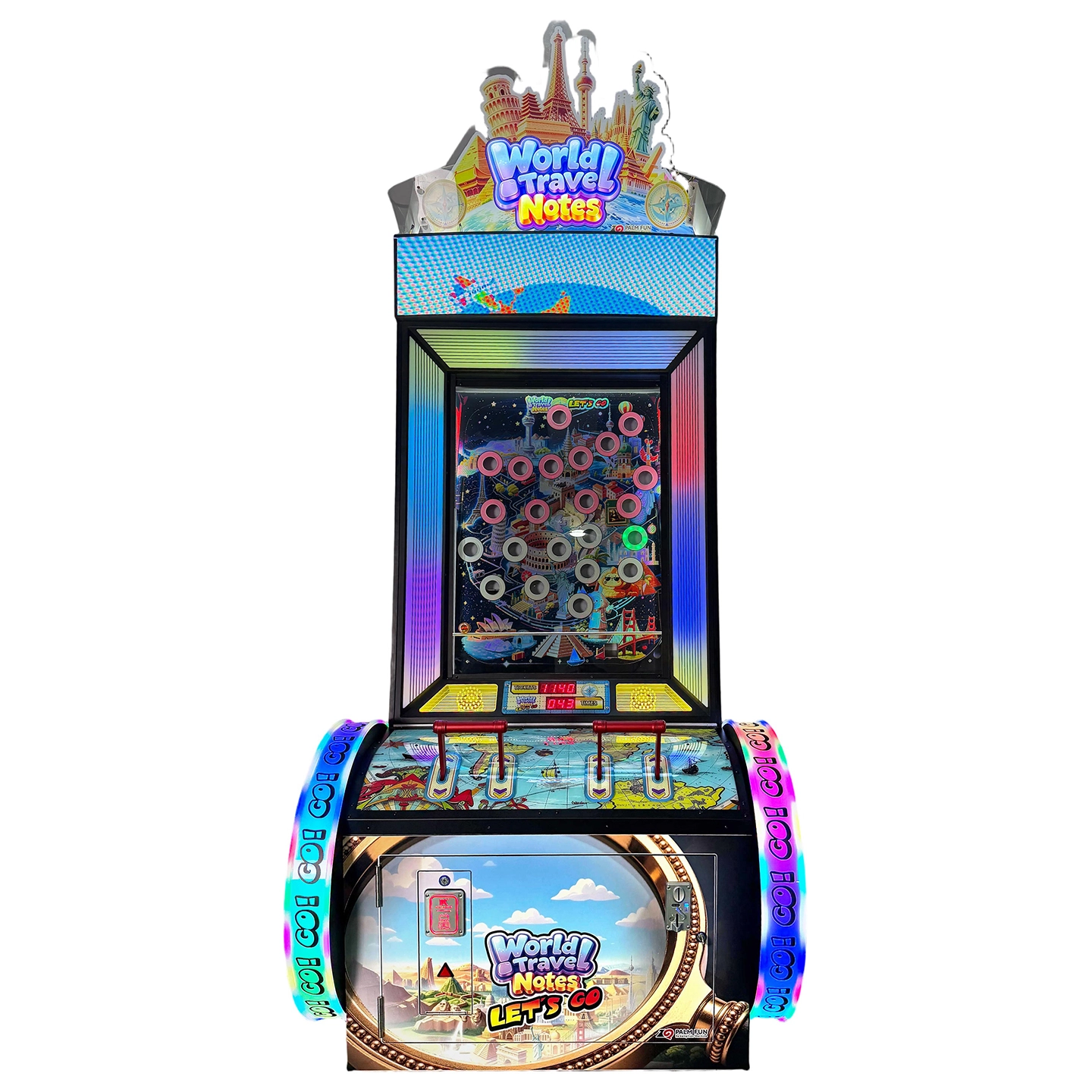
World Travel Notes – Balance Ball Redemption Arcade Game
World Travel Notes is a skill-based balance ball redemption game with a fun world-travel theme. Players use two handles to control the balance bar and guide the ball into each target hole. As the game progresses, the targets become more challenging, leading players toward the final grand prize. With colorful world-travel graphics, dynamic RGB lighting, a live score display, and progressive difficulty, World Travel Notes is designed to attract attention and encourage repeat play in arcades, FECs, shopping malls, and other entertainment venues.
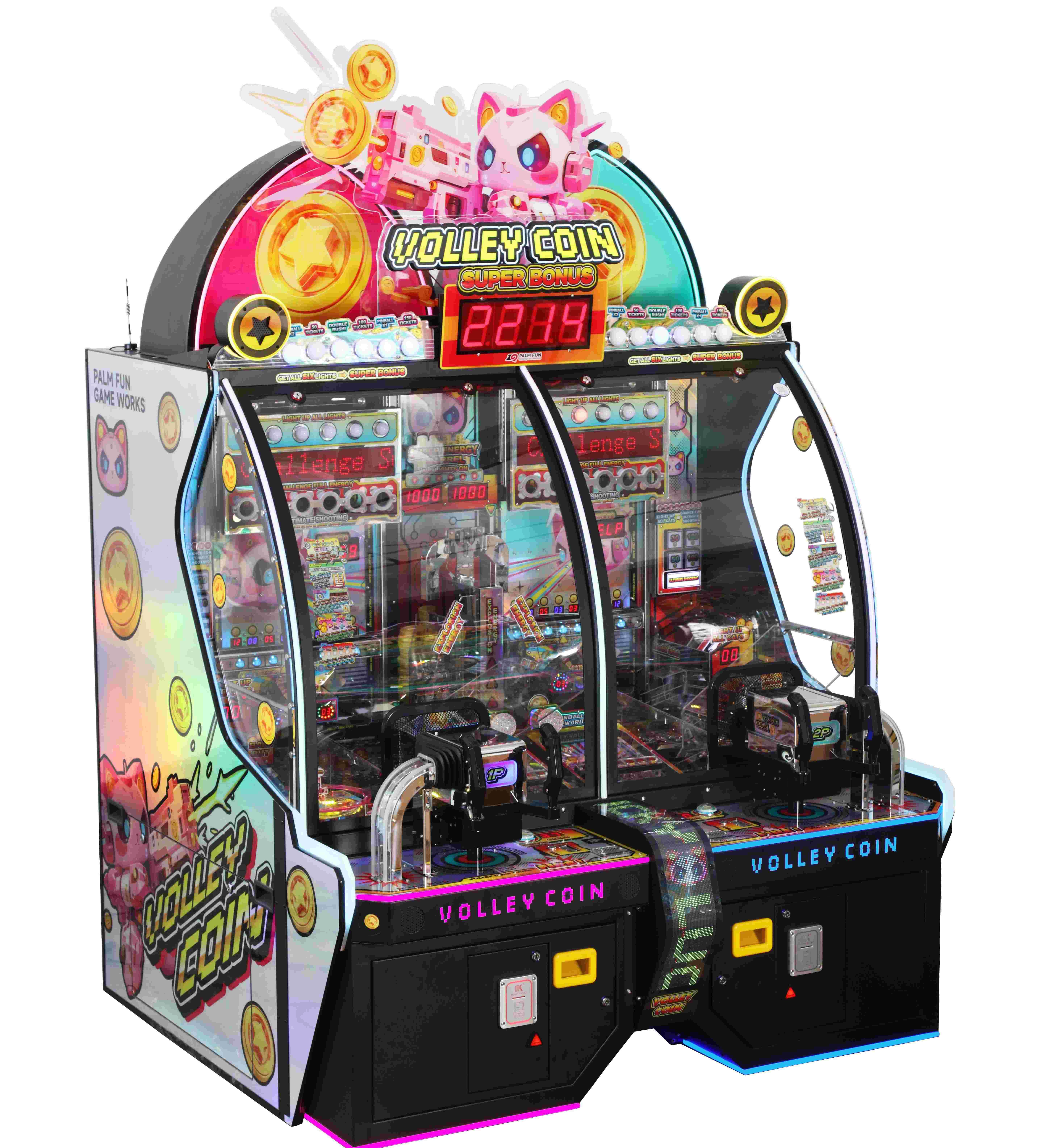
Hybrid Shooting & Pushing | Coin Pusher Arcade Ticket Redemption Machine
Volley Coin is an innovative arcade ticket redemption machine developed by Palm Fun Electronics. Combining the excitement of a fast-paced token shooter game with the proven earning power of a traditional coin pusher machine, Volley Coin offers a fresh and engaging gameplay experience that appeals to players of all ages.
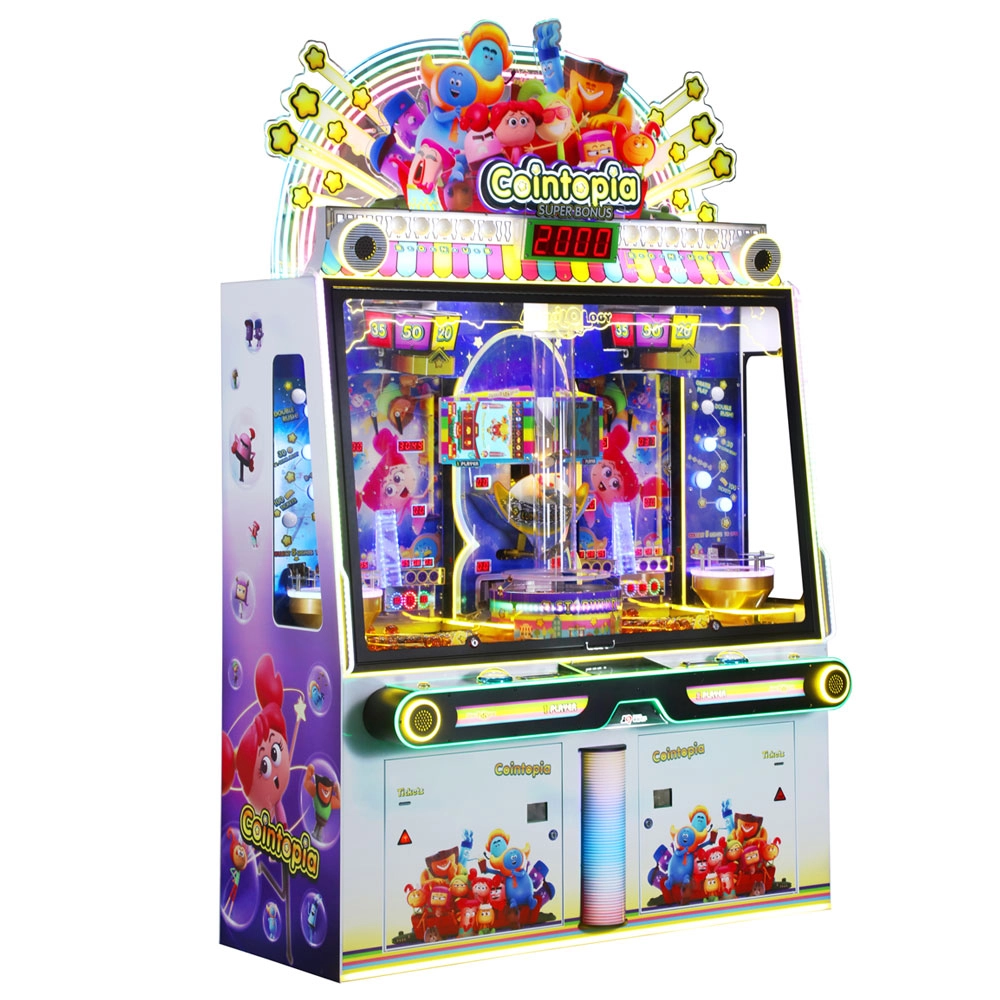
COINTOPIA, Have Fun Together With The Zodiac Buddies in an Utopia
COINTOPIA by PALM FUN is an exciting redemption game machine where players enjoy fun with zodiac buddies in a utopia setting. This ticket redemption machine offers engaging gameplay and rewarding experiences, perfect for family entertainment centers and arcades seeking top-quality redemption games.

Copyright © 2026 PALM FUN All Rights Reserved. | Privacy Policy • Terms and Conditions | Sitemap
palmfunarcade
Palm Fun Arcade Game
Whatsapp: +8618126837443
PalmFun Arcade
PalmFun_Arcade
PALM FUN Redemption Machine