








How Casinos and Arcades Earn Revenue From Coin Pushers
A distinction between regulated money-prize coin pushers and arcade ticket redemption equipment, explaining reporting concepts, jurisdiction-specific rules and model verification.
- Do Casinos and Arcades Use the Same Coin Pusher Business Model?
- Gaming Revenue vs. Arcade Redemption Revenue: The Key Differences
- What Does the House Edge Mean for Coin Pusher Machines?
- Are Cash-Prize Coin Pushers Allowed in Casinos?
- How Should an FEC Operator Evaluate Coin Pusher Equipment?
- Which Commercial Assumptions Should Operators Avoid?
- Frequently Asked Questions About Casino and Arcade Coin Pushers
- How do casinos earn revenue from coin pusher machines?
- Is a ticket redemption coin pusher a casino slot machine?
- Does a house edge apply to every mechanical coin pusher?
- Can a coin pusher award real money in some countries?
- What should an arcade buyer ask before purchasing a coin pusher?
- Conclusion: Separate Casino Gaming Economics From FEC Redemption
How do casinos make money on coin pushers? The answer depends on whether the coin pusher is a regulated money-prize gaming machine or an ordinary arcade redemption game. A permitted gaming operator records stakes and money prizes according to its approved category and reporting rules. A family entertainment center (FEC), by contrast, generally evaluates paid play revenue alongside tickets, points or merchandise-related redemption costs. Both can involve moving coins or tokens, but the game mechanism does not establish that they have the same legal status, payout calculation or commercial model.
Casino-style coin pushers should not be confused with PALM FUN's commercial mechanical redemption equipment. PALM FUN lists coin pusher ticket redemption and other physical amusement machines, but the catalogue does not establish that a given product is approved for cash-prize casino use. Operators must confirm the exact machine, prize arrangement, jurisdiction and required approvals. The following comparison explains the concepts without promising winnings, manipulating players or assigning an unsupported universal operator margin.
Do Casinos and Arcades Use the Same Coin Pusher Business Model?
Not necessarily. Coin pusher describes the physical mechanism: coins, tokens or other play pieces interact with a moving platform that shifts pieces toward an edge or other result area. The same general visual experience can be associated with different inputs, reward systems and regulations. A cash-prize machine operating under gaming rules may require technical standards, permissions and accounting records different from those of a ticket redemption game in a commercial amusement venue.
For an FEC, the business record may include paid credits, tickets or points earned, prize inventory used, machine downtime and service expense. For a regulated money-prize gaming venue, the records may need to show funds wagered, eligible prizes paid, and other regulator-required information. It is inaccurate to treat a ticket as a cash payout or assume that coins visible inside a cabinet belong to the player. The meaning of the game's result must be established by its configured and published rules.
Questions about where coin pushers are installed are a separate topic. For a venue-location comparison rather than operating economics, see whether casinos have coin pushers. The presence of a machine on premises does not independently prove which category of prize it offers.
Gaming Revenue vs. Arcade Redemption Revenue: The Key Differences
Operators should define their measures before comparing business performance. Gross money taken in is not equivalent to profit, and redeemed merchandise has an acquisition cost that differs from its ticket requirement. A regulated gaming machine may be evaluated using applicable gross gaming revenue and permitted prize rules, whereas an FEC may track gross play revenue, reward inventory and operating contribution. Neither metric can responsibly be inferred from a promotional video or one busy hour.
| Question | Regulated money-prize format | Arcade ticket redemption |
|---|---|---|
| Player outcome | Money and/or permitted prizes under applicable rules | Tickets, points or permitted merchandise rewards under venue terms |
| Economic measure | Recorded stakes, prize payments and regulator-defined reporting | Paid plays, actual prize costs and attributable operating expenses |
| Technical assessment | Machine category, approvals, prize limits and required controls | Game instructions, reward compatibility and machine service access |
| Buying priority | Lawful configuration and required licensing or technical status | Suitable model and its documented amusement or redemption settings |
A ticket or point balance should not automatically be described as “cash returned to player.” The accounting approach must reflect what can actually be redeemed, when it can be redeemed and how the business values its rewards. Neither a casino game nor a redemption arcade can guarantee profits merely by displaying a moving shelf of coins. Each requires an understanding of the actual permitted rules and operating conditions.
What Does the House Edge Mean for Coin Pusher Machines?
The term house edge generally describes an expected mathematical advantage in a defined wagering game. It should not be applied indiscriminately to every mechanical coin pusher or to every FEC redemption system. A particular game might involve a mixture of player input and chance, and its legal classification may be influenced by the mechanism, stakes, prizes, control systems and local rules. A physical near-miss does not prove that the machine has a specific mathematical margin.
The old version of this article claimed that casinos carefully manipulate coin pusher payouts and use near misses to increase play. That is not a suitable generalization or an appropriate operating instruction. Where a gaming machine is regulated, operators must follow the approved technical standards and payout or prize limits; they cannot assume they are free to alter the mechanism or reward system. For ordinary ticket redemption, changing how earned awards are recorded should also be restricted to documented, authorized processes.
Commercial performance cannot be measured by a claimed “house advantage” that has never been defined for the actual product. Arcade managers should instead reconcile observed game revenue and the actual cost of delivered prizes, check outstanding earned balances, and include maintenance and other expenses. Those calculations belong in the dedicated coin pusher profitability and ROI guide rather than being confused with casino wagering concepts.
Are Cash-Prize Coin Pushers Allowed in Casinos?
That question has no universal answer. Some coin pusher configurations may be permitted as gaming machines in certain locations; elsewhere, the same reward format may be restricted or prohibited. The terms casino, arcade, penny falls and coin dozer also do not establish a machine's regulatory category on their own. A buyer should determine the destination, venue type and exact prize or stake arrangement before making claims of legal operation.
For one documented example, Great Britain's Gambling Commission includes coin pushers, sometimes called penny falls, in its Category D guidance. That official guidance describes relevant stake and prize limits and lists several types of premises where a permitted machine may be located, including casinos and family entertainment centers. It also notes that some locations are unusual for that category. These are Great Britain-specific rules, not permission for a PALM FUN machine to operate in a U.S. casino, nor a general certification for an imported cabinet.
Read the Gambling Commission's Category D gaming machine guidance for the official framework. Operators in other markets must review their own relevant rules. The separate coin pushers and real-money prize explanation clarifies the difference between cash, tokens, points and merchandise rewards without suggesting that every game pays money.
How Should an FEC Operator Evaluate Coin Pusher Equipment?
Family entertainment centers should focus on the actual amusement use intended for their venues. Before buying, confirm the game's player controls, available credit methods, mechanical operation, cabinet size, power requirements, award recording, spare-part support and recommended service access. A familiar coin pusher design does not guarantee compatibility with an existing cashless payment system or electronic-ticket account. It also does not establish a universal ticket payout percentage or a fixed payback period.
PALM FUN's Burger Mania Coin Pusher Machine is described in the company's live product catalogue as a commercial mechanical coin pusher redemption game. The listing is evidence of its amusement product type, not of gaming licensing, casino approval or cash-prize availability. Buyers should request current model-level documents and confirm the appropriate reward configuration for their project.
Venue managers can use an inspection and reconciliation routine to ensure that credits, game outcomes and tickets or points are being recorded correctly. Staff should be trained to explain the reward rules and document faults. Internal repairs and protected electrical work need authorized technical handling rather than improvised attempts to change the game result. A transparent guest experience and reliable machines support an operation, but neither eliminates normal business risk.
Which Commercial Assumptions Should Operators Avoid?
It is misleading to assume that every coin pusher pays cash, that every machine has a fixed house edge, that a player's near win guarantees the next reward, or that the manufacturer can promise a specified daily income. The mechanical action is only one part of the system. The actual game configuration, local rules and operating records determine which conclusions can be supported. Marketing claims should clearly distinguish demonstrated features from estimated business outcomes.
Another common problem is treating casino gaming revenue and FEC ticket redemption income as though they had identical expense structures. A cash-prize machine records a different kind of award from a ticket redemption game. Merchandise purchases, stored ticket balances and counter staffing can matter to an FEC, while licensed gaming activities can have separate obligations. Financial comparisons should define the time period, revenue scope and cost categories before they are presented to management.
Procurement teams should also avoid relying on broad video claims about high-stakes coin pushers. A video may show unusual prizes, unverified equipment or a market where different legal rules apply. Ask for the model identification, technical documentation and the terms governing its permitted operation. A product demonstration is useful for understanding gameplay, but it does not replace a regulator's or local professional's assessment.
Frequently Asked Questions About Casino and Arcade Coin Pushers
How do casinos earn revenue from coin pusher machines?
Where a money-prize coin pusher is lawfully operated as a gaming machine, revenue is assessed using the permitted stake and prize rules and applicable accounting requirements. The physical coin-pushing mechanism does not establish a universal house edge or profit rate. Exact legal and financial treatment depends on the jurisdiction and machine.
Is a ticket redemption coin pusher a casino slot machine?
No. Ticket redemption equipment and regulated casino slot machines can have different gameplay, prize rules and legal classifications. Do not assume that one is equivalent to the other because both receive player credits or contain moving parts.
Does a house edge apply to every mechanical coin pusher?
Not as a universal fact. A house edge is a defined mathematical concept for a wagering game. Mechanical redemption formats need to be assessed according to their actual rules, award system and operating records rather than assigned an unsupported percentage.
Can a coin pusher award real money in some countries?
Some regulated categories can permit money prizes under specific conditions, as documented for certain Category D machines in Great Britain. Such permission does not apply automatically in other countries or to any particular PALM FUN product. Obtain the appropriate local verification before operation.
What should an arcade buyer ask before purchasing a coin pusher?
Ask for the exact model, controls, game and reward rules, cabinet and power specifications, payment compatibility, maintenance documentation, warranty terms and destination-market compliance requirements. The manufacturer's catalogue should not be taken as a guarantee of profit or legal permission.
Conclusion: Separate Casino Gaming Economics From FEC Redemption
Casino-style money-prize coin pushers and commercial ticket redemption equipment may share visual or mechanical characteristics while operating under different rules and business models. A casino operator must work within the relevant gaming framework; an FEC must understand its paid-play revenue, redemption obligations, operating costs and guest-facing rules. The existence of a moving shelf does not establish identical payout conditions or guaranteed profit. For a venue considering mechanical redemption equipment, contact PALM FUN with the game type, destination market and intended reward system to confirm model-level information rather than assume a casino configuration.


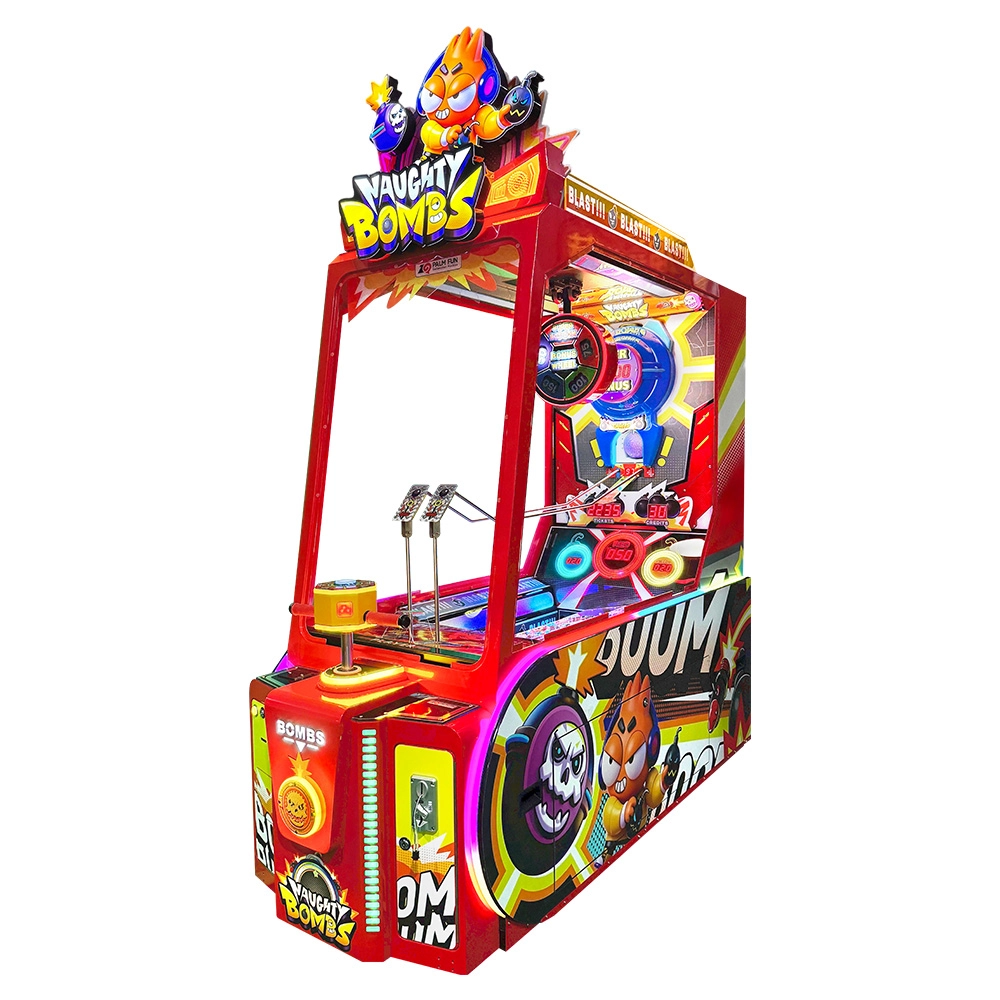
Naughty Bombs is a ball-drop redemption arcade game featuring rolling-ball gameplay, colored targets, ticket prizes, surprise bonus rewards, lighting and sound effects. Players use timing to launch and drop balls toward colored target areas. The product is presented for arcade, family entertainment center and other entertainment-venue projects, with customizable 110V / 220V AC voltage configuration.
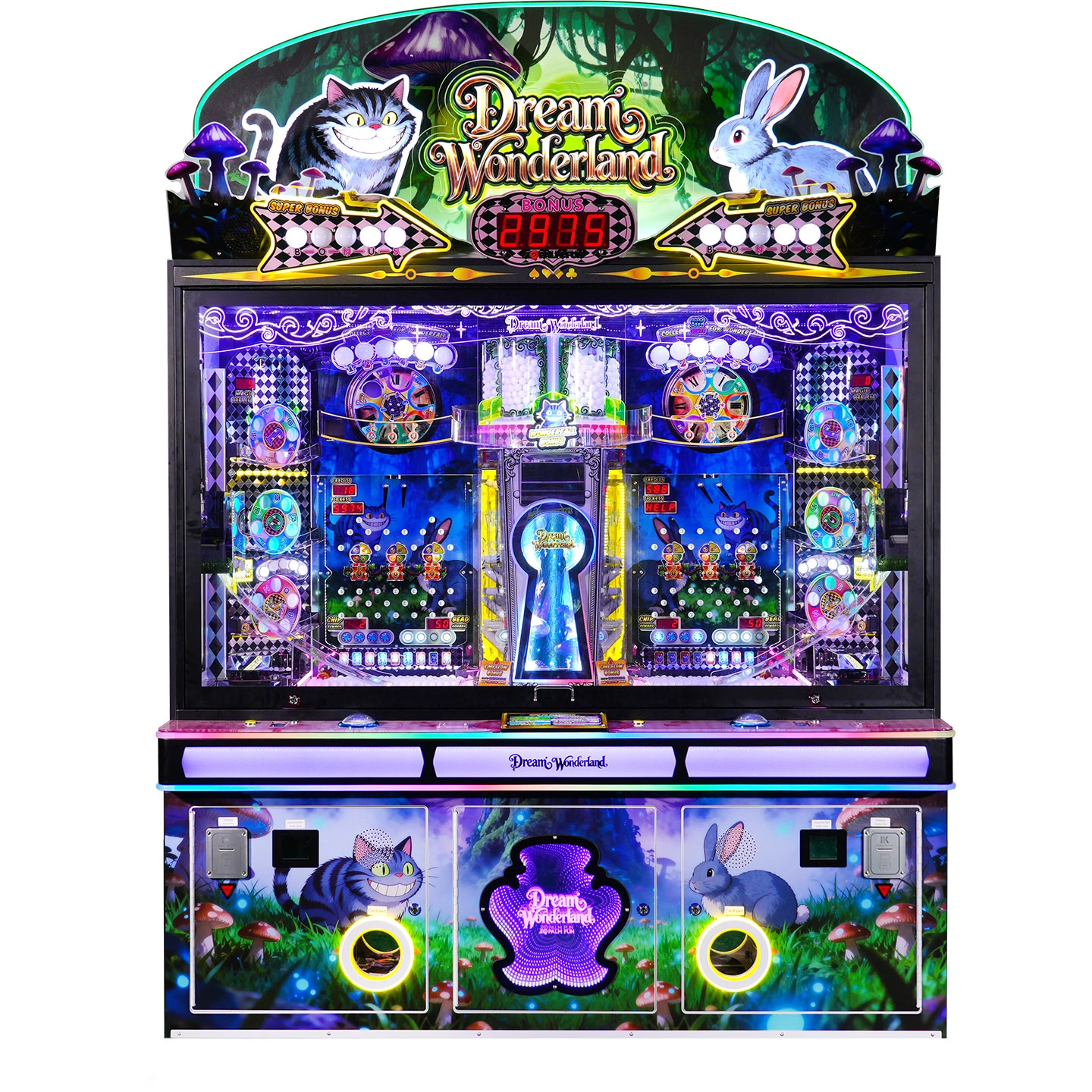
Enter Dream Wonderland — a magical marble pusher adventure filled with glowing lights, magic orbs, bonus wheels, collectible character cards, and exciting jackpot challenges.
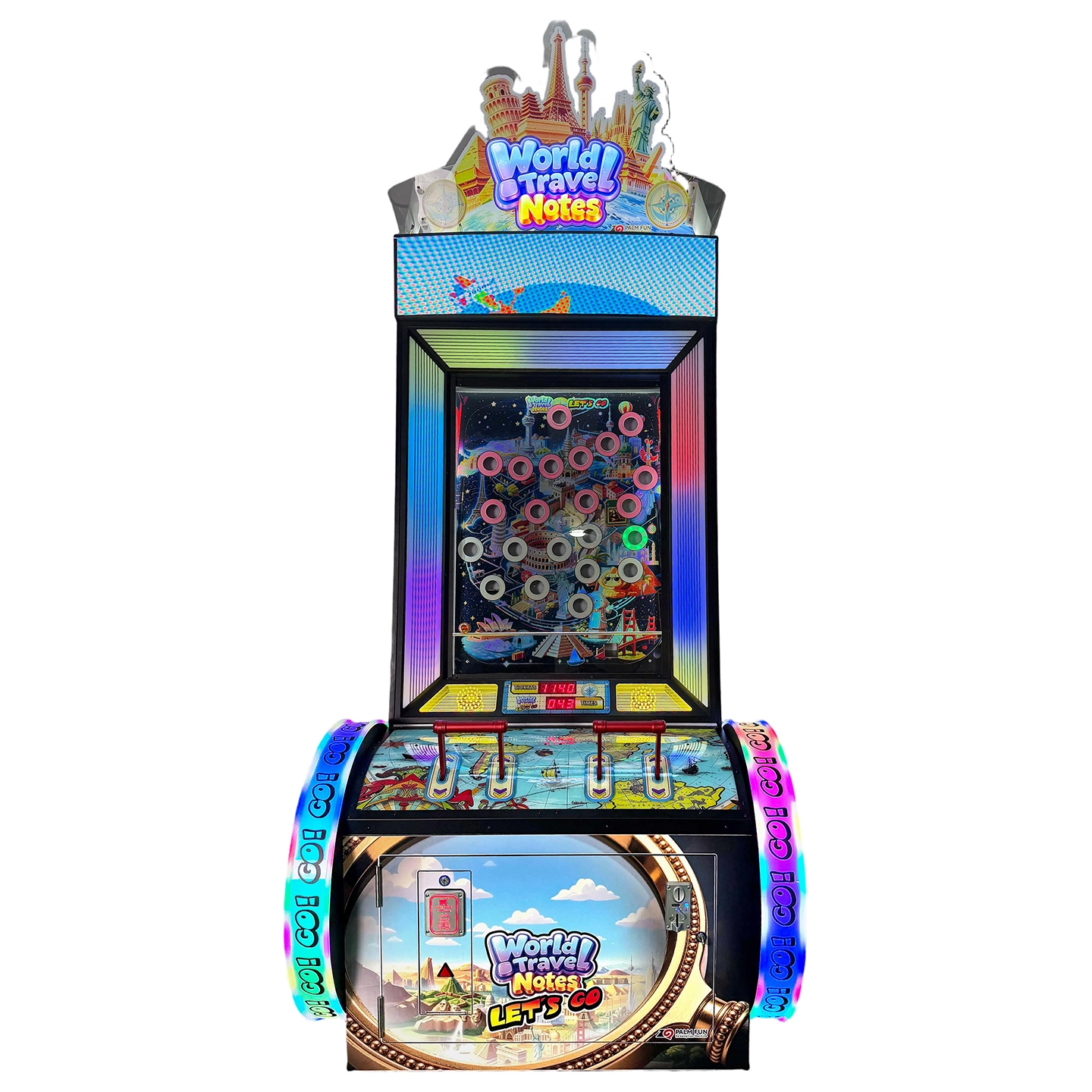
World Travel Notes is a skill-based balance ball redemption game with a fun world-travel theme. Players use two handles to control the balance bar and guide the ball into each target hole. As the game progresses, the targets become more challenging, leading players toward the final grand prize. With colorful world-travel graphics, dynamic RGB lighting, a live score display, and progressive difficulty, World Travel Notes is designed to attract attention and encourage repeat play in arcades, FECs, shopping malls, and other entertainment venues.
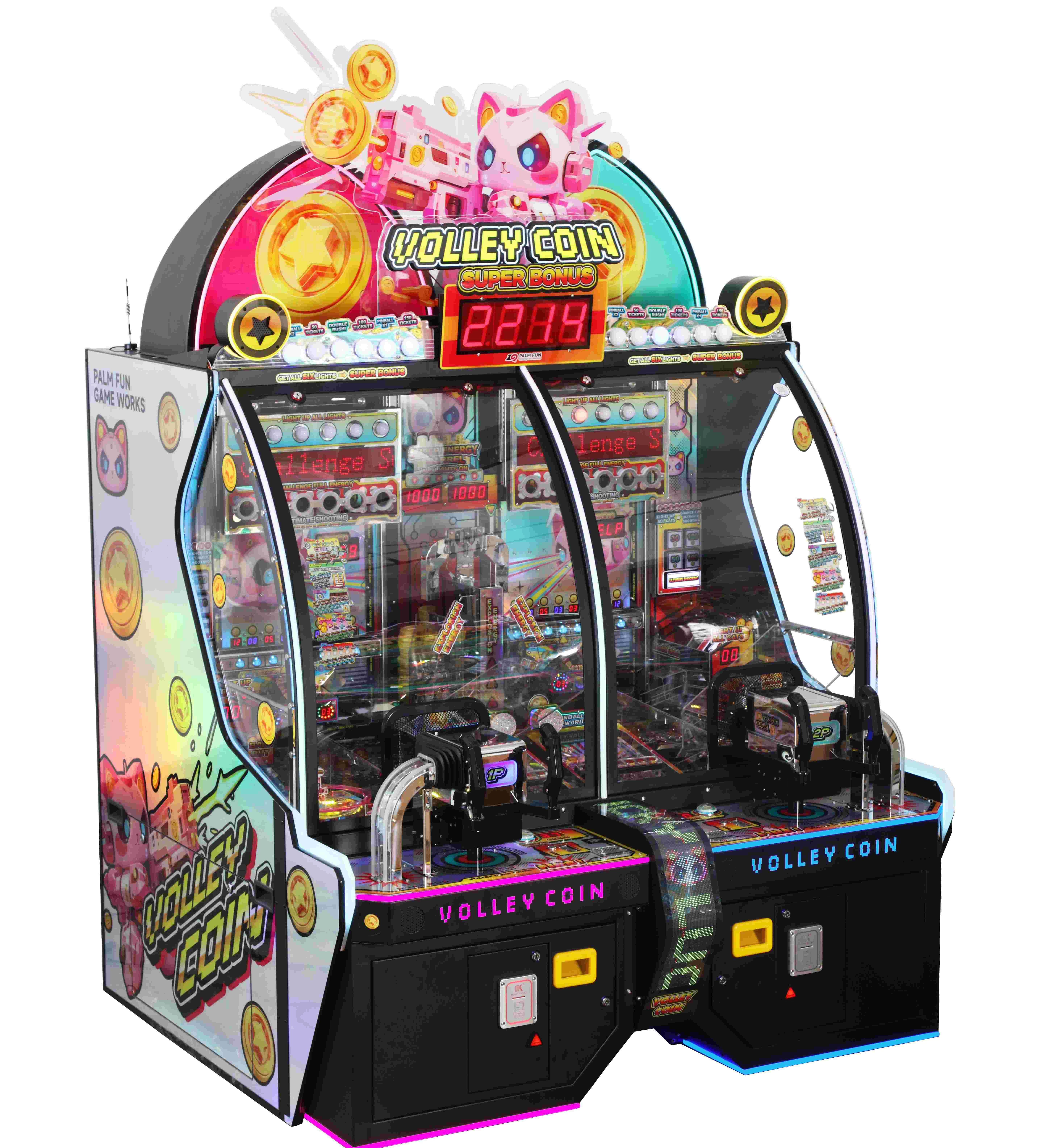
Volley Coin is an innovative arcade ticket redemption machine developed by Palm Fun Electronics. Combining the excitement of a fast-paced token shooter game with the proven earning power of a traditional coin pusher machine, Volley Coin offers a fresh and engaging gameplay experience that appeals to players of all ages.

Copyright © 2026 PALM FUN All Rights Reserved. | Privacy Policy • Terms and Conditions | Sitemap
palmfunarcade
Palm Fun Arcade Game
Whatsapp: +8618126837443
PalmFun Arcade
PalmFun_Arcade
PALM FUN Redemption Machine