








Why Choose a Reliable Arcade Game Supplier for Redemption Machines?
Learn why sourcing redemption equipment from a reliable arcade game supplier protects payout accuracy, reduces downtime, and ensures international compliance.
Quick Answer
Selecting a qualified arcade game supplier ensures redemption machines maintain mechanical reliability, precise payout percentages, and compliant power architecture. Core technical evaluation factors include PCB durability, ticket dispenser cycle ratings, power supply ripple suppression, and optical sensor calibration. Because operational environments vary, final hardware and software configurations depend on specific venue footfall and localized operating conditions.
How Palm Fun Supports Redemption Machine Projects
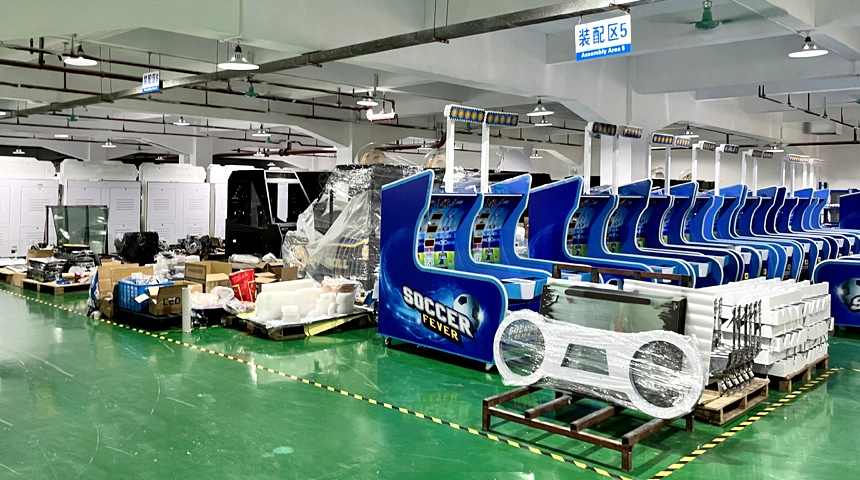
Palm Fun provides comprehensive OEM and ODM manufacturing services for ticket and prize redemption equipment, covering structural metal fabrication, circuit board integration, and final assembly. Standard production quality control protocols verify coin comparators, card swipe interfaces, and mechanical dispensing units before crating and export dispatch.
Prospective buyers must define primary parameters including target payout percentage algorithms, mains voltage specifications (110V or 220V), and token versus card reader integration. Minimum order quantities (MOQ), production lead times, and unit quotations must be confirmed per project based on custom cabinet graphics and hardware components.
Discuss Your Redemption Machine Procurement Requirements
For tailored redemption hardware schedules, provide your target market region, desired cabinet footprint, power input standards, ticket or cashless mechanism type, and expected order volume. Technical engineers review these parameters to establish custom payout algorithms and cabinet adaptations. Contact the engineering sales team directly via www.palm-fun.com or submit detailed project specifications to luobin@palm-fun.com.
Frequently Asked Questions
How do supplier component choices affect redemption machine payout accuracy?
Payout accuracy depends on the precision of ticket dispensing mechanisms, coin comparators, and microprocessor clock stability. Low-grade suppliers often implement generic optocouplers and low-torque continuous-rotation motors that suffer from rotational overrun after braking. High-grade suppliers utilize industrial-grade stepper motors or solenoids coupled with infrared optical sensors that count perforated ticket notches cleanly. Furthermore, superior power supply units (PSUs) regulate output ripple below 50mV, preventing voltage fluctuations that cause logic errors on the mainboard during sudden power surges across high-traffic arcade floors.
What firmware updates prevent payout calculation errors on ticket dispensers?
Firmware architecture dictates how the game microprocessor tracks credits, score increments, and payout ratios. Advanced firmware utilizes non-volatile EEPROM storage and watchdog timers to preserve audit logs during sudden brownouts or power disconnections. It also incorporates debounce algorithms on input pins to filter out mechanical contact bounce from switches, ensuring single physical triggers do not award duplicate ticket signals. Reputable suppliers validate algorithmic payout tables under high-frequency simulated input conditions to ensure field operators do not suffer margin erosion from software arithmetic drift.
How do operators verify electrical compliance across different international markets?
Electrical compliance demands verification of regional safety standards such as CE for Europe, UL/ETL for North America, and equivalent regional safety directives. Reliable manufacturers utilize certified switched-mode power supplies (SMPS) with integrated Power Factor Correction (PFC) and isolated step-down transformers. They conduct dielectric breakdown testing (Hi-Pot test) and ground continuity verification on the production line to eliminate chassis leakage current. Uncertified suppliers often bypass line filters, resulting in high electromagnetic interference (EMI) that can corrupt neighboring redemption card readers and game logic.
Why does cabinet structural integrity dictate long term arcade operating margins?
Commercial redemption equipment experiences sustained physical impact from players and constant mechanical vibration from ticket reels and coin hoppers. Cabinets constructed from CNC-milled, heavy-duty cold-rolled steel or multi-layer moisture-resistant plywood outlast lower-cost standard density fiberboard (MDF) assemblies. Quality fabrication includes powder-coated metal finishes, reinforced cam locks, and heavy-duty piano hinges on service doors. Structural failure in cheap cabinets leads to door sag, misalignment of coin entry slots, optical sensor vibration errors, and accelerated depreciation.
How does optical sensor quality reduce physical ticket jamming occurrences?
Physical ticket jams typically occur due to paper dust accumulation, improper roller durometer ratings, or ambient light bleeding into the optical receiver. Reliable builders specify enclosed, narrow-spectrum infrared optical sensors paired with static-dissipative urethane rollers. These sensors maintain tight threshold tolerances even when paper dust gathers around the ticket path, avoiding false-positive "out of paper" or "chute blocked" warnings. In contrast, basic open-photo interrupters easily misread tickets when ambient family entertainment center (FEC) neon or LED lighting enters the dispenser mouth.
What telemetry protocols ensure accurate revenue accounting on redemption floors?
Modern FEC operations rely on automated cashless card systems and machine telemetry to reconcile gross revenue against ticket liability. Trustworthy manufacturers integrate industry-standard pulse, serial, or SAS (Slot Accounting System) protocol support into their I/O boards. Standardized communication enables bidirectional data exchange, reporting precise metric totals including total plays, tickets paid, paper-out errors, and service door access events. Proprietary or undocumented communication buses from substandard suppliers create accounting discrepancies between the card reader management system and the internal electro-mechanical meters.

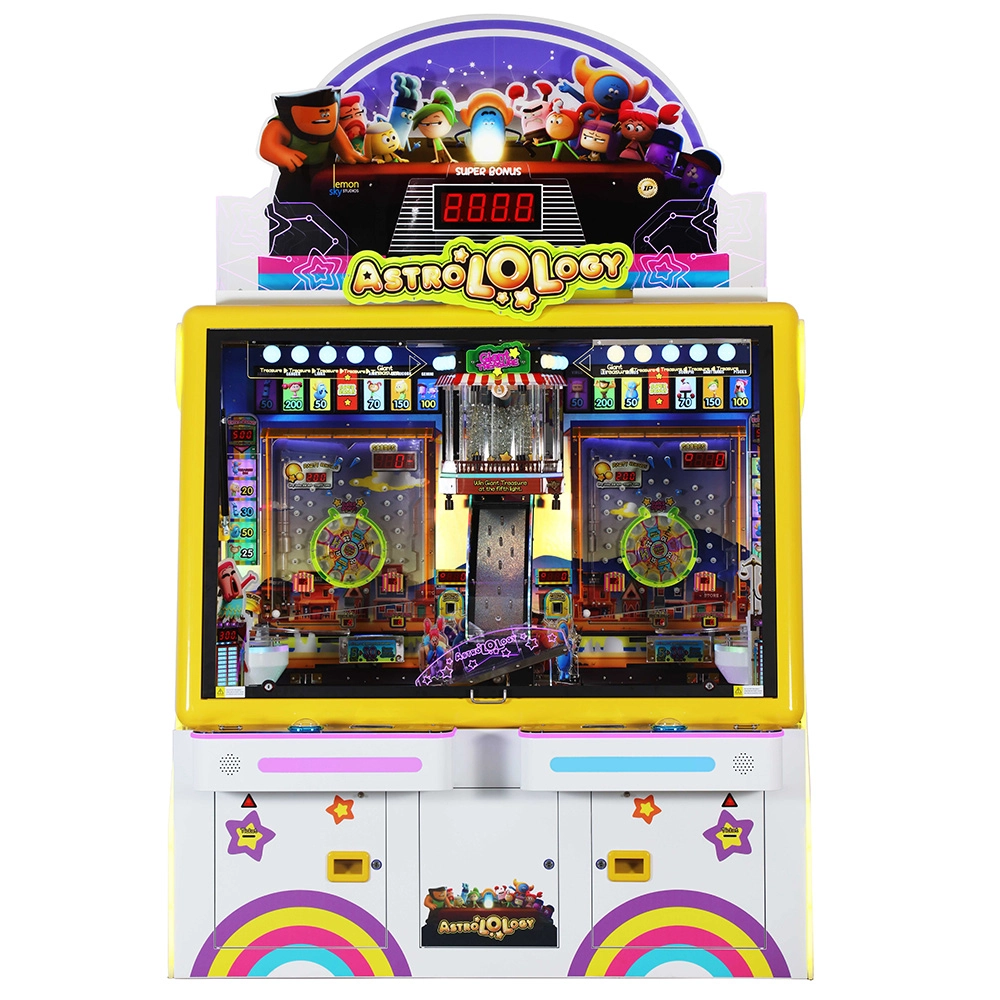
AstroLOLogy collaborates with the famous same-named animation IP copyright. It’s designed and developed by Palm Fun Electronics, an original product. AstroLOLogy has a small footprint (1750 mm * 1100 mm * 2650 mm), but it can generate very high earnings and popularity.
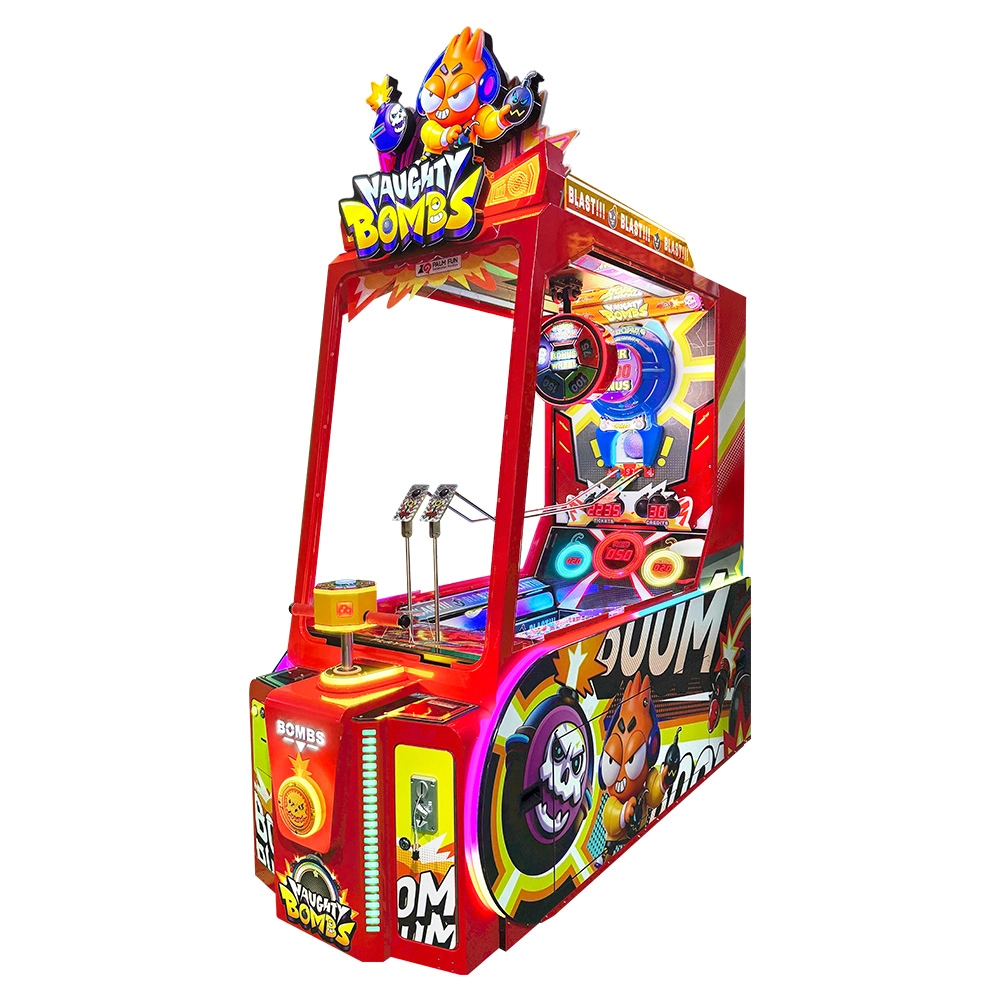
Naughty Bombs is a ball-drop redemption arcade game featuring rolling-ball gameplay, colored targets, ticket prizes, surprise bonus rewards, lighting and sound effects. Players use timing to launch and drop balls toward colored target areas. The product is presented for arcade, family entertainment center and other entertainment-venue projects, with customizable 110V / 220V AC voltage configuration.

World Travel Notes is a skill-based balance ball redemption game with a fun world-travel theme. Players use two handles to control the balance bar and guide the ball into each target hole. As the game progresses, the targets become more challenging, leading players toward the final grand prize. With colorful world-travel graphics, dynamic RGB lighting, a live score display, and progressive difficulty, World Travel Notes is designed to attract attention and encourage repeat play in arcades, FECs, shopping malls, and other entertainment venues.
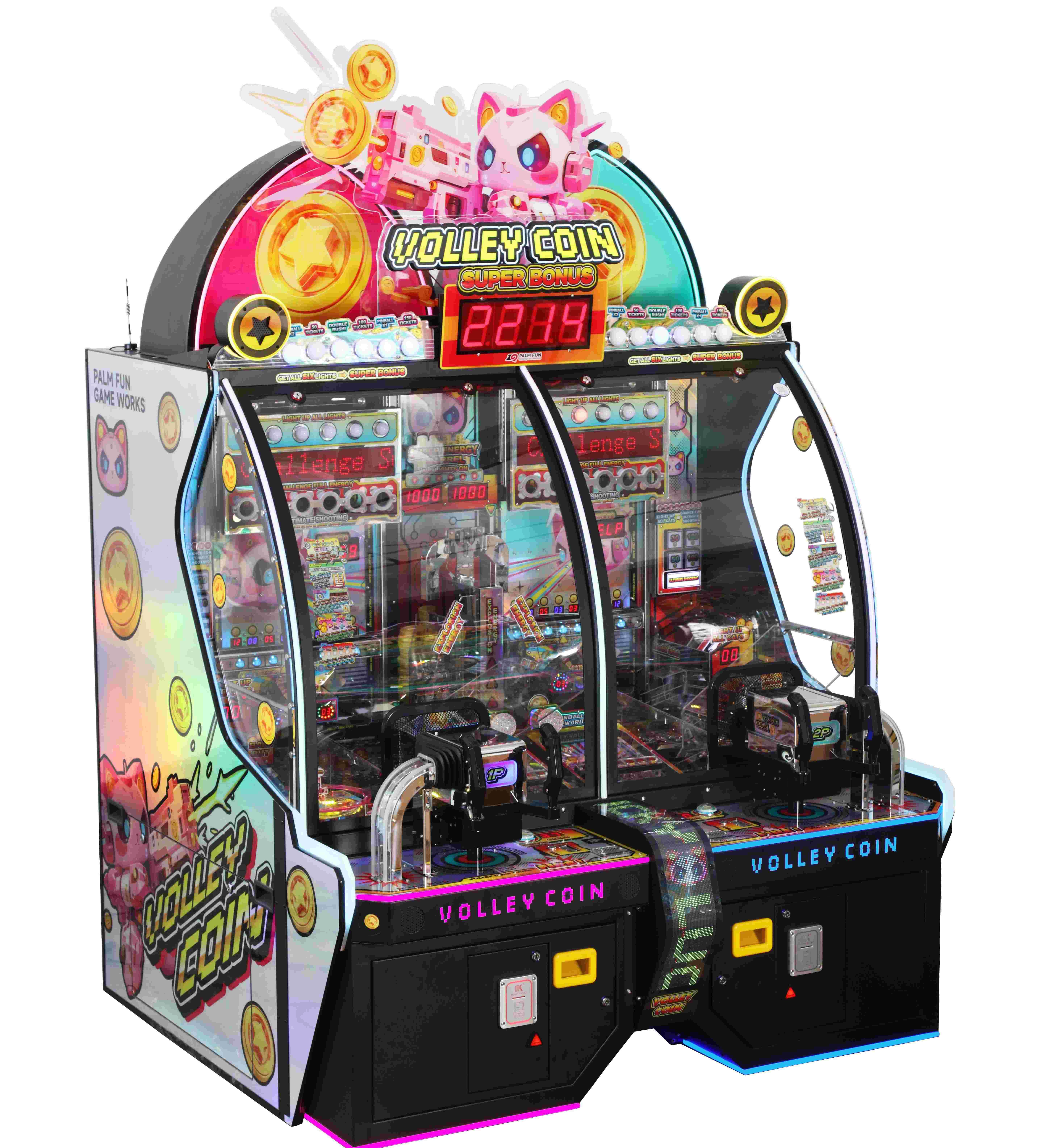
Volley Coin is an innovative arcade ticket redemption machine developed by Palm Fun Electronics. Combining the excitement of a fast-paced token shooter game with the proven earning power of a traditional coin pusher machine, Volley Coin offers a fresh and engaging gameplay experience that appeals to players of all ages.

Copyright © 2026 PALM FUN All Rights Reserved. | Privacy Policy • Terms and Conditions | Sitemap
palmfunarcade
Palm Fun Arcade Game
Whatsapp: +8618126837443
PalmFun Arcade
PalmFun_Arcade
PALM FUN Redemption Machine