








How Coin Pusher Machines Work: Step-by-Step Gameplay
A step-by-step explanation of coin pusher gameplay for arcade players and FEC operators, separating physical mechanics, game results and ticket redemption.
- 1. Coin Pusher Working Principle: A Moving Playfield
- 2. From Game Credit to Coin Release: Five Steps
- 3. Why Do Coins Move or Stay on the Shelf?
- 4. From Physical Result to Tickets and Prize Redemption
- 5. Modern Coin Pushers and Hybrid Machine Variations
- 6. What FEC Operators Should Check During a Demonstration
- 7. Frequently Asked Questions About Coin Pusher Operation
- Why does the coin pusher shelf move?
- Does a falling coin always award cash?
- Can timing guarantee a coin pusher win?
- Are shooting pushers the same as ordinary coin pushers?
- What should an arcade buyer verify first?
- 8. Conclusion: Understand the Game Sequence Before Comparing Models
- FAQ
How does a coin pusher machine work? A player uses the supported credit input, releases a coin or token through the intended control, and watches a mechanical shelf move pieces across the playfield. The moving platform can shift nearby pieces toward a designated edge or scoring area. A visible fall may influence the result, but tickets, points, tokens or prizes are awarded only according to the particular cabinet's game rules. The physical movement alone does not promise cash or a ticket amount.
This explanation is for players and family entertainment center (FEC) operators who need to understand the complete game sequence. It separates the player's experience, the mechanical action and the recorded reward. Actual coin pusher cabinets can have different controls, bonus features and payment or ticket systems. For mechanical faults and component-level service, operators should use a separate model-specific maintenance reference rather than a generic gameplay article.
1. Coin Pusher Working Principle: A Moving Playfield
The recognizable physical feature of a conventional coin pusher is a shelf or plate that moves repeatedly relative to pieces resting on the playing surface. The player introduces approved game media, and the movement transfers force through pieces that contact each other. Coins or tokens may move forward, sideways or remain stacked on the playfield. The outcome depends on the actual positions of the pieces and the machine mechanism, not on a guaranteed result from any single drop.
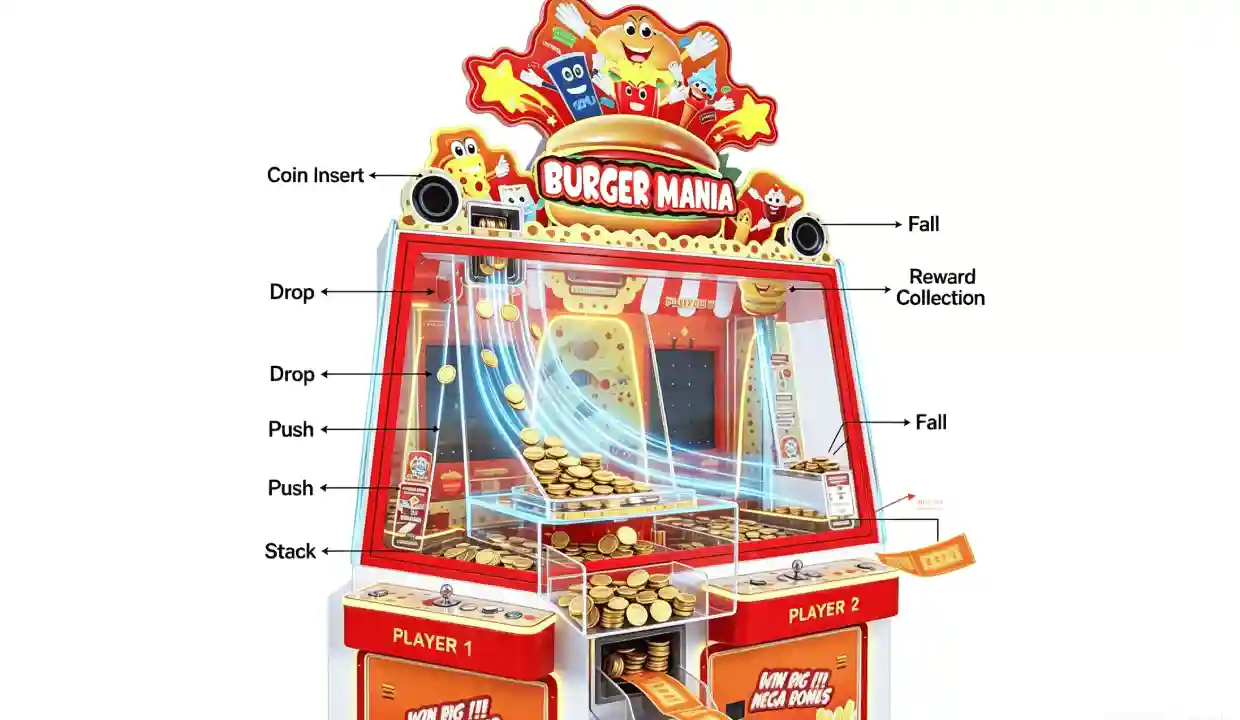
Some designs include additional channels, targets, bonus mechanisms and multiple play positions. Those differences affect how a specific model should be explained to guests. A ball-drop redemption game may have physical movement but is not automatically a conventional coin pusher. Similarly, the presence of a digital screen or electronic ticket interface does not change the need to identify what the player's input actually controls.
Venue instructions should say how to start, where to insert the supported game piece and where the reward is recorded. Staff should not invent a rule about money prizes based on the visual appearance of coins. A mechanical game can be exciting without promising that every play produces a payout.
2. From Game Credit to Coin Release: Five Steps
Breaking the game into stages helps both new players and operating staff understand what should happen. These are typical phases, not the exact control sequence of every PALM FUN cabinet. Bonus games and hybrid products may have additional actions, and some machines record results in a separate venue system. The machine's actual instruction card and current settings take priority.
| Stage | Typical action | What to confirm |
|---|---|---|
| Credit | Accepted payment or token starts the game | Supported inputs and credit display |
| Release | Player introduces the approved piece | Normal control and timing |
| Push | Moving shelf contacts existing pieces | Normal visible cycle |
| Result | Pieces shift or reach a target area | What constitutes a recorded result |
| Reward | The supported award system records value | Tickets, points, tokens or permitted prizes |
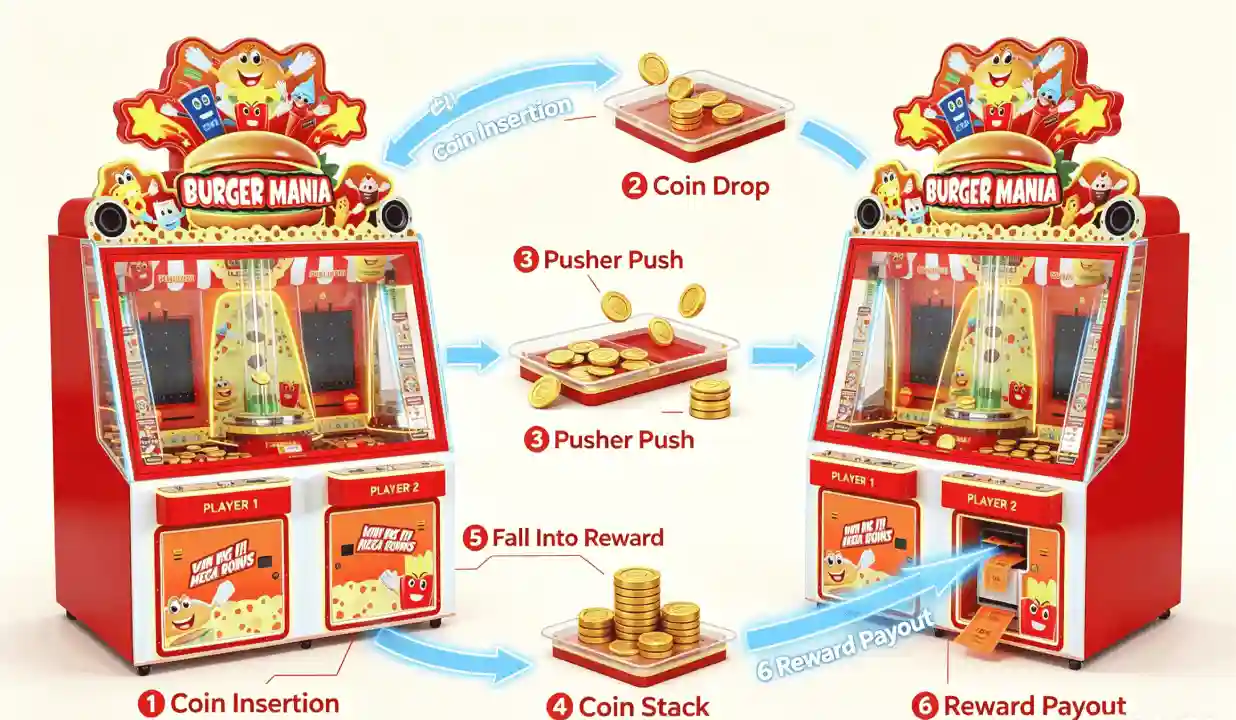
Payment credits and earned reward balances are different information. A player may spend a credit without triggering a ticket, while a score or bonus may require another stage before it appears in the redemption system. Operators should test each transition using approved procedures and clear instructions. A guest report about an incorrect balance should be recorded rather than dismissed because the physical shelf moved normally.
3. Why Do Coins Move or Stay on the Shelf?
The pusher shelf transfers force to pieces that are in contact with it or with other pieces. Stacking, friction and the position of each piece affect what happens as the shelf advances and retracts. A coin near the front edge can remain in place, while a change deeper in the pile can move several pieces. The game state cannot be reduced to a universal “drop at this second to win” formula.
Sometimes a play appears to have no effect because the introduced piece settles into a stable position. At other times, several pieces shift after one input, which can make the outcome feel sudden. Neither event proves that the next play is due to award tickets. Players should follow the venue's published rules, avoid shaking the machine and keep a spending limit consistent with their entertainment budget.
The exact motors, sensors, controllers and protected moving parts vary by model. This article explains what the player sees, not how to open a cabinet or repair its drive. Operators who need component functions and safe fault reporting should read the Coin Pusher Machine Parts and Mechanism Guide.
4. From Physical Result to Tickets and Prize Redemption
A typical arcade redemption machine has at least two connected concepts: how gameplay creates a result and how the equipment or venue records a reward. Some games use paper tickets, while others use electronic points or a different permitted arrangement. The presence of physical coins, a jackpot animation or a prize-shaped object does not establish cash availability. Every guest-facing instruction should identify the supported outcome and how earned value is shown.
When a venue has a central redemption counter, game results must match the supported ticket or point records. A paper-ticket dispenser and a cashless card account may use different technical components. Payment interfaces should not be assumed compatible with the cabinet merely because both systems are found in arcades. For the actual player steps and expected game rules, see the coin pusher rules and gameplay guide.
A staff member should know how to verify an award discrepancy without manipulating moving equipment. Any changes to configured award settings should follow the manufacturer manual and local operating requirements. Internal electrical and mechanical service belongs to trained personnel.
5. Modern Coin Pushers and Hybrid Machine Variations
Modern coin pushers can include themes, bonus scoring, multiple player positions or other mechanical interactions. Some hybrid machines combine a shooting input with a pushing stage. That can change the rhythm of play and the number of actions a guest needs to understand. These differences should be verified for the exact game rather than described as universal technological upgrades.
PALM FUN lists the Burger Mania Coin Pusher Machine as a mechanical coin pusher redemption product. The Larva Series is a four-player coin pusher ticket redemption game with themed bonus features. Their player capacity, installation dimensions and electrical requirements are not interchangeable.
PALM FUN also lists Volley Coin as a machine combining token shooting and pushing gameplay. Its controls and reward configuration are specific to that model, and the supplier should demonstrate the complete play sequence before purchase. A venue may use different pusher formats to create variety, but no single mechanism guarantees higher revenue or a fixed ticket return.

6. What FEC Operators Should Check During a Demonstration
When a supplier demonstrates a coin pusher, ask to see the supported credit input, normal coin release, moving shelf, result display and any available ticket or point output. Check whether the demonstration uses the same hardware and configuration proposed for your location. A showroom demonstration may use a different payment or reward setup from the machine delivered to a customer. Request model-specific specifications in writing before confirming the order.
Practical purchasing questions include player positions, cabinet dimensions and weight, power and voltage, clearance for service, approved payment options and support for the venue's intended redemption system. Ask who provides installation, spare parts, maintenance instructions and warranty service. The information should refer to the named machine, not a generic specification copied from another pusher.
For troubleshooting, floor staff can observe whether credits register and whether a visible game result is recorded. They should not open energized panels or bypass guards to investigate moving parts. A faulty cabinet should be removed from guest use when appropriate and referred to authorized service personnel. Clear records of the model, symptom and time of failure support later diagnosis.
7. Frequently Asked Questions About Coin Pusher Operation
Why does the coin pusher shelf move?
The shelf moves to transfer mechanical force through the coins or tokens on the playfield. Its motion is the core physical interaction of a typical pusher game, but the exact drive system depends on the machine.
Does a falling coin always award cash?
No. An arcade game may give paper tickets, points, tokens or another permitted award. A physical coin dropping does not establish that it belongs to the player as a cash prize.
Can timing guarantee a coin pusher win?
No. Timing can be part of normal play, but the positions and movement of all the game pieces affect the result. A nearly falling coin cannot guarantee a particular outcome.
Are shooting pushers the same as ordinary coin pushers?
They can share a pushing mechanism while using different player controls and gameplay stages. Check the actual model, including its reward system and installation requirements.
What should an arcade buyer verify first?
Request the full gameplay demonstration, supported credits, award settings, dimensions, electrical requirements, safety and maintenance documentation, and after-sales responsibilities for the actual machine.
8. Conclusion: Understand the Game Sequence Before Comparing Models
Coin pusher gameplay begins with a permitted player input and uses a moving shelf to change the arrangement of pieces on a playfield. The mechanical result and any ticket or prize award are distinct parts of the system. Mechanical, multiplayer and hybrid versions can follow different sequences, so accurate instructions and model verification matter. FEC buyers can contact PALM FUN with the intended venue and reward configuration for model-specific information, rather than relying on unsupported promises of cash payouts or guaranteed profits.
FAQ
Are coin pusher machines skill or luck?
They are mainly based on chance, but timing and coin placement can slightly influence outcomes
Why are coin pusher machines so popular?
Because they are easy to understand, visually engaging, and provide frequent small rewards that encourage repeat play.
Can you make money from coin pusher machines?
Yes. In arcade businesses, they are often used as revenue-generating redemption machines due to high player engagement.
What is the working principle of a coin pusher machine?
The working principle is a mechanical push cyde combined wth gravity, where coins are gradually moved and eventually fallinto a reward zone


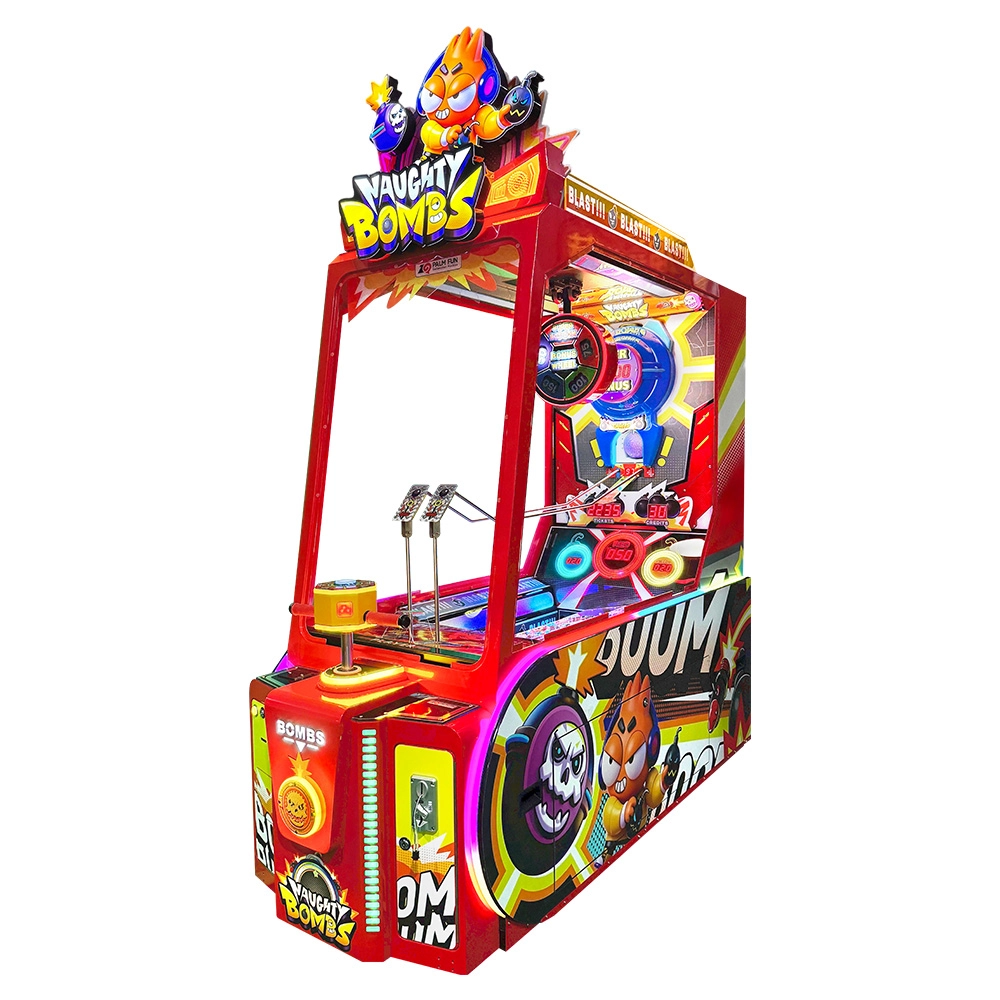
Naughty Bombs is a ball-drop redemption arcade game featuring rolling-ball gameplay, colored targets, ticket prizes, surprise bonus rewards, lighting and sound effects. Players use timing to launch and drop balls toward colored target areas. The product is presented for arcade, family entertainment center and other entertainment-venue projects, with customizable 110V / 220V AC voltage configuration.
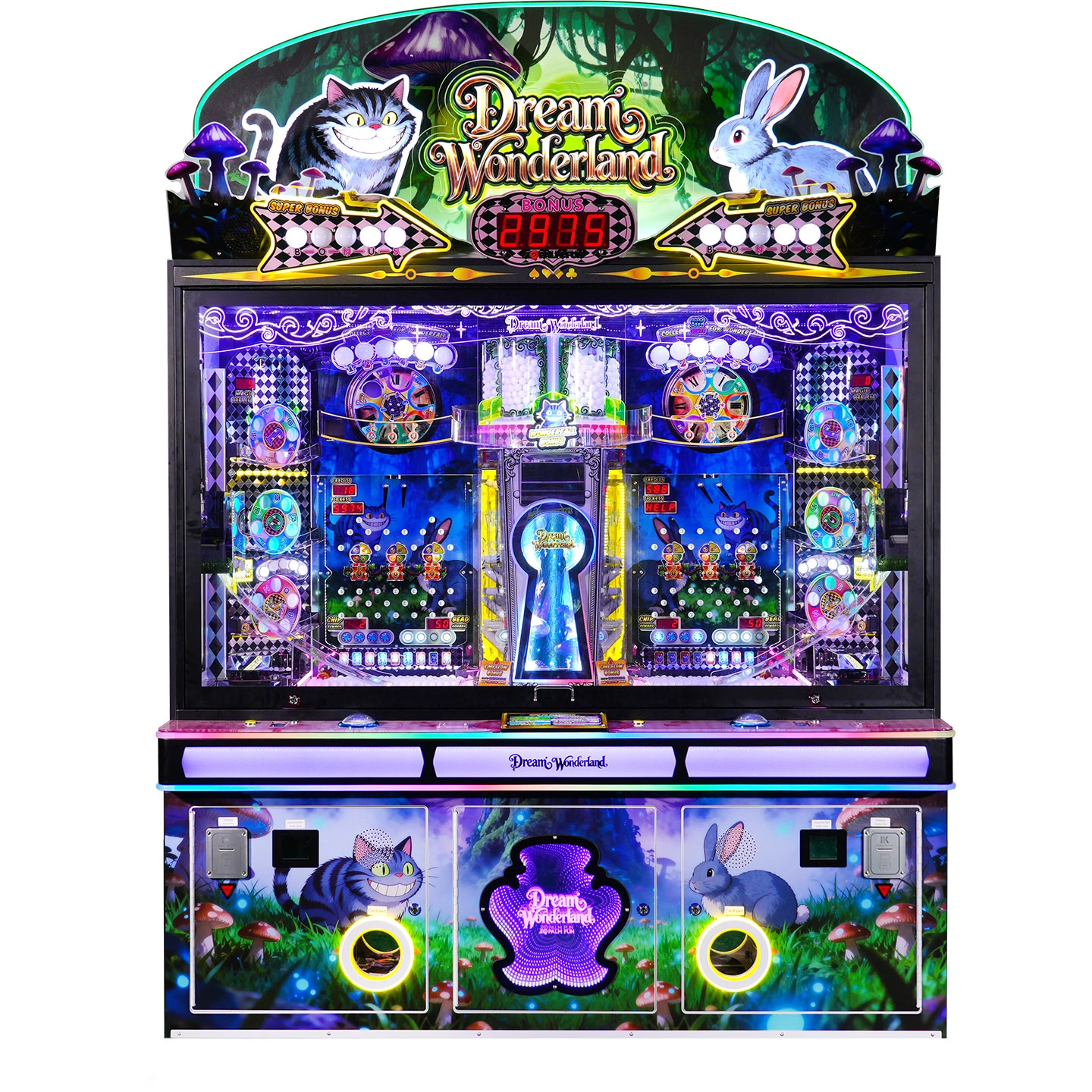
Enter Dream Wonderland — a magical marble pusher adventure filled with glowing lights, magic orbs, bonus wheels, collectible character cards, and exciting jackpot challenges.
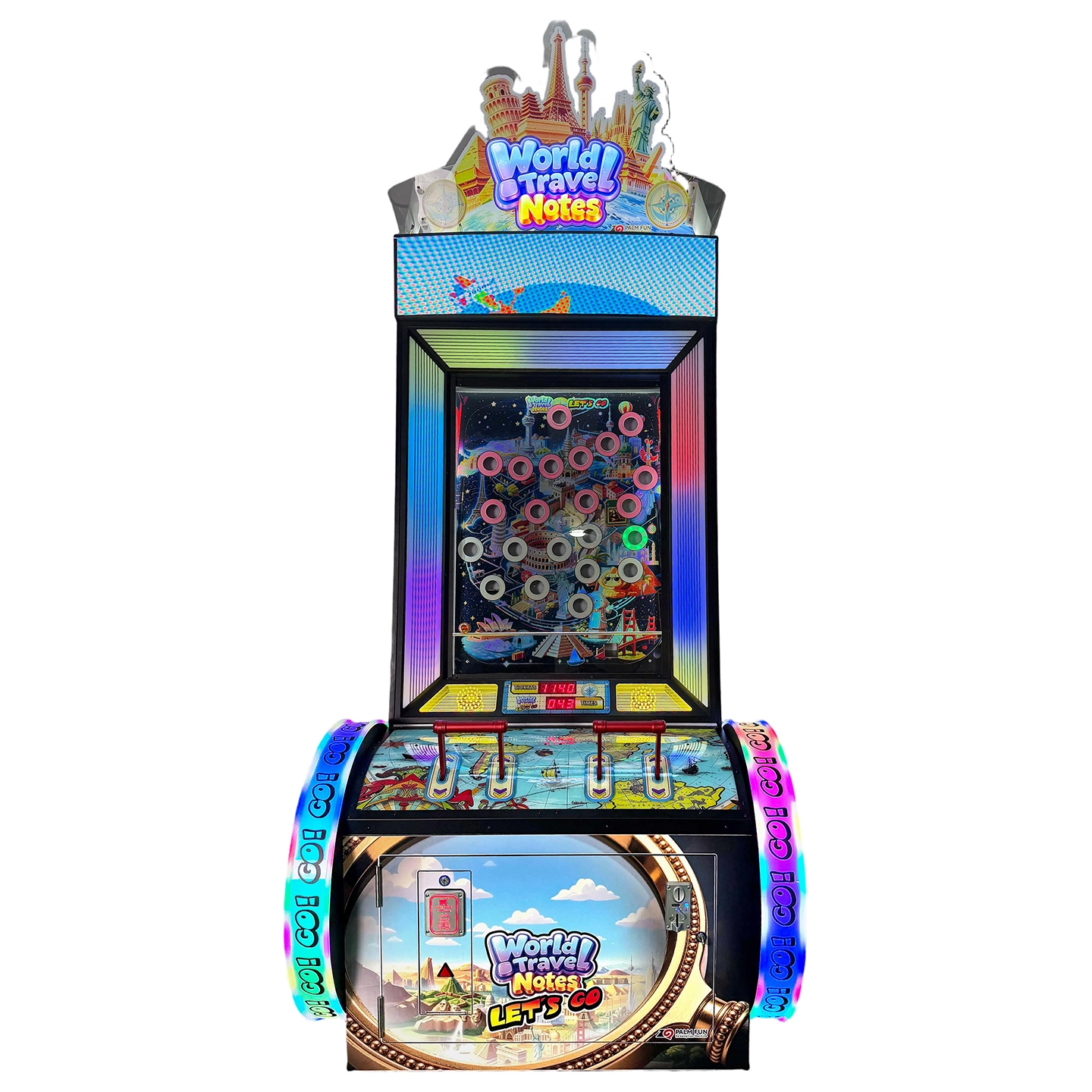
World Travel Notes is a skill-based balance ball redemption game with a fun world-travel theme. Players use two handles to control the balance bar and guide the ball into each target hole. As the game progresses, the targets become more challenging, leading players toward the final grand prize. With colorful world-travel graphics, dynamic RGB lighting, a live score display, and progressive difficulty, World Travel Notes is designed to attract attention and encourage repeat play in arcades, FECs, shopping malls, and other entertainment venues.
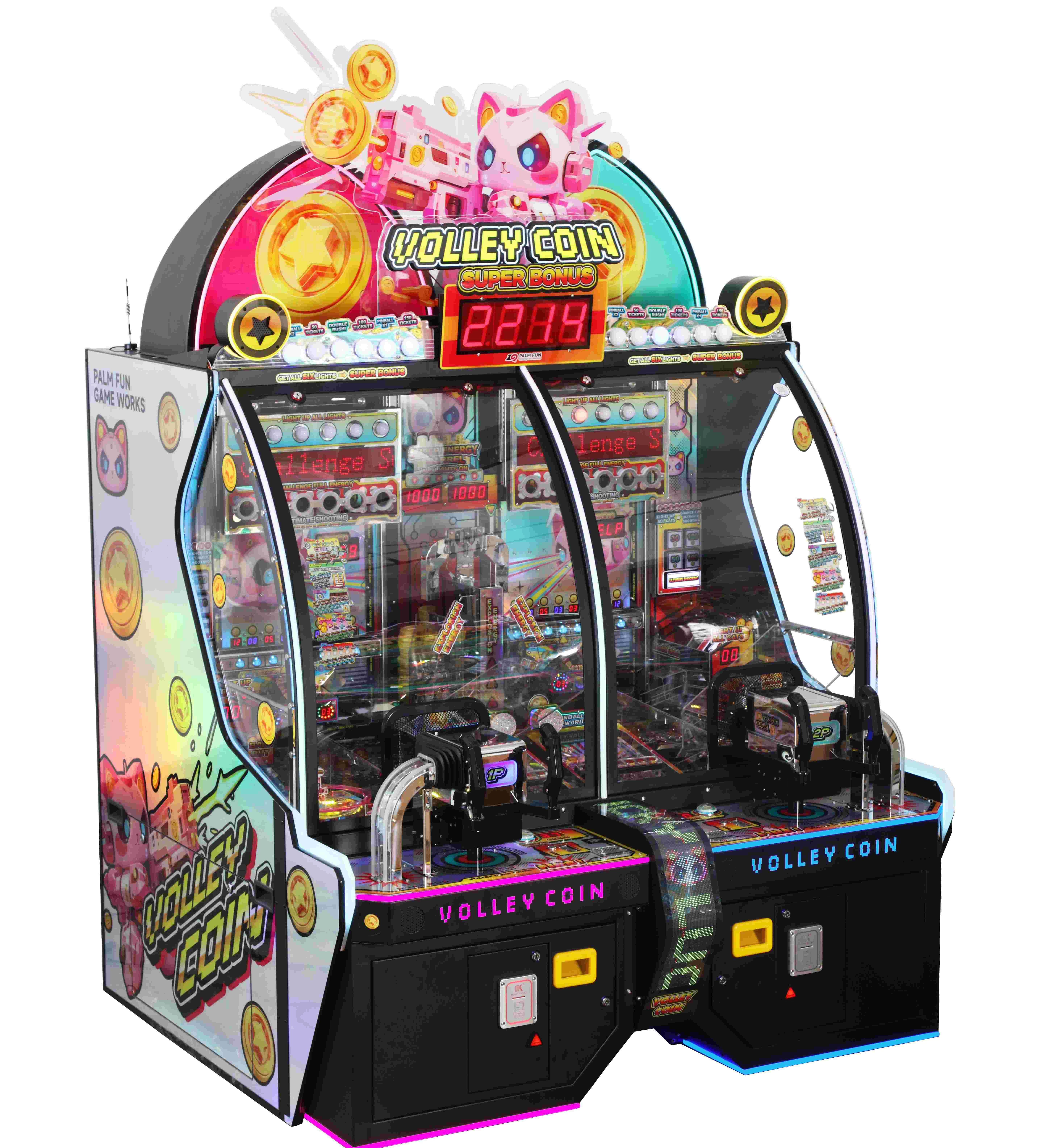
Volley Coin is an innovative arcade ticket redemption machine developed by Palm Fun Electronics. Combining the excitement of a fast-paced token shooter game with the proven earning power of a traditional coin pusher machine, Volley Coin offers a fresh and engaging gameplay experience that appeals to players of all ages.

Copyright © 2026 PALM FUN All Rights Reserved. | Privacy Policy • Terms and Conditions | Sitemap
palmfunarcade
Palm Fun Arcade Game
Whatsapp: +8618126837443
PalmFun Arcade
PalmFun_Arcade
PALM FUN Redemption Machine