








What Are Redemption Arcade Games?
- Quick Answer
- What Are Redemption Arcade Games?
- The Basic Definition
- Why Are They Called “Redemption” Games?
- Redemption Games vs Non-Redemption Arcade Games
- How Do Redemption Arcade Games Work?
- 1. The Player Starts the Game
- 2. The Player Completes the Gameplay Challenge
- 3. The Game Produces a Result
- 4. The Result Creates Redeemable Reward Value
- 5. The Player Redeems the Reward
- Payment, Gameplay, Result, and Reward Are Different Layers
- What Gameplay Formats Can Redemption Arcade Games Use?
- Coin Pusher Games
- Ball-Based Redemption Games
- Mechanical Skill and Timing Games
- Pinball-Style Redemption Games
- Hybrid Gameplay
- How Does Ticket Redemption Fit Into These Formats?
- What About Claw Machines?
- What Should Arcade and FEC Buyers Understand Next?
- FAQ
- Do redemption arcade games always issue tickets?
- Do redemption games always require a physical prize counter?
- Are ticket redemption games and coin pusher machines the same thing?
- Are claw machines considered redemption games?
- Final Takeaway
Quick Answer
Redemption arcade games are arcade or amusement games in which gameplay produces a redeemable reward outcome—such as paper tickets, electronic tickets, points, or another form of redeemable value—that can typically be exchanged for prizes through a venue's redemption system.
The key idea is that “redemption” describes the reward loop, not one specific gameplay mechanism.
A redemption game may involve pushing, aiming, rolling, timing, mechanical movement, skill, chance-influenced gameplay, or a combination of several mechanics.
Player Input → Gameplay → Game Result → Redeemable Reward → Redemption
For arcade operators and FEC buyers, separating these stages makes different machines easier to understand and compare. Once the category is clear, the next step is to evaluate venue fit, player profile, operation needs, and machine selection in the guide on how to choose a redemption arcade machine.
What Are Redemption Arcade Games?
The Basic Definition
A redemption arcade game connects a gameplay result with value that can later be redeemed.
A player starts the game, completes a challenge or interaction, receives a result, and may then earn tickets, points, or another form of redeemable value. That accumulated value can be exchanged for prizes through the venue's redemption process.
Gameplay → Result → Redeemable Reward → Prize
This differs from non-redemption arcade games where the main outcome may be a score, race result, progress, competition, or entertainment without a separate redemption step.
However, the term redemption arcade game does not describe one cabinet shape or one mechanical design.
Two redemption games may use very different gameplay mechanisms while sharing the same basic reward-loop concept.
Why Are They Called “Redemption” Games?
The word redemption refers to exchanging earned reward value for a prize or other available reward.
Depending on the game and operating system, that value may be represented by:
- paper tickets;
- electronic tickets;
- points;
- another form of redeemable credit or value.
Play → Earn Redeemable Value → Redeem → Receive Prize
This is why redemption arcade games should not automatically be defined as “games that print tickets.”
Ticket-based systems are one common redemption model, but tickets are not the definition of the whole category.
Redemption Games vs Non-Redemption Arcade Games
The clearest distinction is whether gameplay is connected to a redeemable reward outcome.
| Dimension | Redemption Arcade Games | Non-Redemption Arcade Games |
|---|---|---|
| Core outcome | Gameplay linked to redeemable reward value | Gameplay primarily produces score, progress, competition, or entertainment |
| Redemption loop | Central to the format | Not a defining requirement |
| Prize connection | Commonly linked through redemption | Not necessarily present |
| Venue operation | Includes reward/redemption management | Reward management is generally not central |
| Gameplay mechanism | Can use mechanical, skill, timing, chance-influenced, or hybrid mechanics | Can also use many different gameplay mechanics |
The important distinction is therefore not the cabinet itself. It is the connection between gameplay result and redeemable value.
How Do Redemption Arcade Games Work?
Individual machines vary, but the basic process can usually be understood in five stages.
1. The Player Starts the Game
The machine first receives an input that allows gameplay to begin.
Depending on the machine and venue, this may involve:
- a coin;
- a token;
- a game credit;
- another supported payment or access method.
This is the input layer.
It should not automatically be confused with the reward layer. For example, a token may be used to start a game in one venue, but that does not mean it is also the player's redemption reward.
2. The Player Completes the Gameplay Challenge
The player then interacts with the machine.
- timing;
- aiming;
- pushing;
- rolling;
- hand-eye coordination;
- mechanical interaction;
- chance-influenced outcomes;
- or several mechanics combined.
Some games place more emphasis on player skill. Others include a stronger chance-influenced component.
For this reason, redemption game is not a synonym for either “skill game” or “game of chance.”
3. The Game Produces a Result
The player's interaction produces an outcome.
- a score;
- a target reached;
- a timing result;
- a mechanical position;
- a bonus outcome;
- another measurable result.
The result itself is not necessarily the reward.
Game Result ≠ Reward Output. A score, for example, may determine how much reward value is awarded.
4. The Result Creates Redeemable Reward Value
The game or venue system may then translate the result into something that can be redeemed.
- paper tickets;
- electronic tickets;
- electronic points;
- another form of redeemable credit or value.
Game Result → Redeemable Reward Value
The exact conversion method depends on the individual machine and operating system.
5. The Player Redeems the Reward
The accumulated reward value can then be exchanged according to the venue's redemption process.
Different arcades and FECs may organize redemption differently, so buyers should not assume that every venue uses exactly the same physical prize-counter setup.
For an operator, the practical question is: How does the machine's reward output fit the redemption system used by the venue?
Payment, Gameplay, Result, and Reward Are Different Layers
For B2B buyers, one of the most useful ways to understand a redemption machine is to separate the major layers of operation.
| Layer | What It Describes | Examples |
|---|---|---|
| Input / Payment | How play begins | Coin, token, credit, supported payment method |
| Gameplay Mechanism | What the player does | Push, aim, roll, time, control |
| Game Result | What gameplay produces | Score, position, timing result, mechanical outcome |
| Reward Output | What may later be redeemed | Paper tickets, electronic tickets, points, other redeemable value |
This distinction matters commercially.
- floor-space requirements;
- player interaction;
- mechanical complexity;
- maintenance considerations;
- operating requirements.
Likewise, similar gameplay mechanisms may be connected to different reward configurations.
Buyer Note: It is generally more useful to evaluate gameplay mechanism, reward output, and venue redemption compatibility separately than to classify a machine only by whether it “gives tickets.”
What Gameplay Formats Can Redemption Arcade Games Use?
There is no single gameplay mechanism used by every redemption game.
The following are examples of gameplay formats that may be found in redemption arcade machines. They should not be treated as a rigid or mutually exclusive industry taxonomy.
Coin Pusher Games
Coin pusher games use mechanical movement and a pushing platform as the central gameplay mechanism.
Players typically place or release coins, tokens, or another game element and observe how the moving platform affects the objects inside the machine.
- mechanical movement;
- pushing action;
- visible progression.
The term coin pusher primarily describes how the game works mechanically. It does not by itself define the reward system. Buyers who want to examine this distinction in more detail can continue to the ticket redemption arcade machine vs coin pusher machine comparison.
Ball-Based Redemption Games
Some redemption games use a ball as a central gameplay element.
- ball dropping;
- ball rolling;
- target interaction;
- scoring zones;
- timed release.
In this context, ball-based describes how the player interacts with the game. It does not determine whether the reward is handled through tickets, electronic points, or another redemption system.
Mechanical Skill and Timing Games
Some machines rely on physical or timing-based interaction.
- stopping an action at a particular moment;
- aiming at a target;
- coordinating movement;
- controlling a mechanical action.
The degree of skill involved varies by game, so these examples should not be interpreted as one fixed machine category.
Pinball-Style Redemption Games
Some redemption games use mechanics associated with physical ball movement, rebounds, targets, scoring areas, or timing-based interaction.
The gameplay result may then be connected to redeemable reward value. Here again, pinball-style describes a gameplay approach, while redemption describes what happens at the reward layer.
Hybrid Gameplay
Some machines combine several mechanics.
- mechanical movement;
- timing;
- skill;
- bonus stages;
- multiplayer interaction;
- several scoring methods.
For that reason, gameplay descriptions can overlap. A machine does not always fit neatly into only one format.
How Does Ticket Redemption Fit Into These Formats?
Ticket redemption describes a different classification layer from a term such as coin pusher.
A coin pusher primarily describes a mechanical gameplay mechanism.
Ticket redemption primarily describes the game's reward and redemption model, rather than one specific way the player must interact with the machine.
This means different gameplay formats may potentially operate with ticket-based or electronic redemption systems, depending on the actual machine and venue configuration.
- What does the player do?
- What result does the game produce?
- What redeemable reward does that result generate?
- How does the reward connect to the venue's redemption system?
What About Claw Machines?
Claw machines are frequently operated in the same arcades and FECs as redemption games, but they should not automatically be treated as the same category.
A typical claw machine gives the player an opportunity to win merchandise directly from the machine. This is different from the classic redemption sequence:
Gameplay → Redeemable Value → Separate Redemption → Prize
A December 10, 2025 article in IAAPA's Funworld discussing arcade operations similarly refers to ticket redemption games and self-merchandisers such as claw machines as separate parts of a modern arcade mix.
This is an example of industry usage rather than a universal classification standard. Terminology may vary between operators, suppliers, markets, and individual machine designs.
For buyers, the practical point is to confirm whether a machine awards a prize directly or generates value that is redeemed separately.
What Should Arcade and FEC Buyers Understand Next?
Understanding the definition of a redemption arcade game is only the first stage of a commercial equipment decision.
- which gameplay format suits the venue;
- who the target players are;
- how the reward system will operate;
- how much floor space is available;
- what operating requirements the machine introduces;
- how service and maintenance will be handled.
Understand the Category → Compare Formats → Evaluate Venue Fit → Choose the Machine
| Buyer Question | Recommended Next Step |
|---|---|
| Which redemption arcade machine may fit my venue? | How to Choose a Redemption Arcade Machine |
| What broader machine types and commercial factors should I understand? | Complete Redemption Arcade Machine Guide |
| How do ticket redemption and coin pusher machines differ? | Ticket Redemption vs Coin Pusher |
| What game categories can I explore? | PALM FUN Arcade Game Categories |
For a B2B buyer, understanding these distinctions before comparing machines or quotations can help prevent a category mismatch from becoming an operating problem later.
FAQ
Do redemption arcade games always issue tickets?
No. Paper tickets are one possible form of redeemable reward output, but they do not define the entire category. Depending on the game and venue system, reward value may instead be represented through electronic tickets, points, or another form of redeemable credit or value.
Do redemption games always require a physical prize counter?
No.
A 2025 IAAPA Funworld article on arcade operations discusses counter-style and store-style redemption arrangements, as well as automated options used in some operations.
The specific setup depends on the venue. For equipment buyers, the important question is whether the machine's reward output can work with the intended redemption process.
Are ticket redemption games and coin pusher machines the same thing?
Not necessarily. Coin pusher primarily describes a gameplay mechanism, while ticket redemption primarily describes a reward/redemption model. A coin pusher may operate within a ticket-redemption system depending on its design and configuration, but the two terms describe different aspects of the machine.
Are claw machines considered redemption games?
Claw machines are often operated alongside redemption games, but they may be treated separately as instant-win or self-merchandiser machines.
A typical claw machine gives the player the opportunity to win merchandise directly, while a classic redemption system links gameplay to value that is redeemed separately. Industry terminology can vary, so buyers should confirm how a specific machine is designed and operated.
Final Takeaway
Redemption arcade games are defined primarily by their gameplay-to-redemption reward loop, not by one specific cabinet or gameplay mechanism.
For commercial buyers, the most useful approach is to separate Gameplay Mechanism → Game Result → Reward Output → Venue Redemption Compatibility. Once those layers are clear, comparing different redemption machines becomes much more practical.


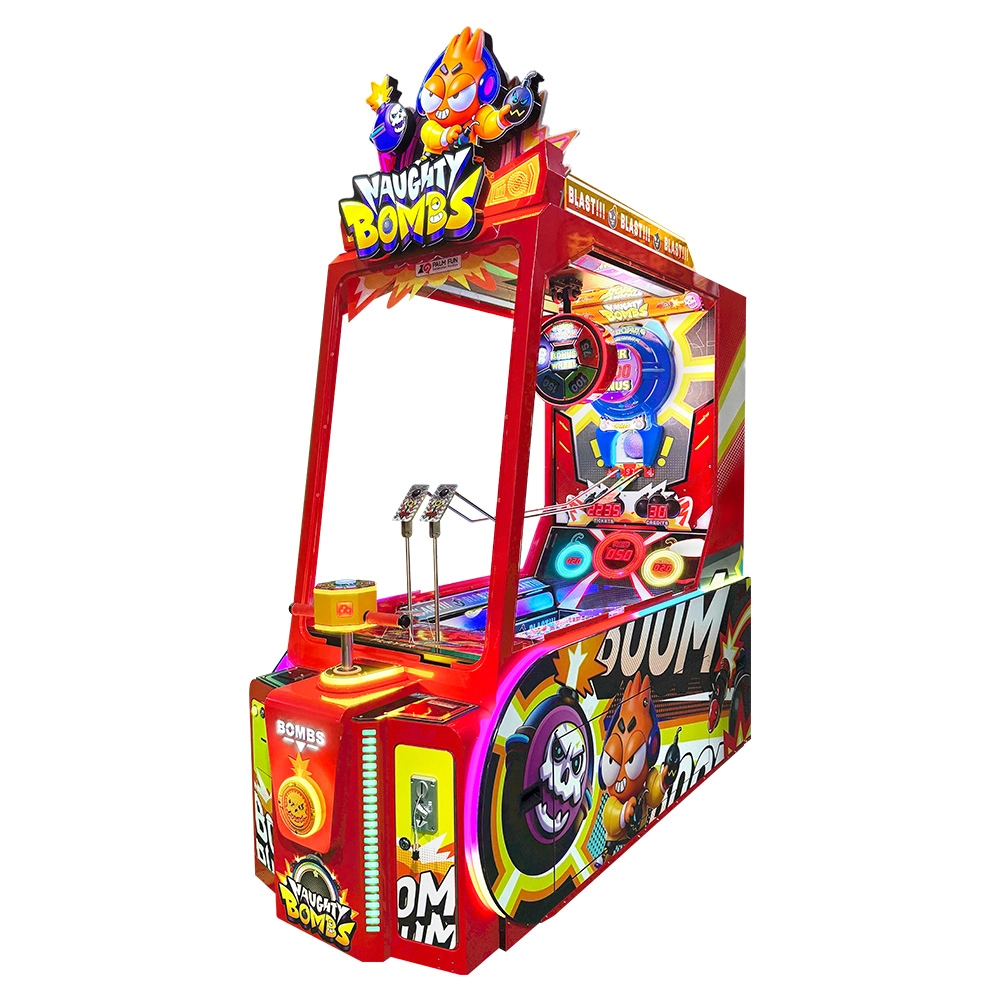
Naughty Bombs is an exciting redemption arcade game designed to capture attention and keep players coming back for more. Featuring a bright red cabinet, dynamic lighting, fun sound effects, and interactive rolling-ball gameplay, it delivers nonstop excitement in a compact footprint. Players test their timing skills by launching and dropping balls into colored targets to unlock surprise bonus rewards and ticket prizes. With easy-to-learn mechanics, engaging skill-based action, and strong visual appeal, Naughty Bombs is an ideal attraction for arcades, FECs, and entertainment venues looking to boost player engagement and revenue.
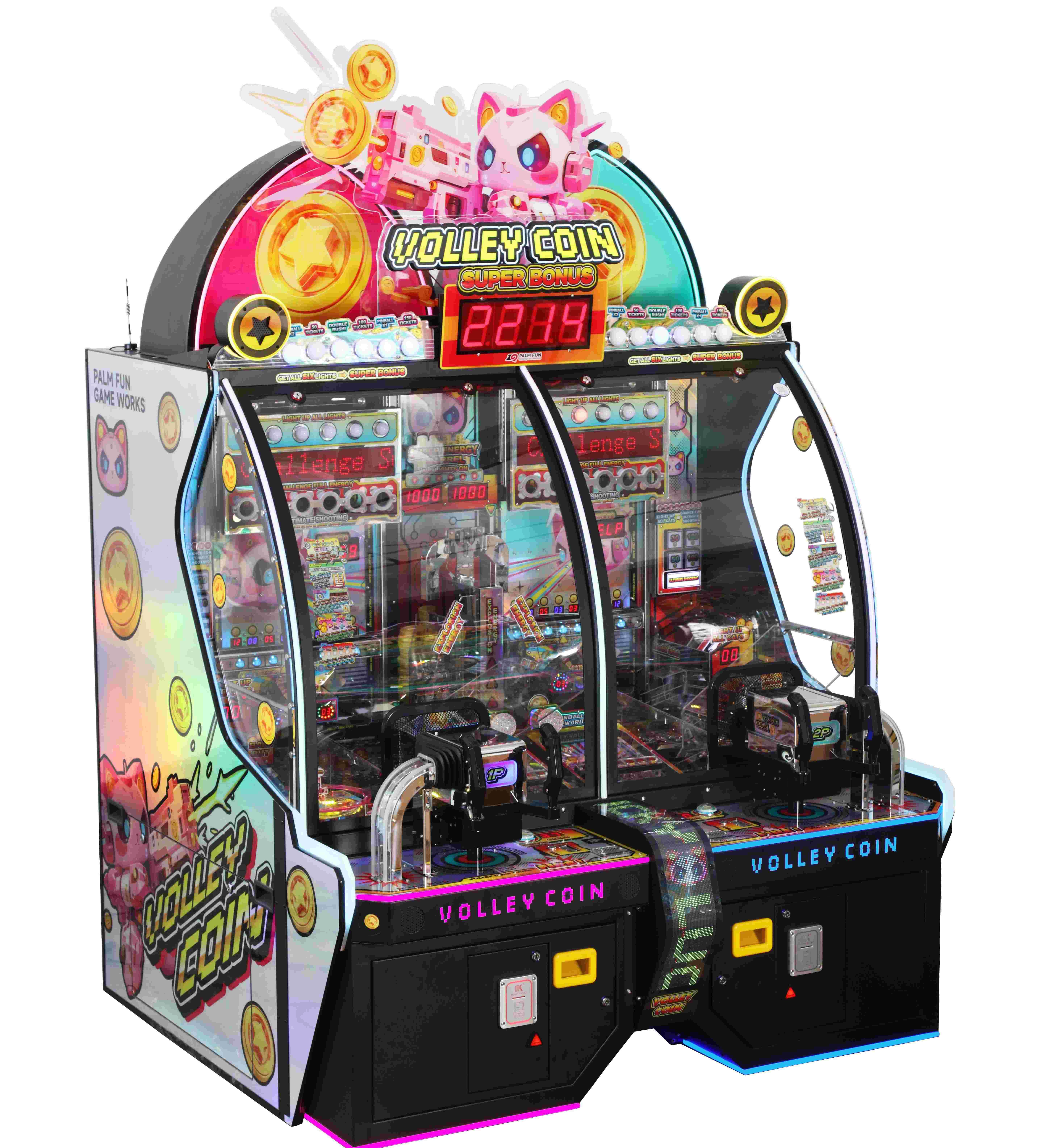
Volley Coin is an innovative arcade ticket redemption machine developed by Palm Fun Electronics. Combining the excitement of a fast-paced token shooter game with the proven earning power of a traditional coin pusher machine, Volley Coin offers a fresh and engaging gameplay experience that appeals to players of all ages.
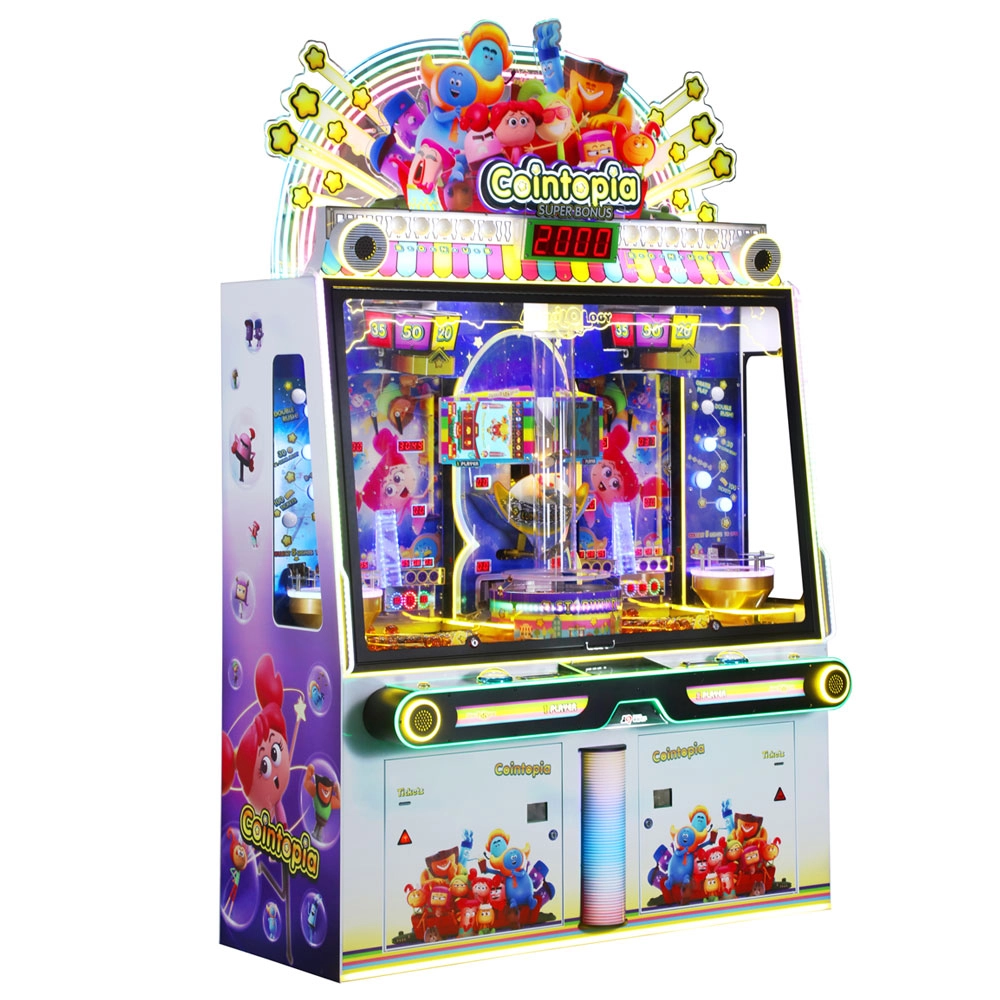
COINTOPIA by PALM FUN is an exciting redemption game machine where players enjoy fun with zodiac buddies in a utopia setting. This ticket redemption machine offers engaging gameplay and rewarding experiences, perfect for family entertainment centers and arcades seeking top-quality redemption games.
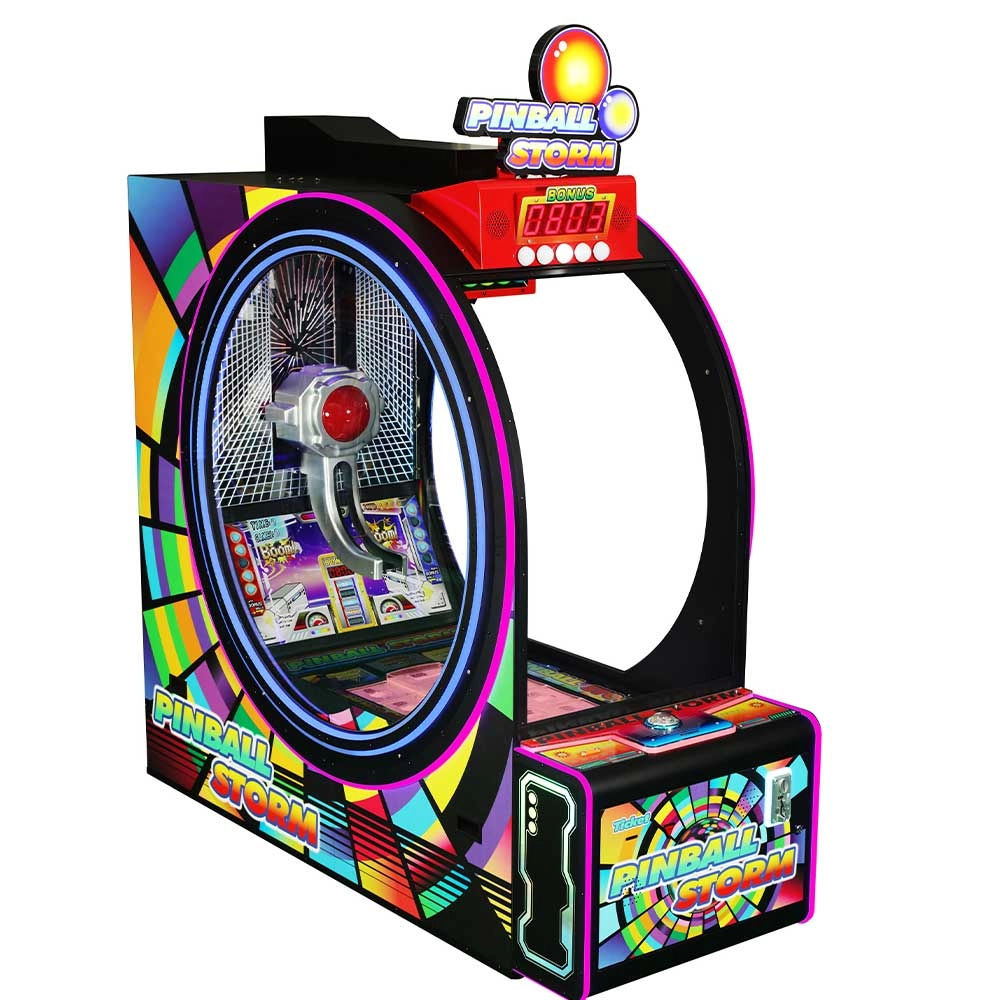
Classic pinball reimagined! Hit, bounce, and win prizes. Trigger the Pinball Storm for an epic multi-ball blast!

Copyright © 2026 PALM FUN All Rights Reserved. | Privacy Policy • Terms and Conditions | Sitemap
palmfunarcade
Palm Fun Arcade Game
Whatsapp: +8618126837443
PalmFun Arcade
PalmFun_Arcade
PALM FUN Redemption Machine